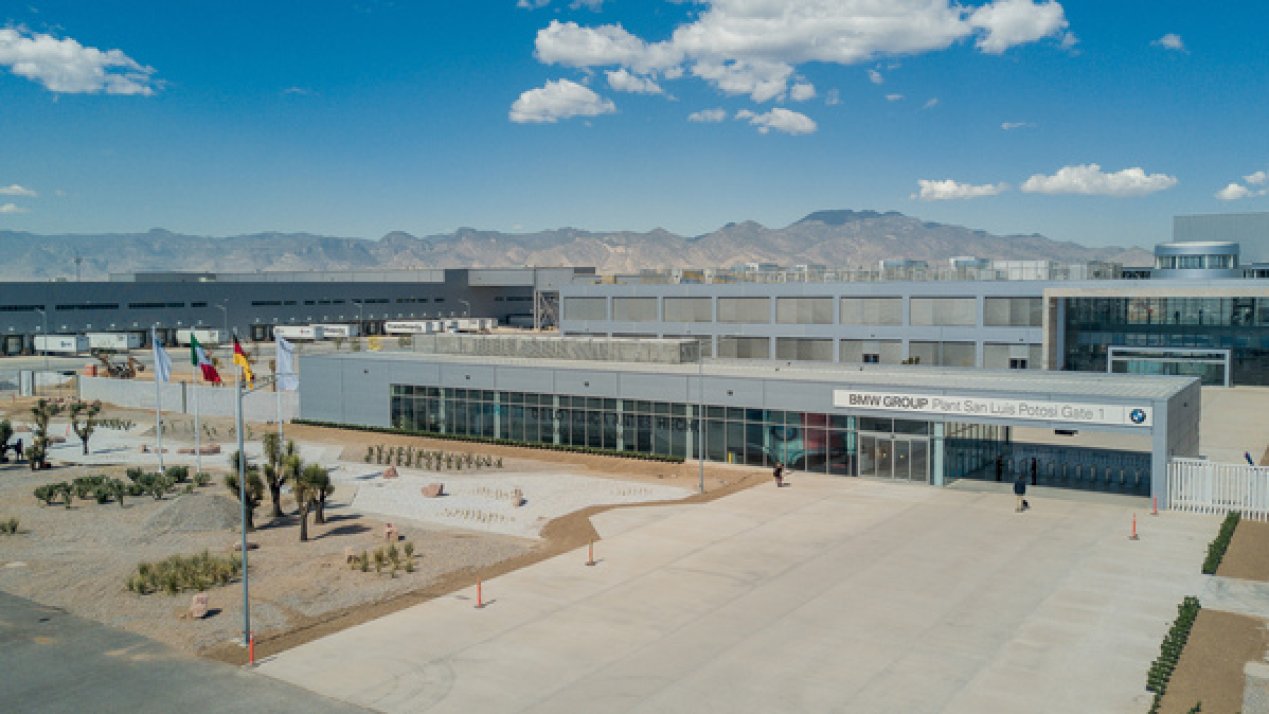
BMW Group’s manufacturing plant in San Luis Potosi is advancing toward electric vehicle production through the integration of the Neue Klasse architecture, the company’s next-generation platform designed to standardize electrification technologies across global operations. Beginning in 2027, the facility will assemble fully electric vehicles and produce high-voltage batteries locally, positioning Mexico as a key hub within BMW Group’s global electrification strategy while supporting technology transfer, supplier development, and digitalized manufacturing processes.
The company outlined these developments in its 2025 Corporate Social Responsibility report, Driving Toward the Future, which details environmental performance, workforce development, and community engagement initiatives. The report frames sustainability as a core operational pillar rather than a parallel initiative, noting that company programs reached more than 12,000 people in 2025 and strengthened the plant’s integration into regional economic development and advanced manufacturing transformation.
BMW Group confirmed it will maintain its manufacturing strategy in Mexico despite trade uncertainty linked to tariff policies promoted by US President Donald Trump. While several automakers have reassessed regional investments, BMW executives indicated that the company’s production roadmap remains unchanged.
Reiner Braun, president and CEO, BMW Group Latin America, said producing the iX3 in Mexico supports supply proximity and market responsiveness. He noted that models such as the X1, 3 Series, and X3 remain strategically important for Latin America, making regional production essential for logistics efficiency. The iX3 will become the first vehicle produced locally under the Neue Klasse platform.
In 2023, BMW announced an investment of €800 million (US$870 million) to prepare the San Luis Potosi complex for electric vehicle manufacturing and lithium battery assembly. The project includes the installation of advanced automation systems, energy-efficient production technologies, and battery integration capabilities. Braun added that multiple future models will share the Neue Klasse architecture, allowing Mexico to operate alongside plants in Hungary, Germany, the United States, and China as a key production center.
Trade dynamics continue to influence Mexico’s automotive sector, particularly for manufacturers dependent on US exports. However, BMW’s diversified export strategy has mitigated exposure to policy volatility. Data from INEGI shows the company exported 91,490 vehicles in 2025, with 42% shipped to the United States and the remainder distributed across global markets.
Braun said Mexico’s efforts to expand international trade agreements reinforce confidence in future production growth. The San Luis Potosi plant currently exports vehicles to approximately 80 countries, demonstrating logistical flexibility and global integration. He added that ongoing discussions surrounding the United States-Mexico-Canada Agreement (USMCA) are expected to preserve economic cooperation, as governments recognize the mutual importance of maintaining competitive manufacturing industries and integrated regional value chains.
The plant’s strategic relevance has grown steadily since launching operations in 2019 with production of the BMW 3 Series. In 2021, the facility added the 2 Series Coupé, followed by exclusive global production of the BMW M2 beginning in 2022. These milestones have transformed the site into one of BMW Group’s most advanced manufacturing operations, combining premium vehicle assembly, export capacity, and engineering specialization within Mexico’s Bajio industrial corridor.
During 1Q26, BMW Group recorded declines across its main operating indicators in Mexico amid broader market adjustments. Production reached 11,436 vehicles, down 35.8% year over year, while exports totaled 12,298 units, a decrease of 36.4%. Domestic sales also softened, falling 8.8% to 4,177 vehicles, according to INEGI.
Workforce Development and sustainability
BMW Group expanded sustainability efforts in 2025 through education and workforce training programs developed with Programa Adopte un Talento, Colonia Juvenil, and UNICEF, benefiting more than 12,000 students and 1,000 teachers. The company also received certification from the Cámara Mexicano-Alemana de Comercio e Industria for its dual education model, which has graduated more than 570 apprentices, and donated an industrial robot to the Universidad Tecnológica de San Luis Potosi to train over 1,000 engineering students.
Environmental management and labor stability remained priorities at the San Luis Potosi plant. BMW treated and reused 100% of its wastewater and saved more than 13,000 cubic meters of water in 2025, while maintaining a workforce of about 3,700 employees, 36% of whom are women. A 2026 labor agreement granted workers an 8% wage increase and a 0.5% annual bonus.