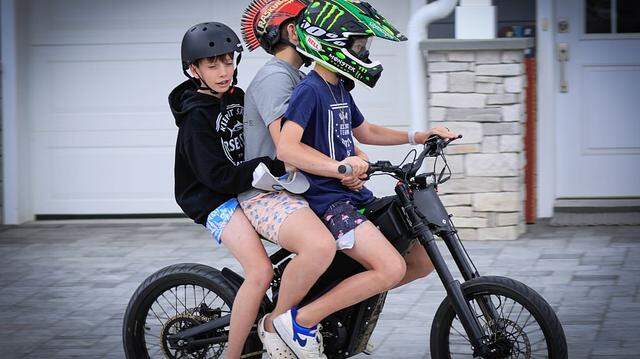
Fort Worth residents have strong opinions about electric bikes and scooters. In certain areas, they’’ve become a danger, some say. In this file photo, kids ride an e-bike on May 25, 2025, in Point Pleasant, New Jersey.
Kena Betancur
Getty Images
It was a Monday afternoon, and Chris Hall, who lives in far north Fort Worth, was driving his son to jiu-jitsu when out of nowhere, a kid on an electric dirt bike shot in front of his vehicle.
Hall said he slammed on his brakes, and the kid nearly lost control of his bike. Fortunately, the young rider, who was wearing a helmet, righted himself at the last moment, then zipped off down a residential sidewalk at a pretty good rate of speed, based on a video Hall shared on Facebook after the close call — likely with a little more adrenaline coursing through his veins.
“[I]f I had hit him and he ended up in the street it could have been devastating,” Hall wrote on Facebook. “I’m not angry just shaken. This was way too close for comfort.”
Days later, Hall reiterated those sentiments when talking with the Star-Telegram. He said he understood why kids enjoy riding the electric dirt bikes that have become prevalent around his neighborhood, but he was concerned about their safety and the safety of those around them, to say nothing of the fact electric dirt bikes are prohibited in public areas by law.
Speak to enough people who live near TCU, and you’ll most certainly hear similar complaints about e-scooters. Those devices are a popular way for students to get to, from and around campus, and residents have said some of those students operate them with little regard for safety. One longtime TCU-area resident told the Star-Telegram she was fed up with students riding e-scooters recklessly at night, when the danger of a collision is heightened.
In January, TCU adopted new guidelines for personal mobility devices, which includes e-bikes and e-scooters. Under the rules, students and university employees must ride at a safe speed, obey traffic signs and signals, yield to pedestrians and slow down in areas with heavy pedestrian traffic. The rules also prohibit operating a mobility device on unpaved surfaces, on covered walkways or while under the influence of alcohol or controlled substances.
Still, the problem around TCU has gotten so bad that it’s come to the attention of City Council member Michael Crain, who recently asked city staff for a report on e-bike and e-scooter regulations. Right now, the city’s safety ordinances governing bicycles don’t explicitly mention e-bikes or scooters, and Crain wants that changed. He said the laws should be updated to reflect the current reality.
While the Fort Worth city code doesn’t directly address e-bikes and e-scooters, there are state laws in place. E-bike and e-scooter riders are allowed to use city roads with a posted speed limit less than 35 mph, and they can ride on sidewalks and paths, except in areas where there are posted restrictions on wheeled vehicles. The city code says bicycle riders under 18 have to wear a helmet. It’s safe to assume e-bikes are included in that, but the code doesn’t say anything about scooters.
Electric dirt bikes, however, are limited to private property and are not allowed on any public roadways, sidewalks, bike lanes or bike paths. Essentially, if the bike doesn’t have pedals, it’s not allowed.
Dr. Terence McCarthy, director of the emergency department at Texas Health Harris Methodist Hospital in Fort Worth, said he’d seen a dramatic uptick in injuries from e-bike and e-scooter use over the past decade.
“We’ve just seen in the last few days a few pretty bad injuries related to e-bikes,” McCarthy said.
On average, McCarthy said Harris ER physicians see about two patients a week who have been hurt riding an e-bike or e-scooter. Injuries from collisions with a car are often the worst, added McCarthy.
Of course, bicycle and scooter injuries are nothing new. Generations upon generations of kids have skinned knees and elbows while out riding, and it’s not uncommon for adult cyclists to have accidents.
But e-bike and e-scooter injuries are more likely to be severe, McCarthy said, because of the speed involved. Even class 1 e-bikes, the lowest level, can reach speeds up to 20 mph. Class 3 bikes, the highest class, top out at nearly 30 mph.
“It used to be e-bikes where you’d go 5 miles an hour if you used the motor. Now they can just go so fast, and they can really get away from you if you’re not careful,” McCarthy said. “And really, with any kind of vehicle-related collision, speed correlates with severity of injury. So the faster you go, the worse the injuries are going to be.”
New Jersey recently adopted some of the strictest e-bike laws in the nation, requiring riders to have a license, registration and insurance, similar to what’s required for a car or motorcycle. The laws were in response to fatal accidents involving e-bikes, including one where a 13-year-old boy was killed.
But McCarthy didn’t think more regulation was necessarily needed in Texas to curb accident rates. To him, simple common sense on the part of riders was the better solution.
“Wearing a helmet. Not riding recklessly. Being aware of your surroundings. Staying out of traffic. Those are the ways to keep it safe and fun on an e-bike,” said McCarthy.
In this area, Colleyville has some of the most stringent regulations governing e-bikes and e-scooters. Last year, the city adopted an ordinance that set the maximum speed limit for e-bikes and e-scooters at 10 mph on sidewalks and trails and 20 mph on the Cotton Belt Trail, which runs from North Richland Hills to Grapevine. Those changes to the city code came after residents raised concerns.
Hall, who is a real estate agent, said he predominantly sees electric dirt bikes, bikes and scooters when he’s showing homes in more affluent areas, like Colleyville. Those are the people, Hall reasoned, who have the expendable income for the devices, which range in price from a few hundred to a few thousand dollars.
“It’s an upper middle-class problem,” said Hall.
Hall said e-bikes and e-scooters are here to stay, and he’s happy that kids are spending time outdoors on them. But he, like others, wants to see something done to ensure riders are being safe and mindful.

Fort Worth Star-Telegram
Matt Adams is a news reporter covering Fort Worth, Tarrant County and surrounding areas. He previously wrote about aviation and travel and enjoys a good weekend road trip. Matt joined the Star-Telegram in January 2025.