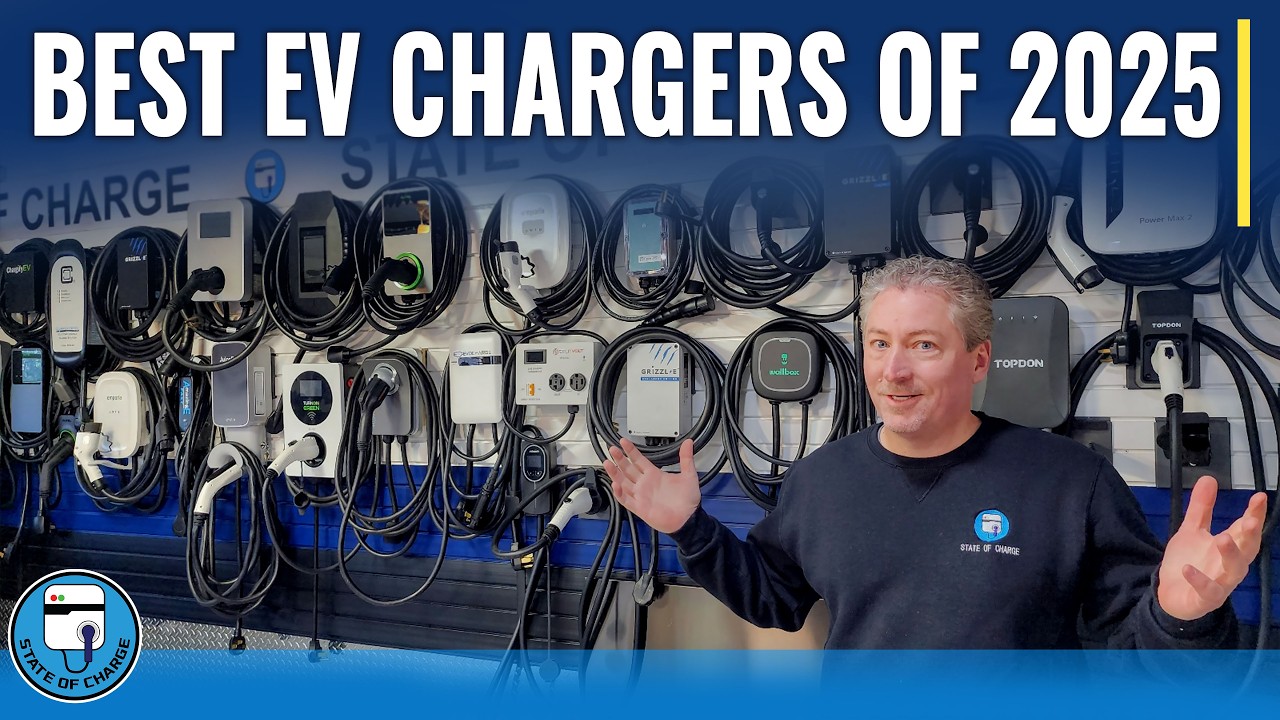
These Are The Best EV Chargers Of 2025
All right, so you’ve stepped out of the combustion past and into the electric future. You’ve got yourself an electric car. One of the biggest decisions you could make now is what electric vehicle charging equipment do I buy? Now, there are literally hundreds of different electric vehicle chargers, many of which may have low prices, but are very low quality and probably won’t last that long. Here in the state of charge garage, I relentlessly test, use, and review electric vehicle charging equipment and accessories. In fact, I probably have the widest variety of electric vehicle charging equipment here than anywhere in the country. And in today’s video, I’m going to announce my top electric vehicle chargers for 2025. But before we get into the video, I’m going to ask you to do something that I’ve never asked my followers to do before, and that’s to hype this video. Hype is a new feature on YouTube that helps smaller creators like me get more views. The more the video is hyped, the more YouTube is likely to recommend it to others on the platform. It’s important to note that Hype is currently only available on mobile devices and not on desktop. So, if you’re on mobile, I’d appreciate if you’d take a second to hype my videos. To do so, you simply click on the video you want to hype and scroll down to the comment section. You then swipe the comments section to the left and you’ll see the hype feature there. Just tap hype and it’s done. Thanks a lot. I really appreciate it. And with that said, let’s get into it. All right. Before I get started, I want to point out that I’m not ranking the chargers that I’m talking about here today. They’re all my top choices. You could take a look at all of them, decide which one is best for you. Let’s start off with the Charge Point Home Flex. The Charge Point Home Flex has been on the market about as long as any of the chargers that you’re going to see today. Charge Point was definitely an early mover with electric vehicle charging equipment and they have a lot of public chargers in addition to home charging equipment. This unit here benefits from the fact that they have a lot of public charging units because some of its components were made with the durability of public use. Take for instance the connector. This is one of the best connectors that you can get today and it’s custom made for Charge Point. It’s not just a commodity that they bought from a supplier. They had this made for them. I love the fact that it has a rubberized grip. It’s very heavy and strong. And the cable is the best cold weather cable of any charger I’ve ever tested. In fact, I use the Charge Point Home Flex cable to compare to other chargers just to show the difference on how good a cold weather cable can be. This cable could be cold soaked at up to -15° Fahrenheit and it still remains flexible and pliable. So, this is really the best combination of cable and connector on the market today. I also like the fact that it has this swivel head with a back lit LED light. So, if it’s dark where you have the charger installed, it’s very easy to holster the connector and it swivels up and down. Very good design. I’m surprised nobody else has really copied exactly what Charge Point uh has done here, but I definitely like that design. See, it has this U bevel on the top here, so you can hang the cable. Nice design there. And I also like the fact that this front cover is plastic and it’s removable. Okay, you can take this off and wrap it or even paint it. I’ve seen people paint this the color of their garage so it matches the wall. So, um, all these reasons together add up to the Charge Point Home Flex being one of my perennial choices for best chargers. So, let’s take a look at the Chargeoint Home Flex’s key features. Okay, we’ll start off with the price. The hardwired version is $584. If you want it with the Nema 1450 plug, it costs $599. The dimensions are 12.6 in x 9 in x 3.4 4 in. It can deliver up to 50 amps, which is 12 kowatt. It has adjustable current from 16 amps up to the full 50 amps. Comes with a 23 ft cable. You could order it with either the J1772 or the North American Charging Standard or Knack connector. It has a Nema 3 enclosure. The ambient operating temperature range is 122° F to – 22° F. It is a Wi-Fi connected smart charger which you pair to the Charge Point app. It is UL safety certified. It’s Energy Star rated. It comes with a standard three-year warranty and the unit is made in Mexico. And I mentioned that you can order it as either a hardwired unit or with a Nema 1450 plug. You can also order it with a Nema 650 plug. That’s a less common plug for electric vehicle charging equipment. Some of the earlier chargers back 10, 12 years ago came with a Nema 650 plug, but the industry has coalesed around the Nema 1450 plug now, but you can order it with a Nema 650 plug if you have a Nema 650 outlet. One of the few chargers that you can order with a Nema 650 plug. However, it’s going to cost you more. That’s $639 if you need that unit. And also one of the features that’s unique to the Charge Point Home Flex is if you, let’s say, had one a few years ago and you bought it with a J1772 plug, but now you get an EV that has the Knack connector, you can swap the cable and Charge Point will sell you the replacement cable. It cost $199, but it’s easy to swap out. You don’t even need to get an electrician to do it because once you open up the unit, the tabs inside simply lift up, the wires pull out, you slide the new wires in, and you snap them down. You don’t need to have any type of electrical connectors or anything like that. It’s it just slides in, snaps in, and closes. So, super easy to do. Cost $199, which isn’t cheap. But if you have the unit and now all of a sudden you find yourself with a NX equipped electric vehicle, you don’t want to use an adapter for daily charging, you can order the uh the cable with the Knax connector and uh switch it. Now, you could also do it the other way. I don’t know why many people would do that. Maybe you had a Tesla and you were charging it with the the Knack uh connector and now you went to a J1772 vehicle. You can order the uh cable with the J1772 and swap that out. Also, it’s just as easy. Now, on the negative side, for the Charge Point Home Flex, you can only pair one unit to your Charge Point app. That’s very rare. Pretty much every other electric vehicle charger on the market will allow you to add multiple units to the same app. Let’s say you have two electric vehicles and you buy two Charge Point Home Flexes. You need to set up two accounts with two different email addresses and have two different apps for the Chargeoint Home Flex. That’s really not ideal. I don’t know why Charge Point hasn’t updated this. There must be a technical reason because virtually all the other units available on the market now today will allow you to add multiple units to the single app. The other negatives is that it doesn’t have any of the smart charging features that some of the new electric vehicle chargers have. I’m talking like uh dynamic load management and also uh the ability to power share amongst two units. That’s if you have one circuit come to your garage and you have two chargers. Some of the chargers today allow you to share that one circuit with the two units. Uh most people don’t have the extra capacity in their homes to have two let’s say 50 amp circuits going to their garage. Uh so they have one circuit with two units and the two units communicate with each other to share the power. The Charge Point Home Flex cannot do that. Okay. Finally, let’s take a look at how the Chargeoint Home Flex did on the Charger Raidator point-based charger rating system. All right. In the cost and value category, it scored 19 points. For power and construction, 27 points. In the testing category, it got 22 points. And for intelligence, it scored 18 points. And that gave the Charge Point Home Flex a total of 86 points, which when translated to a five-star rating is 4.3 stars out of five. Next up is the Emporia Pro 48 amp charger. It’s new for 2025, but Emporia is not new. They’ve been selling electric vehicle chargers for a few years now. They originally just came out with the Emporia charger. Now, they’ve named that the Emporia Classic because they wanted to distinguish it between the Emporia Pro. The Emporia Pro is a high-end charger. It has a lot of smart charging features. It’s available in white or black, either with the J1772 or Knack connector, which I have here, and also either as a hardwired unit or with a Nema 1450 plug. Obviously, if it comes with the Nema 1450 plug, you need to dial down the output to a maximum output of 40 amps. But if you hardwire it, you can uh get the full 48 amps. One of the best features of the Emporia Pro is that it does intelligent load management, and you don’t need to buy any other devices. Intelligent load management is a very effective tool for electric vehicle owners that want to charge their vehicle with high power but don’t have the capacity at their house to install a high-owered charger. Many homes in America have a 100 amp or 150 amp service panel. So you’d need to install a 48 amp charger on a dedicated 60 amp circuit. If you have a 100 amp main in your house, you probably can’t spare 60 amps just for your electric car charging. you need that power for the other units. But with the Emporia Pro, with Emporia’s power smart feature, you can install this at your house, even if you have low total capacity, and the unit will intelligently manage your power. Let’s say you’re not using a lot of things in your home. You plug in your electric car. You do have a spare 48 amps to charge your car. The car charges at 48 amps. Then the air conditioning kicks on cuz it’s a hot day. You start cooking on your electric range. Now all of a sudden you don’t have enough power to give the car charging 48 dedicated amps. So the power smart system lowers the output to the car. It might drop it down to like 16 amps of output or something like that until you turn off the stove and the air conditioning shuts off later on. Then it restores the power to the full power and the electric vehicle charges at a higher rate. Uh there are other electric vehicle chargers that can do this, but for the other ones, you generally have to buy an external device and pair it with this. With the Emporia Pro, it all comes in the box for $599, which is an outstanding price just for that feature. But that’s not all the Emporia Pro does. It also allows you to share power between multiple chargers. So you could have one circuit and have a couple chargers all charging from the same circuit. You don’t have to run a separate circuit. It also allows you to use your excess solar generation. If you have a solar system, you’re going to set it up so that the car will only charge from the excess solar energy that your home’s not using. So, you could truly power your electric vehicle with 100% renewable energy, provided you have a solar array that produces more energy than what the house is consuming. A lot of people like that feature. They just want to charge their EV on solar electricity. The Emporia Pro allows you to do that. Okay, let’s take a look at the key features of the Emporia Pro. As I mentioned, the unit cost $599. The dimensions are 11.5 in by 8 in x 3.1 in. It’s a 48 amp charger that can deliver up to 11.5 kW to your EV. The power output is adjustable from 12 amps up to the full 48 amps. It has a 25 ft long cable. As I mentioned, it comes with J1772 or Knax connector. It has a Nema 4 enclosure. It has that dynamic load balancing feature that will allow you to install it in a residence that really doesn’t have the excess capacity to install a 48 amp charger. It allows you to charge from excess solar electricity. The operating temperature is -22 degrees Fahrenheit to 122 degrees Fahrenheit. It is UL safety certified. It comes standard with a three-year warranty. And the unit is made in India. And one of the things I really do appreciate with the Emporia Pro is its cable. It’s a very thin, lightweight cable. Very easy to maneuver, easy to loop around the connector holster. Uh it just makes uh plugging and unplugging uh much nicer when you have a cable that is willing to work with you. Some of these EV chargers have really thick, heavy cables, and daily plugging and unplugging can be a pain. Particularly if you get out of your car, you’re carrying something with one hand, you unplug. Now you got to wrap it around. This thin cable here is very easy to maneuver even when it’s cold. It did well in our cold weather testing. One of the things I don’t like is the connector holster. It’s kind of a very thin, flimsy connector holster. There are much better connector holsters on the market. If I were to use this charger daily, I’d probably buy a third party connector holster. They’re available for like $20 on Amazon. I just don’t find this one very easy to work with and it’s kind of uh thin and cheaply made in my opinion. Other than that, there’s very few things that you could knock with the Emporia Pro. This is the complete unit here and uh it has tons of smart charging features. The Emporia app is great. You could pair it with other things in the Emporia ecosystem. They have all types of energy management devices for the home and this fits right into the Emporia ecosystem. So, this is a winner here and uh I could I could foresee this being one of my top choices many years in a row. Okay, next let’s take a look at how it scored on the Charger Raider point-based charger rating system. Okay, in the cost category, it scored 19 points. For power and construction, a total of 24 points. In the testing category, 21 points. And for intelligence, it scored 23 points. And that gave the Emporia Pro a total of 87 points. And when you convert that to a five-star rating, the Emporia Pro scored 4.35 stars out of five. And before we move on to the next best of 2025 chargers, I want to give an honorable mention to the Emporia Classic. This unit is a super well-made unit. It retails for only $429. So, it’s $170 less than the Emporia Pro. And if you don’t need all of the smart charging features of the Emporia Pro, like the intelligent load management and the solar charging, then this unit here is a fantastic option. It’s super wellmade. It’s always scored highly when I’ve reviewed it, and it’s definitely on my recommended list. But with the Emporia Pro available out now, it’s what I consider slightly better and it offers all those other smart charging intelligent features. So, it makes the list this year, but the Emporio Classic definitely gets honorable mention. And next up, I’m going to go with the Grizzle E Ultimate 48, which is another new unit for 2025. Now, I have had the United Chargers Grizzly line in my best of chargers in previous years, but that was their Grizzly Classic 40 amp charger. Now, for 2025, they have a new line they call the Ultimate line, which is higher powered chargers. They still offer the 40 amp classic units, but now they have the Ultimate 48 and the Ultimate 80. The Ultimate 48 is making my top chargers of 2025, as you can see it here. has the same extremely durable cast aluminum casing as the other Grizzle E units. This would make a super unit if you’re going to install this outside somewhere because it’s extremely durable and it has a really good weatherproof rating. It has a nice thin cable. J1772 or Knack connectors are available. This is the J1772. I don’t love the J1772 that Grizzly uses. It’s not a bad connector. I just don’t think it’s one of the better connectors. And they offer the unit with a remote connector holster. As you could see here, you could locate it somewhere else in the garage. And it has this tab on the front here to loop the cable around it. Or you could just loop it around the top of this if you’d like to, as long as you mount it strongly to the wall. This unit here is a very good unit at a very good price. So, let’s take a look at the Grizzly Ultimate 48’s key features. All right, so I just mentioned the price. The Grizzly Ultimate 48 can be had for $479, which is a very good price for a very high quality 48 amp charger. The dimensions are 10.25 in x 6.25 in x 3.75 in. It is a 48 amp unit that can deliver up to 11.5 kW to your EV. It has adjustable power output from 16 amps up to the full 48 amps. It has a 25 foot long cable that I mentioned earlier is thin and easy to manage. It’s available with either the J1772 or Knack connector for the same price. The unit has an IP67 rated enclosure, making it really good for outdoor installations. The operating temperature is 122° F to -22° F. It is a Wi-Fi connected smart charger that comes with the Grizzle E app. It’s UL safety certified by CSA. It is Energy Star rated. It comes standard with a three-year warranty, but you can get an additional two years for $100 extra. And the unit is proudly made in Canada. One of the things that I like about the Grizzly line of electric vehicle chargers, the whole line, is that they’re priced very competitively and they’re high quality, sort of like nononsense chargers. You don’t see uh fancy design or anything. It’s a square aluminum box. It gets the job done. They last long. I don’t get very many reports from my followers that they have issues with them when they do, United Chargers customer service seems to take care of them. Uh, some of the negatives for the Grizzly Ultimate 48 is there’s no smart charging features like intelligent load management. Uh, there’s no power sharing. You can’t set it up to communicate and share one circuit with multiple chargers. And the app has limited features. the Grizzly app. Although United Chargers has been updating the app and giving it more features, it’s not really featurerich as some of the other apps on some of the other chargers. So, let’s see how well the Grizzly Ultimate 48 did on our Charger Raider. In the cost and value category, it scored 21 points. In the power and construction category, 25 points. In the testing category, 20 points. And in the intelligence category, 22 points. And that gave a Grizzle E Ultimate 48 a total of 88 points on our charger rator. And when you convert that to a five-star rating, it comes out to 4.4 stars out of five. And before I head off to the next charger in the best of 2025, I’m going to give out another honorable mention, the Grizzle E Classic. It’s a 40 amp charger that comes as a plug-in unit with a Nema 1450 plug. You can of course remove the plug and hardwire it, but if you don’t need the full power of a 48 amp charger and you can live with 40 amps, which most people can, you can buy the Grizzly E Classic for only $349. That’s a great deal. It’s only available currently with the J1772 connector, though, and it is available in different colors. You can get it in white, you can get it in black, and they even have like a camo color if you’re interested. but it’s definitely worthy of my honorable mention in the 2025 best of series. Next up, I’m going to go with the EVCO EV Power 2 48 amp charger. Now, you might notice this unit is plugged in, and that’s because I happen to have the 40 amp version in the state of charge garage here, but the 48 amp version is exactly the same, functionally the same. It just has a higher power output. Okay, why do I like it so much? Well, number one, I love the price. This is a very high quality unit that’s safety certified, and it’s offered at a fantastic price. You can get the Knack equipped version for only $43. The J1772 version cost a couple dollars more, and that retails for $47. But for everything that this offers and how high quality it is, for around $400, it’s really hard to beat. EVCO is not new. They’ve been out for a few years now, but this year the model has been revised and improved. They improved the design of the body of the unit. They also gave it a much better cable. This cable scored excellent in the cold weather cable freeze test, almost as good as the Charge Point Home Flex. It’s probably the second best cable we’ve ever tested for cold weather. It also has a fantastic connector. I love this connector. really heavy, solid quality connector with a a metal locking tab on the top. Many of these tabs are plastic on chargers today. And if you drop them, the plastic could crack easier than the metal. So, I like the fact that it has this nice metal locking tab. And also, it’s it’s got like a rubberized grip. It’s really heavy, wellmade. It doesn’t feel cheap and plasticky. I’m sure you could drop this thing a ton of times without breaking it. The connector holster is also nice, too. It has a bit of a swivel here like the Charge Point Home Flex. It’s a little bit different, but it does has a have a similar swivel. You put it in and it locks down. And Evico just reached out to me to tell me that they’ve even improved this connector holster. Now, the uh outer rim around where you holster the connector has fluorescent paint on it. So, let’s say you had this installed outside or somewhere where it’s dark, you don’t have to fumble with trying to find where to holster the connector. It’ll have a nice ring around it. you just hit it right in the middle and holster it. So, little things like that matter in everyday electric vehicle life. You don’t realize it until you have to deal with something that could be annoying. Okay, let’s take a look at the EVCO EV Power 2 key features. All right, as for the price I mentioned earlier, it’s $43 if you get the Knack connector, $47 if you want the J1772 connector. The dimensions are 9.45 in by 9.45 45 in x 4 in. It’s a 48 amp charger that can deliver up to 11.5 kW. The power is adjustable from 6 amps up to the maximum 48 amps. It has a 25 ft long cable. You can order it with either the J1772 or Knack connector. The enclosure has an IP66 weatherproof rating which is equivalent to a Nema 4 rating. The operating temperature is -22° to 122° F. It is a Wi-Fi connected smart charger. You pair it with the EVCO app. It is ETL safety certified, Energy Star rated, comes with a three-year standard warranty, and it’s made in both China and Thailand. And as for my complaints with the EVCO EV Power, there aren’t many. It’s a really good unit at a really good price, but if I’m going to nitpick, I’d like to see the app add some more features. And I’d also like to see the unit have more smart charging features. Things like intelligent load management, power sharing, maybe even solar charging. I know those would likely bring the cost of the price up. And one of the things that I love about this unit is it’s so affordable, but I would like to see maybe EVO offer those as optional on a higherend uh unit. uh particularly the intelligent load management because that’s a big problem with a lot of people not having enough power to install a 48 amp charger without a expensive service upgrade which could cost thousands of dollars. So uh that might be a feature for EVCO to look at in the future. All right, next up let’s take a look at how it scored on our charger raider. All right, in the cost and value category, it scored 22 points. For power and construction, it scored 28 points. For testing, it scored 21 points. And in the intelligence category, it scored 17 points. And that gave the EVCO EV Power 2 48 amp charger a grand total of 88 points on the charger rator. And when we convert that to our fivestar rating, it scored 4.4 stars out of five. And last, but certainly not least, it’s the Tesla wall connector and Tesla universal wall connector. Now, they’re two separate units, but they look exactly the same. They have the same capabilities and functionalities except for one. The Tesla universal wall connector has an integrated adapter, which allows it to charge both electric vehicles that have a knack inlet and also electric vehicles that have a J1772 inlet. If you just remove the connector from the unit, you get the Knack connector. This is the connector that Tesla vehicles have been using since 2012. While all of the other electric vehicles used the J1772 inlet until just recently, the industry is coalesing here in North America and everybody is transitioning to use the Knack connector. However, there’s a lot of electric vehicles out there with the J1772 connector. So Tesla created the universal wall connector so that you could use it to charge vehicles with a knack inlet, but also if you press the button inside here on the adapter and pull it out, now you can charge electric vehicles that have a J1772 uh inlet. Before this unit came out, there was no charger that could do this. Well, there still isn’t. The universal wall connector is the only one that has an integrated adapter. All the other chargers that have, let’s say, a knack connector need to use a knack to J1772 adapter like this. Uh, and while these can be had for relatively cheap these days, less than $100, the convenience of having it integrated here can’t be beat. And plus, if you have a uh Tesla wall connector, let’s say, without this adapter, and you use this uh adapter, you’ve got to remove it every time you want to holster the connector. And that’s just while you can certainly do it, it it’s not a great user experience. Uh, this unit is fantastic for two EV households if you have one Knack inlet electric vehicle and also one that has the J1772. Uh, and also just to futureroof, uh, some of my followers purchased this unit that had a J1772 inlet electric vehicle cuz they said, “Listen, I know the whole industry is going to Knack. So, I’ll use the adapter now and then in a couple years when I get an EV that has the Knack connector, I’ll just use that way.” So, fantastic integration here that Tesla did. Absolutely love this feature and it’s why it’s permanently mounted on my wall here. As you could see, uh this isn’t one of the units that comes on and off the wall. This gu is attached to the wall here. So, um big fan of the Tesla universal wall connector as I am with the Tesla wall connector. The difference is $150. So, uh you know, it’s a relatively steep price for this added functionality, but I think it’s worth it. And otherwise, the uh the these units are fantastic units. They’re one of the top selling electric vehicle chargers year after year. Um maybe even the top Tesla owners in particular um have have been uh very loyal to Tesla charging products. Tesla makes great charging products. Uh the even their mobile uh charger is is a fantastic unit and I don’t say that about a lot of the other uh OEMs that make their own charging equipment. not really a big fan of the charging equipment by the manufacturers that sell the electric vehicles. Many of the car companies are putting out their own charging equipment. Uh you’ll notice none of it’s been uh in any of my uh best of for any of the years I’ve been doing these. I’m not a big fan of the charging equipment in general that’s made by the manufacturers. The third party chargers seem to be better and at much better priced except for the Tesla unit. this deserves to be uh in pretty much everybody’s uh best of because it’s one of the best charging units you can get out there and it’s offered at a pretty good price. So, let’s take a look at the Tesla wall connector and universal wall connector’s key features. Okay, the Tesla universal wall connector sells for $600 and the Tesla wall connector sells for $450. Everything else on this list is exactly the same for both units. The dimensions 13.75 in x 6 in x 5.75 in. They’re both 48 amp chargers that can put out up to 11.5 kW. They have adjustable current from 12 amps up to 48 amps. 24 ft cables. The universal wall connector has the knack and the J1772 connector. And the regular Tesla wall connector is just the Knack connector. It has a Nema 3 enclosure. The operating temperature is 122° to -22° F. It is a Wi-Fi connected smart charger that you pair to your Tesla app. It’s ETL certified. It comes with a long 4-year warranty and the unit is made in Taiwan. So, as far as usability, it has a nice thin cable which performed well in our cold weather testing. The sidemounted connector holster is interesting because if you mount the unit on a wall like this, you don’t have a problem. But there are some instances where you don’t have a lot of wall space in your garage and the sidemounted holster can be an issue. It’s easier for people to holster their chargers right from the front, but uh you’d know specifically if that was going to be a problem in your garage. I know some people like to install their electric vehicle chargers in between the two garage doors in their garage. And in those instances, you can’t install this because there’s not enough room to holster the connector. There’s typically the track for the garage doors is too close and it doesn’t allow you to install it there. So, that’s something to keep in mind. The unit’s also not available as a plug-in unit. It’s only available as a hardwired unit. I personally like the sleek design of the wall connector. It has a glass plate on the front. And you can also order these in different colors. And there’s also thirdparty companies that make different skins for the front. Both the wall connector and universal wall connector can also power share amongst like units, but they have to be like units. You can’t have one universal wall connector and one regular wall connector and have them power share one circuit. Has to be the same charger in order for it to work. And it doesn’t work with their previous versions of the wall connector. This is gen 3. Tesla had two other versions earlier. They will not communicate with each other to do power sharing, but you can set these up to power share and share one circuit as long as you have like units. The unit can also dynamically load balance. However, Tesla doesn’t make it easy for you to set it up. You have to order uh a Norio power meter and that is hard to do. They’re not regularly available. I’ve seen some available on eBay, but Tesla wants their certified installers to do this installation. So, it’s only available to certified installers, and you do that through the Tesla 1 app. That’s not the regular Tesla app. It’s the Tesla 1 app that their installers and partners use. I actually have a copy of that uh because I’ve uh done some installations of Teslas and I was able to find the unit through my Tesla 1 app and could order it if I wanted to order it. But others have found it difficult to be able to order the Norio kit in order to do the uh dynamic load management and uh have had to contact a Tesla certified installer to have it done that way. If you’re persistent, you’ll be able to order one online and set it up yourself. Uh it’s not too hard. There are good instructions. There’s even videos online to show you how to do it. So, you can use the Tesla wall connector and universal wall connector to dynamically load manage if you can’t uh install a 60 amp circuit to power the full thing if your electric is low. It does work in that regard. It is a smart charger and it has good smart charging features. Okay, finally, let’s take a look at how well the Tesla universal wall connector and regular wall connector did on our charger raider. All right, we’ll first look at the charger rator for the Tesla universal wall connector. In the cost and value category, it scored 19 points. For power and construction, 27 points. In the testing category, 21 points. And for intelligence, 22 points. And that gave the Tesla universal wall connector a total of 89 points. And when you translate that to a five-star rating, it received 4.45 stars out of five. And now let’s take a look at the scoring for the Tesla wall connector. In the cost and value category, 23 points. Power and construction, 25 points. Testing, 21 points. And for intelligence, 22 points. And that gives the Tesla wall connector the highest score on our newly revised charger rator of 91 total points. And when we translate that to a five-star rating, it receives 4.55 stars out of five. All right. Well, there you have it. These are my top choices for electric vehicle chargers in 2025. I will have links to these chargers in the description of this video. If you’d like to purchase them, use the link and go directly to the website and purchase them. And I’m going to offer one more bonus recommendation. Now, you may have noticed all of these are 48 or 50 amp electric vehicle chargers, and that’s because that’s pretty much the industry standard today. Uh, not too long ago, most electric vehicle chargers that were on the market were 32 amp chargers that could deliver 7.7 kilowatt to the electric vehicle. Then a couple years later, 40 amp chargers became the norm and they deliver 9.6 kW. Now, most electric vehicles today come with a 48 amp onboard charger. So, they can accept 11.5 kW, pretty much what all of these units here can deliver. And I think that the industry is going to kind of coalesce around that number now. I don’t think we’re going to see much higher onboard chargers. So I think a 48 to 50 amp electric vehicle charger is going to be able to deliver the maximum that most electric vehicles will be able to accept for the foreseeable future. Now there are some electric vehicles with very large batteries like my Ford F-150 Lightning for instance that has an 80 amp onboard charger. And there are 80 amp chargers available on the market today. Most of them are expensive, more than $1,000. So, I’m going to give a bonus recommendation. If you do want an 80 amp charger, I’d recommend the Grizzly Ultimate 80. It looks exactly like the Grizzly Ultimate 48. Same case and everything. It’s just that it’s more powerful. The unit’s available for $899, which is expensive, but it is less expensive than any of the other quality, safety certified 80 amp electric vehicle chargers you could buy on the market. And it is a nice, good, reliable, well-made charger, just like the Grizzly Ultimate 48. So, if you’re in the market for an 80 amp charger, that’s the one that I’d recommend you get. Now, one last thing I want to mention. I highly recommend you hardwire your electric vehicle charging equipment. We’re seeing a lot of problems with plug-in units. It’s not necessarily the unit, uh, but most of the plug-in chargers today don’t have temperature sensors in their plug. And what’s happening is many people are using poor quality Nema 1450 outlets. Electricians are doing it also. They’re buying the cheapest one they can get. And what’s happening is the continuous load of electric vehicle charging is melting these outlets. You can buy a high quality industrial-grade outlet. They cost $50 to $60 as opposed to the $10 outlets that are melting. But a lot of people don’t know about that. And a lot of electricians try to save money and they buy a cheap outlet. I have a whole video series called Recharge Rescue where I go to people’s houses and fix their charging problems. And it’s primarily due to these inferior Nema 1450 outlets. People have fires in their house because of it. We don’t want to see you have any problems like that. So, I definitely recommend you have a licensed electrician pull a permit, hardwire, do a permanent install in your charging equipment and get it inspected and you’ll have many years of troublefree charging. The last thing you want to do is have a fire in your house because you wanted to save a couple hundred and installed an outlet yourself. Please don’t do that. And also, if you don’t want to use my recommendation on these chargers, that’s fine. You buy whatever you want out there. The one thing I urge you not to do is don’t go to Amazon and sort electric vehicle chargers lowest price to highest. Cuz what you’re going to find is there are very inexpensive electric vehicle chargers out there. Almost all of them are not safety certified. Even though sometimes the advertisement says they’re safety certified, they’re not. The companies lie. A lot of these charges are coming out of Asia now. and they’re from no-name companies that you’ve never heard of that just started up and are making electric vehicle charging equipment. If there’s a bunch of problems with their chargers and people’s houses burn down, they’re just going to close up shop. You’ll never hear from them again. You won’t be able to sue them or anything like that. So, um, buy good quality electric vehicle charging equipment. And these chargers here represent what I believe to be the highest quality electric vehicle chargers at good, reasonable prices that you could buy today. All right. Well, that’s all I have here today. I hope this video helped you decide what electric vehicle charger you’re going to buy. And if this is your first time here at State of Charge, please don’t forget, hit that subscribe button, ring the notification bell, and as I mentioned earlier, please hype this video. And uh as always, thanks for watching.
After thoroughly using and testing dozens of electric vehicle chargers, these are my picks for the best EV chargers of 2025.
Order one of my top picks:
Tesla Wall Connector: https://amzn.to/3WJecAs
Tesla Universal Wall Connector: https://amzn.to/4hR3Xnp
Grizzl-E Ultimate 48: https://grizzl-e.com/products/grizzl-e-ultimate-48/?hr=KRHU2MRQGI2A
Grizzl-E Ultimate 80: https://grizzl-e.com/products/grizzl-e-ultimate/?hr=KRHU2MRQGI2A
EVIQO Evipower: https://eviqo.io/products/eviqo-level-2-ev-charger-hardwire-version-240v-48-amp-home-charging-station-25-cable-40-input-cable?ref=c0nLwakF8tvZBN
Emporia Pro: https://shop.evchargingstations.com/collections/residential-chargers/products/emporia-pro-ev-charger-w-powersmart
ChargePoint Home Flex: https://shop.evchargingstations.com/collections/residential-chargers/products/chargepoint-home-flex-j1772
Check out my new EV charging website: https://evchargingstations.com/
Reviews of my top picks:
Grizzl-E Ultimate 48: https://youtu.be/vscUFCl1-P0?si=y9l1zAcQpHOFFspf
Grizzl-E Ultimate 80: https://youtu.be/dvVCnJvWAVw?si=I3Bq2RhXjjuXZuhq
EVIQO Evipower: https://youtu.be/5i1Gq6Lj3_c?si=Rsrwr79UY_g8jVnt
Emporia Pro: https://youtu.be/iIic_biLXHE?si=DB5IkHvfqWpVJOpZ
ChargePoint Home Flex: https://youtu.be/5orCI78MS8o?si=OvIfU1KyAiv4FOny
Tesla Universal Wall Connector: https://youtu.be/X7HnxjNcH5Y?si=NjvLZAP2dcahFHfo
This video is powered by Qmerit, North America’s leading provider of installation services for EV charging equipment. Follow this unique link, and Qmerit will waive the $150 deposit: https://qmerit.com/ev/charge
Use my “STATEOFCHARGE” coupon to save on my recommended NACS to CCS1 adapters
A2Z Typhoon Pro: https://a2zevshop.com/?ref=lsh8xAcYPbdmNg
Lectron Vortex Plus: https://shareasale.com/r.cfm?b=2540907&u=2912074&m=96492&urllink=&afftrack=
Chapters:
00:00 Intro
01:55 ChargePoint Home Flex
08:28 Emporia Pro
14:41 Honorable Mention: Emporia Classic
15:31 Grizzl-E Ultimate 48
19:34: Honorable Mention: Grizzl-E Classic
20:24 EVIQO Evipower
25:08 Tesla Wall Connector & Tesla Universal Wall Connector
34:35 Summary and the best 80-amp EV charger of 2025
36:45 Why you should hardwire your EV charger
39:06 Outro
Note: I earn a commission on sales from the above links.