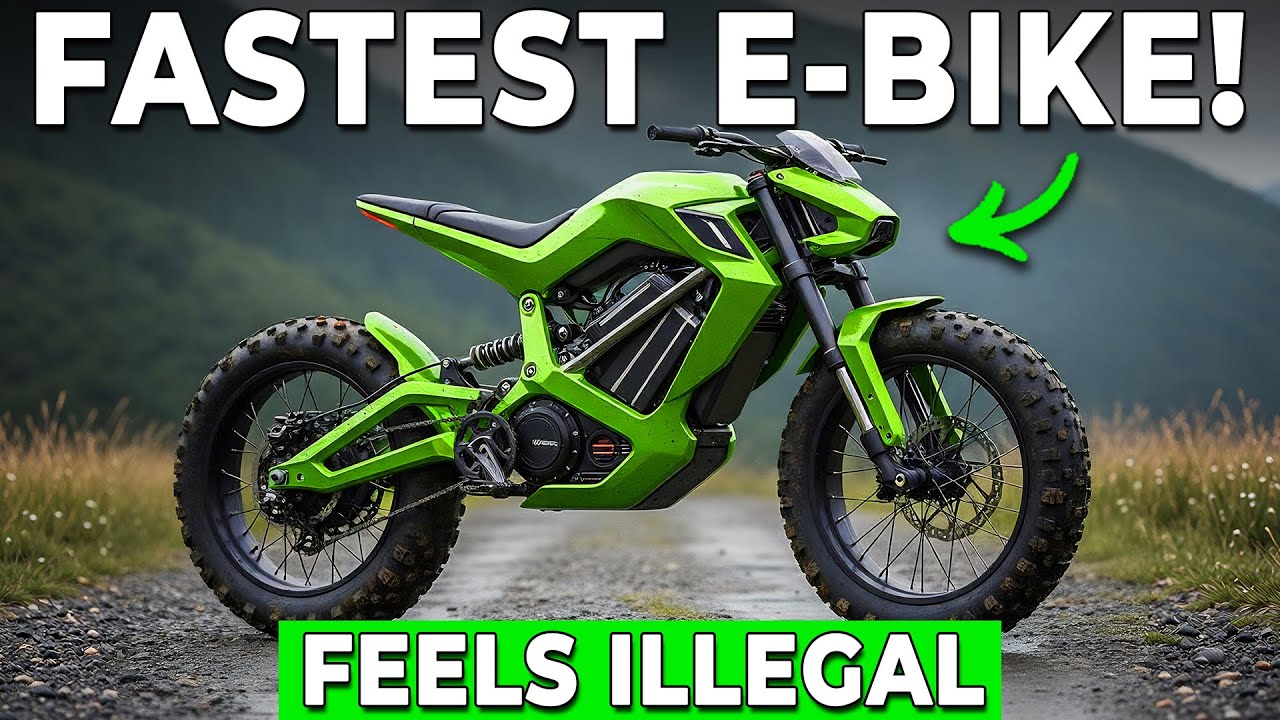
13 Fastest Electric Bikes That Feels Illegal to Own
Most riders think electric bikes are just slow, eco-friendly commuters. But what if I told you that some electric bikes are so fast they make most motorcycles look like toys? Bikes that look innocent in the shop, but can hit 70 mph and technically remain street legal. In this video, we’ve got the 13 fastest electric bikes that feel illegal to own, ranked from slowest to fastest based on real world performance data and legal analysis. And trust me, some of these speed demons might shock you. From clever legal loopholes to motor ratings that mean absolutely nothing, these bikes exploit every weakness in outdated legislation. And here’s the kicker. The number one bike on this list is so fast it can outrun most motorcycles while still being classified as a bicycle. Stick with me to the end because this isn’t just a speed ranking. It’s your guide to understanding the legal gray areas that make these machines possible. Miss this and you could end up owning something that’s legal in one state but gets you arrested in another. Number 13, Super 73Z Miami. Starting our countdown at number 13 is the Super 73Z Miami. A bike that’s become the poster child for the retro electric moped movement. With its distinctive design that screams 1970s beach cruiser meets modern technology, the Z Miami captures attention wherever it rolls. The bike features a 750 W rear hub motor that can peak at 12,200 watts, propelling riders to speeds of 28 mph in its unlocked off-road mode. The Super 73 brand has mastered the art of lifestyle marketing, positioning their bikes as essential accessories for the Instagram generation. The Z Miami specifically targets younger riders with its Miami Vice color scheme and approachable $1,795 price point. The 615Wh battery provides a respectable 30 to 50 m range, making it practical for urban adventures and weekend beach trips. However, the Super 73 ownership experience reveals a troubling pattern that potential buyers need to understand. Customer complaints on Better Business Bureau sites paint a disturbing picture of poor customer service with reports of customers unable to reach support for weeks at a time. Multiple owners describe bikes that stopped working after just months of use, followed by endless delays in receiving replacement parts. One particularly devastating case involved a family that purchased six Super 73 bikes only to have five breakdown with no way to get parts after the model was discontinued. The Z Miami represents the classic trade-off in this market segment. You’re buying the lifestyle and aesthetic appeal, but the afterale support may leave you stranded when things go wrong. Number 12, Super 73R series. At number 12, we have the Super 73R series. The premium offering from the same company that brought us the Z Miami. Priced from $3,995, the R series represents Super 73’s attempt to justify higher prices with better components and build quality. The bike maintains the same 750 W motor configuration as its cheaper sibling, reaching identical 28 mph top speeds in off-road mode. The R series differentiates itself through premium materials, improved suspension components, and more sophisticated electronics. The higher price point should theoretically translate to better reliability and customer support. But unfortunately, the same customer service issues that plague the Z Miami extend across Super 73’s entire product line. The R series illustrates a fundamental problem in the electric bike industry. Companies that excel at marketing and lifestyle branding don’t always possess the operational competence needed to support complex products long term. Despite the premium pricing, buyers report identical issues with customer service responsiveness and parts availability that affect the cheaper models. The bike’s retro styling remains unmatched in the industry, making it the clear choice for riders who prioritize aesthetics above all else. However, potential owners must accept the significant risk of being left without support when mechanical issues inevitably arise. Number 11, Bitrix Juggernaut Ultra FS. Coming in at number 11 is the Bitrix Juggernaut Ultra FS. A machine that takes a completely different approach to high performance electric biking. Rather than pursuing maximum straight line speed, the Juggernaut focuses on delivering serious off-road capability with impressive velocity when needed. The bike’s 1 W Buffong mid drive motor can peak at 1,500 watts, generating a massive 160 Newton meters of torque that makes steep hills feel flat. The Juggernaut’s 38 mph top speed might seem modest compared to other entries on this list, but its real strength lies in how it delivers that power. The torque sensing pedal assist system provides natural feeling power delivery that enhances rather than replaces human pedaling effort. This makes the bike feel less like a motorcycle and more like a supercharged bicycle with incredible climbing ability. Professional reviews consistently praise the Juggernaut’s component quality, highlighting the Tekro hydraulic brakes and Rock Shock suspension that handle the bike’s substantial power output. The $5,499 price tag reflects genuine engineering investment in creating a machine that can handle demanding trail conditions while delivering roadworthy speed when required. The Juggernaut represents the thinking rers’s choice in the high performance ebike space. It prioritizes versatility and build quality over pure speed numbers, making it ideal for riders who want capability across multiple riding scenarios rather than just straight line velocity. Number 10, Vintage Electric Tracker. At number 10, we encounter the Vintage Electric Tracker. A bike that proves style and substance can coexist in the electric bicycle world. The Trackr combines nostalgic cafe racer aesthetics with genuinely impressive performance capabilities. Featuring a 750 watt hub motor that can be unlocked to peak at over 2,800 watts through the mysterious race mode pin. This power delivery enables a 36 mph top speed that feels even faster thanks to the bike’s lightweight construction in aggressive riding position. The Trackr’s design language draws heavily from vintage motorcycles, incorporating leather accents and carefully considered proportions that make it look like it belongs in a premium motorcycle showroom rather than a bike shop. Vintage Electric positions their products as luxury items and the premium pricing reflects this positioning. The company focuses on quality materials and attention to detail that justifies the substantial investment required for ownership. Unlike some competitors that prioritize raw performance over refinement, the Trackr delivers a complete experience that includes visual appeal and build quality. The bike’s 702-wh battery provides a modest 25 to 40 m range, reflecting the reality that high-speed operation dramatically reduces efficiency. The Trackr is designed for riders who value the complete package, performance, style, and craftsmanship rather than just maximum velocity or longest range. Number nine, Ride OneUp Rev 1FS. Sliding into number nine is the Ride OneUp Rev1 FS, a bike that has earned widespread praise for delivering exceptional value in the high performance ebike segment. Priced at $2,495, the Rev 1 offers capabilities that typically cost thousands more from other manufacturers, the bike ships as a class 2 ebike limited to 20 mph. But unlocking reveals its true potential with speeds reaching 37 mph. The secret to the Rabo V1’s impressive performance lies in its 1,000 W Bofang motor paired with a 52vt battery system. This combination delivers substantial torque and acceleration that feels significantly more powerful than the motor’s nominal rating would suggest. Reviews consistently highlight the bike’s planted, stable feel at high speeds, attributed to its moped style design and quality hydraulic braking system. Professional reviewers have noted that the Ray V1 offers component quality and performance that typically requires spending significantly more money with other manufacturers. The full suspension system, hydraulic disc brakes, and robust frame construction demonstrate genuine engineering investment rather than cost cutting compromises. The Rev 1 represents the sweet spot in the high performance ebike market. It delivers serious speed and capability without the premium pricing that puts similar performance out of reach for most riders. The bike proves that exceptional value still exists in this market segment for buyers who know where to look. Before we continue counting down these speed demons, if you’re finding this breakdown of legal loopholes and performance capabilities as fascinating as we are, make sure to subscribe for more deep dives into the tech industry’s most controversial products and regulatory gray areas. Number eight, Wired Ebikes Cruiser. At number eight, we have the Wired eBikes Cruiser. the entry-level offering from a company that explicitly markets their products as power performance bikes due to their ability to exceed legal limits when unlocked. The Cruiser features a 1,500 W motor that can peak at 3,200 watts, enabling speeds of 35 plus mph in unrestricted mode. Wired ebikes has built their entire business model around the legal loophole that allows motors to exceed their nominal ratings. The cruiser ships programmed as a street legal class 2 bike, but simple display adjustments unlock significantly higher performance levels. This strategy allows the company to sell high performance machines while placing legal responsibility on the customer to comply with local regulations. The $2,199 price point makes the Cruiser accessible to riders who want serious performance without premium pricing. The bike’s 60volt 35 a battery system provides approximately 90 mi of range. Though this figure drops dramatically when using the full power capabilities that make the bike exciting to own. The cruiser’s dual battery system represents innovative thinking about power delivery and range extension. By combining multiple battery packs, wired ebikes creates higher voltage systems that can sustain peak power output longer than single battery configurations. This approach demonstrates genuine engineering consideration for the demands of high performance electric biking. Number seven, Wired eBikes Warrior. Number seven brings us the Wired eBikes Warrior. The middle child in the company’s performance focused lineup. With a 5,000 watt peak motor output and the same 35 plus mph top speed as its siblings, the Warrior represents a significant step up in power delivery over the entry-level cruiser while remaining more affordable than the flagship Predator. The Warrior’s $2,799 price point positions it as the value leader in the high wattage segment, offering nearly twice the peak power of the cruiser for just $600 more. This pricing strategy reflects WireD bikes understanding that their target market prioritizes raw performance over premium materials or aesthetic refinement. The bike maintains the same dual battery system architecture as other Wired DBX models, providing the high voltage needed to sustain peak power output during aggressive riding. The 72vt electrical system enables power delivery that would be impossible with lower voltage configurations, demonstrating the technical sophistication hidden beneath the utilitarian exterior. Professional reviews consistently note that Wired eBikes products prioritize function over form, delivering impressive performance capabilities without the premium styling or component quality found in more expensive alternatives. The Warrior represents this philosophy perfectly. It’s built for riders who care more about acceleration and top speed than visual appeal or luxury features. Number six, Wired eBikes Predator. At number six, we encounter the Wired eBikes Predator, the flagship offering from a company that has made exploiting legal loopholes their core business strategy. The Predator features a dual motor all-wheel drive system that can peak at a staggering 8,000 watts, making it one of the most powerful electric bikes available at any price point. The dual motor configuration provides advantages beyond just raw power output. All-wheel drive traction enables aggressive acceleration without wheel spin, while the distributed power delivery creates more balanced handling characteristics than single motor bikes. The system can propel the Predator to speeds exceeding 35 mph while maintaining stability that would be impossible with rearwheel drive alternatives. At $3,699, the Predator represents exceptional value in the ultra high performance segment. Comparable power levels from other manufacturers typically require investments of $8,000 or more, making the Predator an attractive option for riders who prioritize performance over premium branding or luxury features. The bike’s dual battery system provides the electrical infrastructure needed to sustain 8,000 W peak output, creating a 72vt platform that can deliver massive current without voltage sag. This technical sophistication demonstrates genuine engineering competence despite the relatively modest pricing compared to premium alternatives. Number five, Delast Top 3.0. Coming in at number five is the Delast Top 3.0. A bike that holds the Guinness World Record for longest distance traveled on a single charge. an impressive 228 miles that demonstrates the potential of electric bicycle technology. However, the top 3.0 is far more than just a long range commuter with a 50 mph top speed that puts it firmly in motorcycle territory. The bike’s rear hub motor delivers a nominal 3000 watts with peak output reaching 6,000 watts, providing acceleration and sustained high-speed capability that rivals many motorcycles. The massive 3,456watth battery pack enables both the record-breaking range and the sustained power delivery needed for extended high-speed riding. However, the top 3.0’s impressive specifications come with significant practical compromises. The bike weighs 154 lb, making it the heaviest electric bike many reviewers have ever encountered. This substantial weight creates challenges for handling, transportation, and storage that potential owners must carefully consider. The 6,649 price tag reflects the genuine engineering investment required to create a machine with such extreme capabilities. The top 3.0 represents the thinking person’s choice for riders who need both exceptional range and serious speed capability. though the weight penalty makes it unsuitable for many riding scenarios. Number four, Onyx RCR. At number four, we have the Onyx RCR. A machine that perfectly illustrates the blurred line between electric bicycle and motorcycle. With a 65 plus mph top speed and the ability to accelerate from 0 to 30 mph in just 1.7 seconds, the RCR delivers performance that exceeds many gasoline powered motorcycles. While technically remaining classified as an electric bicycle, the RCR’s motor can deliver a maximum power output of 18,000 watts, a figure so extreme that it challenges every assumption about what constitutes bicycle level performance. This massive power output enables not just impressive top speeds, but brutal acceleration that can catch even experienced riders off guard. Despite its motorcycle level performance, the RCR maintains electric bicycle classification through the nominal power rating loophole that allows manufacturers to dramatically understate their products actual capabilities. The bike ships with eco and sport modes with the ladder unlocking the full performance potential that makes ownership feel genuinely illegal. At $4,699, the RCR represents exceptional value in the ultra higherformance segment, delivering capabilities that would cost significantly more from traditional motorcycle manufacturers. The bike’s retrostyled design adds visual appeal to the impressive performance specifications, creating a complete package that appeals to riders seeking both speed and style. Number three, High Power Cycles Revolution X. Taking the bronze medal at number three is the High Power Cycles Revolution X, a machine that represents American electric bicycle manufacturing at its absolute pinnacle. With a top speed exceeding 65 mph and a 6,000 to 8,000 W motor, the Revolution X delivers performance that rivals high-end motorcycles while maintaining electric bicycle classification. High Power Cycles handcrafts each revolution X from premium materials including 6061 aluminum and carbon fiber creating machines that justify their premium pricing through genuine engineering excellence. The bikes feature worldclass components like DBO suspension and Mura quad piston brakes, essential safety equipment for handling such extreme velocities. The Revolution X’s unique Schlump high-speed drive represents innovative thinking about human power integration at motorcycle speeds. This 2.5 times overdrive crank set allows riders to comfortably pedal at speeds exceeding 60 mph, creating an experience that reviewers describe as feeling like Superman. Humanpowered flight at impossible speeds. Starting at $12,999, the Revolution X commands premium pricing that reflects its position as a custombuilt Americanmade superbike. The investment is justified by component quality, engineering sophistication, and performance capabilities that simply aren’t available from mass-produced alternatives. The Revolution X represents the absolute state-of-the-art in electric bicycle performance. Number two, Halo Motor FC1. At number two, we encounter the Hollow Motor FC1, a machine that prioritizes raw velocity above all other considerations. With a top speed of 68 mph, the FC1 represents one of the fastest electric bikes available at any price point, achieving performance that exceeds many motorcycles while maintaining electric bicycle classification. The FC1’s $4,868 price tag makes it significantly more affordable than comparable speed from premium manufacturers. Though this cost advantage comes with compromises in component quality and overall refinement. The bike is built for riders who prioritize maximum velocity over luxury features or premium materials. Professional reviews note that the FC1 sacrifices ride refinement and component quality to achieve its impressive top speed at a relatively accessible price point. This represents a valid design choice for riders who want maximum performance per dollar spent, though it requires accepting compromises in other areas. The FC1’s ability to reach 68 mph while maintaining electric bicycle classification demonstrates the complete breakdown of regulatory frameworks designed for much slower machines. At these speeds, the distinction between bicycle and motorcycle becomes purely legal rather than practical, highlighting the urgent need for updated legislation. Number one, high power cycles revolution X9. Finally taking the top spot as the fastest electric bike that feels illegal to own is the High Power Cycles Revolution X9. A machine so advanced that it represents the absolute pinnacle of electric bicycle performance. With a top speed exceeding 70 mph in a 10,000 plus watt motor, the X9 delivers capabilities that exceed most motorcycles while technically remaining an electric bicycle. The X9 represents the 2026 model year evolution of high power cycles flagship platform. Incorporating lessons learned from years of building extreme performance electric bikes. The 10 kW motor output enables not just incredible top speeds, but sustained high velocity performance that rivals purpose-built motorcycles. The bike’s 3,450Wh battery system provides the electrical infrastructure needed to sustain 10,000 plus watt output while maintaining the 100m range that makes the X9 practical for extended high-speed riding. This combination of extreme performance and reasonable range represents genuine engineering achievement. At approximately $18,325, the Revolution X9 commands supercar level pricing that reflects its position as the absolute pinnacle of electric bicycle technology. The investment buys access to performance capabilities that simply don’t exist anywhere else in the electric bicycle world, making it the ultimate expression of what’s possible when legal loopholes meet engineering excellence. The X9’s existence demonstrates how completely current regulations have been outpaced by technology. A machine capable of 70 plus mph that legally remains a bicycle highlights the urgent need for updated legislation that reflects the reality of modern electric vehicle capabilities rather than outdated assumptions about bicycle performance. While these electric bikes exploit legal loopholes to deliver genuine performance, many manufacturers use different tricks to deceive customers about basic specifications like range. Check out our breakdown of 17 electric bikes that fake their range.
Most riders think electric bikes are just slow, eco-friendly commuters. But what if I told you that some electric bikes are so fast they make most motorcycles look like toys?
Bikes that look innocent in the shop—but can hit 70 mph and technically remain street legal.
▶️ Watch more videos from Tech Charge: 🔋
_____________________________________________
The UGLY Truth About Electric Cars…
_____________________________________________
When Will Electric Cars Become Affordable
_____________________________________________
The INSANE History of Electric Cars
_____________________________________________
This Tiny EV is a HUGE SUCCESS
_____________________________________________
First EV to Reach 1000 MILES Range
_____________________________________________
The First EV to Reach 1,000 km Range
_____________________________________________
🔔 Subscribe: https://bit.ly/30vR5eV