By Mitesh Zaveri and Shrawan Raja
The Optiq is Cadillac’s attempt to make its entry EV feel just as special as the larger models like the Lyriq, Vistiq, and the Escalade IQ.
Recently, I spent a few days driving the North American-spec Luxury 2 trim (MY25), which sits at the top of the lineup in Canada, and it left a good impression for the way it looks, the amount of tech it offers, and the way Cadillac has tuned the power delivery.
It also showed a few small frustrations in the way some functions are buried in the screen and in the day-to-day usability of details like the door handles, the rear visibility, and a few cabin controls.
Design

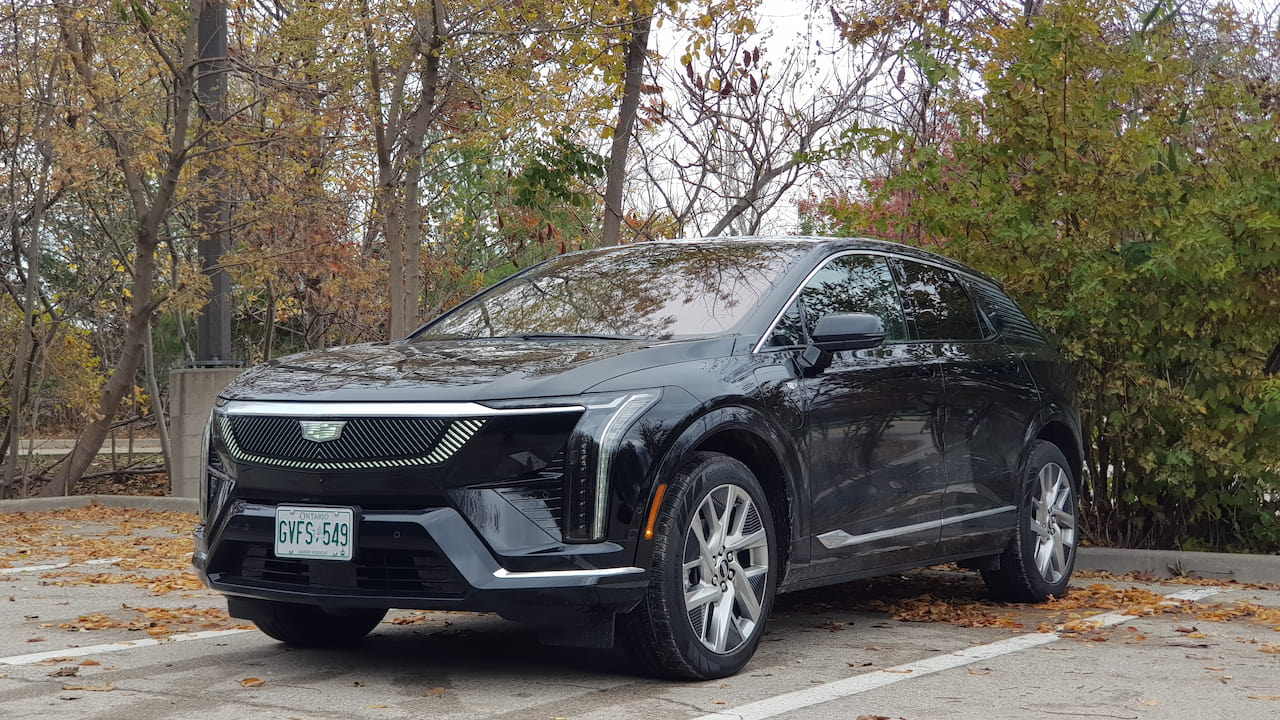
The Optiq looks sharp without trying very hard. Cadillac designers have managed to make it feel premium and modern without filling it with unnecessary character lines or gimmicks. The front uses a covered grille with an illuminated Cadillac badge, and the lighting around it forms part of the daytime running light signature.
The vertical lighting layout suits the shape well, and the main headlamp cluster is placed lower in the fascia, with cornering lights and dynamic LED turn signals also included. Active grille shutters sit behind the lower opening to help with cooling and efficiency.

From the side, the lines are soft and smooth, and the 20-inch pearl nickel wheels with black inserts fit the design well. The half-chrome window surround and the body surfacing give it just enough styling detail without making it feel overdone.
The flush door handles look neat and include illuminated strips, though I did keep thinking about winter use. In freezing temperatures, if you wash the car and water remains around those handles, it could freeze and make them hard to use.
At the rear, the taillights are split and vertical, and the signature lighting doubles as the turn signal. The lower bumper is plain, with dark gray trim and chrome detailing.

The powered trunk can also open automatically when you approach from the back with the key. That sounds useful, but I found it a bit annoying because if I was just standing behind the car, it would still open when I did not want it to.
Interior
The cabin is where the Optiq starts to pull away from mainstream EV offerings. Cadillac mixes leather, fabric, and recycled materials, and the result feels more interesting than if it had simply applied leather throughout.
The white trim sections across the dash use a mix of wood, paper, plastic, and other recycled materials. Ambient lighting is integrated into the dash, doors, and footwells, and the 19-speaker AKG audio system with Dolby Atmos sounds excellent.
Infotainment

The centerpiece is the 33-inch curved display, which combines the driver display, the center control section, and the infotainment area into one long panel. It looks dramatic, but it is not too tall, and does not block the view ahead.
The graphics are good, and the system is well organized once you get used to it. The issue is that some of the features are buried a bit too deep. You need to go into the controls menu for functions like the glovebox release, dome lights, camera controls, traction control, and vehicle shutoff.
There is no dedicated start-stop button, so turning the car off means using the screen, which feels unnecessarily complicated. There is also a sensor near the light controls that felt a bit wonky in use.
The Optiq uses Google built-in for navigation and services, and GM has decided not to offer Android Auto or Apple CarPlay. The system itself is quick and Google Maps works well, but some drivers will still miss smartphone mirroring.
Cadillac also gives the car 72 GB of 5G data connectivity, and the My Cadillac app is genuinely useful. It lets you view range, lock and unlock the car, locate it, and remotely heat or cool the cabin.
Driving Position and Seating
The front seats are one of the best parts of the Optiq. They are broad, soft, and feel right for a luxury SUV. Both front seats are heated, cooled, and include massage, with eight-way power adjustment and four-way lumbar support. There is plenty of side support, and under-thigh support feels good because of the level of adjustability.

The massage function is controlled through a side joystick, and while it works well, Cadillac oddly asks you to use that side controller even though the function also appears on the touchscreen, which feels a bit unnecessary.
At 5’11”, the rear seat space is generous enough for everyday use. The rear bench is broad, and knee room is good because of the seat shaping. The issue is that the rear seat base sits low and the floor is raised, so thigh support is not as good as it could be. There is also not much room to slide your feet under the front seats, which you notice on longer road trips.
Headroom is decent at around two inches, though the panoramic glass roof and its trim eat into the available space. The rear backrest is fixed, so there is no reclining function, and the bench-like shape means it is more about width than contour.
The middle seat is usable because there is no tunnel, but the backrest is firmer because of the cupholders folded into it. Rear passengers do get heated outboard seats, USB-C ports, air vents, and ISOFIX points. Rear door storage is limited to about a half-liter bottle.

Rear visibility is on the restricted side, so the rear-view camera mirror feed helps, and the image itself is crisp and adjustable.
Cargo and Practicality
The cargo area is wide and easy to use. The lip is low, which helps when loading heavier bags, and the trunk floor is flat when the rear seats are folded. With the rear seats up, the Optiq offers 26 cubic feet of space.
Fold them down and it expands to 57 cubic feet, and those are solid numbers for the segment. Cadillac also includes a 12-volt socket, hooks, lighting on both sides, and a trunk separator that stows neatly under the floor.
There is no spare wheel or tire repair kit in the usual sense because the Cadillac Optiq uses self-sealing tires. Minor punctures are meant to seal themselves. Under the trunk floor, there is some storage and the portable charger. Up front, there is no frunk, since the motors and electrical hardware take up that space.
Performance

The Optiq uses two electric motors, one at each axle, for a combined 300 horsepower and 354 lb-ft of torque. It is AWD, and the 89 kWh battery has 85 kWh of usable capacity.
Cadillac has calibrated the power delivery differently from many other EVs. Instead of giving you a sudden burst of torque right away, it builds power more gradually unless you really press the accelerator past halfway or switch into Sport mode.
That makes the car easier to manage and more natural in everyday driving, and I came away impressed with that tuning. It still feels quick, but it does not lunge forward in a way that catches you out.
Efficiency also impressed me. In city use, I recorded 20.8 kWh per 100 km (62 mi), while highway use came out around 26.1 kWh per 100 km (62 mi). The claimed range is 486 km (302 mi), and the real-world range observed in cold conditions stayed close to that.

Temperatures were between 0 and 5 degrees Celsius (32 to 41°F) for several days, yet the Optiq held up well and did not punish the range heavily when accessories were in use.
Cadillac’s range prediction also seems realistic rather than inflated. The Google Maps integration helps here too, since it shows the battery percentage at destination and nearby chargers.
Charging performance is decent, though not class-leading. The Optiq can charge at up to 150 kW DC, and Cadillac says 10 to 90 percent takes 55 minutes.
Level 2 charging at 11.5 kW adds 50 km (31 mi) of range per hour, while a 19.2 kW setup can add 88 km (54.6 mi) per hour. Cadillac also includes a portable 7.7 kW charger.
Ride, Steering, and NVH
Ride quality is one of the Optiq’s nice surprises. The suspension is tuned to feel luxurious, and it absorbs bumps very well without making the car feel heavy or lazy. It felt close to an air-suspension setup at first because of how well it manages body movements. Cadillac’s chassis engineers have done a good job here.

The steering system is another highlight. It is electronic, but it has good feedback and feels precise enough that the car comes across as agile for an EV SUV. Sport mode adds on a little more weight. The only real drawback is that the turning radius is slightly larger than expected for a midsize SUV, though it is still manageable enough for three-point turns.
The brakes themselves feel progressive and firm. Most of the time, I would probably rely on the one-pedal drive and the regen paddle, both of which work well and help maintain range. In terms of noise levels, the Optiq is quiet overall, especially for an EV riding on 20-inch wheels.
The side glass is double glazed, and the tires remain fairly quiet. The one issue is that the front glass lets in a bit more noise than the rest of the cabin. I’m not flagging this as a problem, but it is noticeable against how hushed the rest of the car feels.
Pricing

The Optiq is priced (MSRP, excluding destination, taxes and other fees) between USD 50,900 and USD 53,900 in the U.S., and (MSRP, excluding taxes and other fees) between CAD 61,042 and CAD 64,142 in Canada. The prices don’t include the performance-spec Optiq-V.
TopElectricSUV says
The top-end Optiq looks expensive, its cabin feels premium, the 33-inch display is dramatic without being awkward, and the power delivery is among the most natural I have seen in an EV at this level. The range also stands out because it appears accurate and dependable, even in colder weather.
Its weaknesses are mostly small, but are also noticeable. There is no frunk, the rear visibility is restricted without the camera, the auto-opening tailgate can be too eager, and the flush door handles may be awkward in freezing conditions.

Some of the cabin controls are buried too deep in the screen, there is no Android Auto or Apple CarPlay, the rear seat misses some under-thigh support, and the front glass lets in a bit more noise than I would like.
Also See: We check out the Cadillac Optiq Arctiq Edition shown at the Paris Motor Show
Even so, the overall package is superb. For someone looking for a compact luxury EV with real style, range confidence, and a genuinely premium feel, the Optiq makes a compelling case!

An automobile engineer by training, I’ve analyzed the global car market since 2005, with a keen focus on EVs since 2008. My journey in online automotive publishing spans 17 years, during which I have reviewed cutting-edge automotive technologies and interviewed leading global CEOs and vehicle developers.