
The Material Revolution – How Specialty Polymers Are Shaping the Future
In today’s fast-changing world, innovation is not just about new gadgets or software. It’s also about the materials we use to build everything around us. From cars and airplanes to medical devices and smartphones, a new class of materials is quietly transforming industries. These materials are called specialty polymers.
Unlike ordinary plastics, specialty polymers are designed for specific purposes. They are stronger, lighter, more durable, and often able to handle extreme heat or harsh chemicals. Because of these qualities, they are becoming essential in modern engineering and manufacturing.
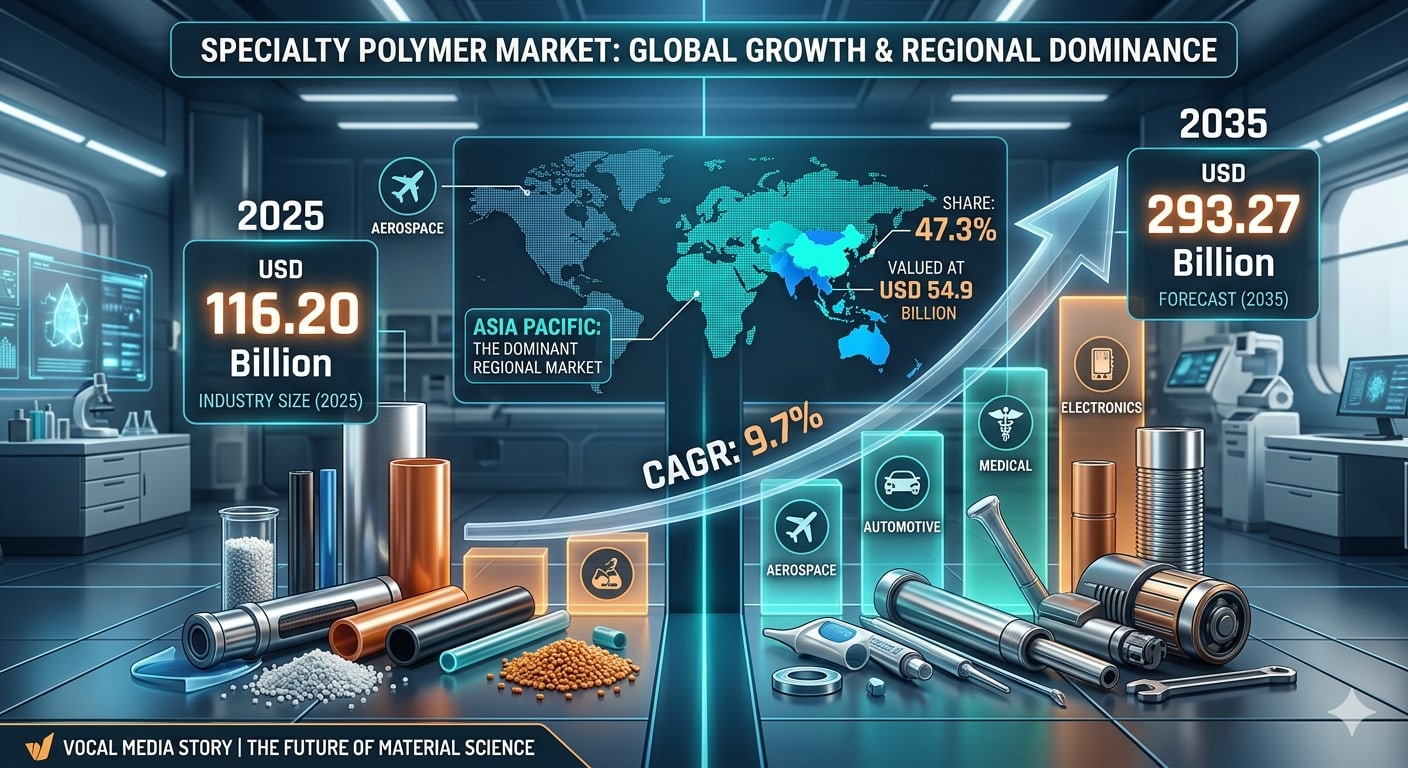
The market for these advanced materials is growing steadily. By 2025, it is expected to be worth over 116.2 billion dollars. Over the next decade, that number could rise to nearly 293.2 billion dollars. This growth reflects how important these materials have become across multiple industries.
Market Highlights
The Global Specialty Polymer Market is projected to grow from USD 116.2 billion in 2025 to USD 293.2 billion by 2035, registering a CAGR of 9.7%.Asia Pacific is the dominant regional market with a share of 47.3%, valued at USD 54.9 billion. Specialty Elastomers lead the product type segment with a dominant share of 47.5%, driven by high-performance applications. Natural sources dominate the source segment, accounting for 51.4% of total market share. Injection Molding is the leading processing technology, holding 38.7% of the market due to efficiency and scalability. Automotive is the largest end-use segment, contributing 43.7% of overall demand.
Get In-Depth 2026 Industry Insights & Projections
So, what is driving this demand?
One of the biggest factors is the push for lighter and more efficient products. In the automotive industry, for example, reducing weight is critical. Lighter vehicles use less energy, which improves fuel efficiency and extends the range of electric cars. Specialty polymers are replacing metal parts in many areas of a vehicle, helping manufacturers meet strict environmental targets.
This shift is even more important in electric vehicles. These cars require materials that can handle high temperatures and provide electrical insulation. Specialty polymers fit these needs perfectly, making them a key part of battery systems and power components.
The aerospace industry is also a major user. Aircraft need materials that are both strong and lightweight. Using specialty polymers instead of traditional materials helps reduce fuel consumption and improve performance. At the same time, these materials can withstand extreme conditions, making them ideal for use at high altitudes.
Beyond transportation, specialty polymers are playing a growing role in healthcare. Medical devices, surgical tools, and implants all require materials that are safe, durable, and easy to sterilize. Specialty polymers meet these strict requirements, making them essential in modern medicine. As healthcare systems expand around the world, demand for these materials is expected to increase further.
Another important area is electronics. As devices become smaller and more powerful, they require materials that can handle heat and protect sensitive components. Specialty polymers are used in connectors, circuit boards, and insulation systems. They help ensure that devices perform reliably, even under heavy use.
Construction is also benefiting from these advanced materials. Specialty polymers are used in pipes, insulation, coatings, and adhesives. They offer durability and resistance to corrosion, which reduces maintenance costs over time. In large infrastructure projects, this reliability is a major advantage.
There is a growing focus on sustainability. Many companies are now looking for materials that have a lower environmental impact. This has led to increased interest in bio-based and biodegradable polymers. These materials are made from natural sources and can break down more easily after use, reducing plastic waste.
Manufacturers are also exploring recycling and reuse systems. The goal is to create a circular economy where materials are used again and again, instead of being discarded. This shift is not only better for the environment but also opens up new business opportunities.
Advanced processing methods, such as injection molding, allow manufacturers to produce complex parts quickly and efficiently. This makes it easier to use specialty polymers in large-scale production.
Another exciting development is 3D printing. This technology allows companies to create custom parts on demand. Specialty polymers designed for 3D printing are enabling new possibilities in design and manufacturing. Industries like aerospace and healthcare are already using this approach to produce highly specialized components.
Despite these advantages, the market does face some challenges.
One issue is the cost of raw materials. Many specialty polymers are made from petrochemicals, and their prices can fluctuate based on global oil and gas markets. This makes it difficult for manufacturers to plan costs and maintain stable pricing.
Environmental regulations are another factor. Governments around the world are introducing stricter rules on chemical use and waste management. While these regulations are important for safety and sustainability, they can increase costs for producers and require changes to existing products.
There is also the challenge of high investment. Producing specialty polymers often requires advanced technology and large-scale facilities. This can make it difficult for smaller companies to enter the market.
However, the industry continues to move forward.
Innovation remains strong, with companies investing heavily in research and development. New materials are being designed to meet specific needs, from heat-resistant polymers for electric vehicles to high-performance materials for next-generation electronics.
Partnerships are also becoming more common. Manufacturers are working closely with customers to develop customized solutions. This collaboration helps ensure that materials meet exact performance requirements and can be integrated smoothly into final products.
Regionally, Asia-Pacific is leading the market. Countries like China, Japan, and South Korea have strong manufacturing bases and high demand for advanced materials. Their growing automotive and electronics industries are major drivers of this demand.
North America and Europe also play important roles. In these regions, innovation and strict environmental standards are pushing the development of new, sustainable materials. Investments in research and advanced manufacturing are helping maintain their competitive edge.
The future of specialty polymers appears bright.
As industries continue to evolve, the need for advanced materials will only increase. Whether it’s building more efficient vehicles, creating safer medical devices, or developing smarter electronics, specialty polymers will remain at the heart of innovation.
This is more than just a materials story. It’s about how industries adapt to new challenges and find better ways to build the world around us.
From lighter cars to stronger buildings and smarter devices, specialty polymers are helping shape a future that is more efficient, more sustainable, and more advanced than ever before.
And while these materials may not always be visible, their impact is everywhere—quietly supporting the technologies and systems that define modern life.