Tesla (NASDAQ: TSLA) stock has plummeted 20% since notching a record high in December (at one point it was down as much as 30%). Volatility in the broader market hasn’t helped, but it seems investors are coming to terms with the company’s languishing electric vehicle (EV) business, which has been a drag on its earnings.
On April 22, Tesla will release its operating results for the first quarter of 2026 (ended March 31). The company is likely to provide forward guidance on its EV sales, but investors will probably be more focused on the progress of future product platforms, such as the Cybercab robotaxi and Optimus humanoid robot.
Will AI create the world’s first trillionaire? Our team just released a report on a little-known company, called an “Indispensable Monopoly,” providing the critical technology Nvidia and Intel both need.
Can the upcoming report — and subsequent commentary from CEO Elon Musk — reverse the slump in Tesla stock? Here’s why investors should think twice before buying it ahead of April 22.
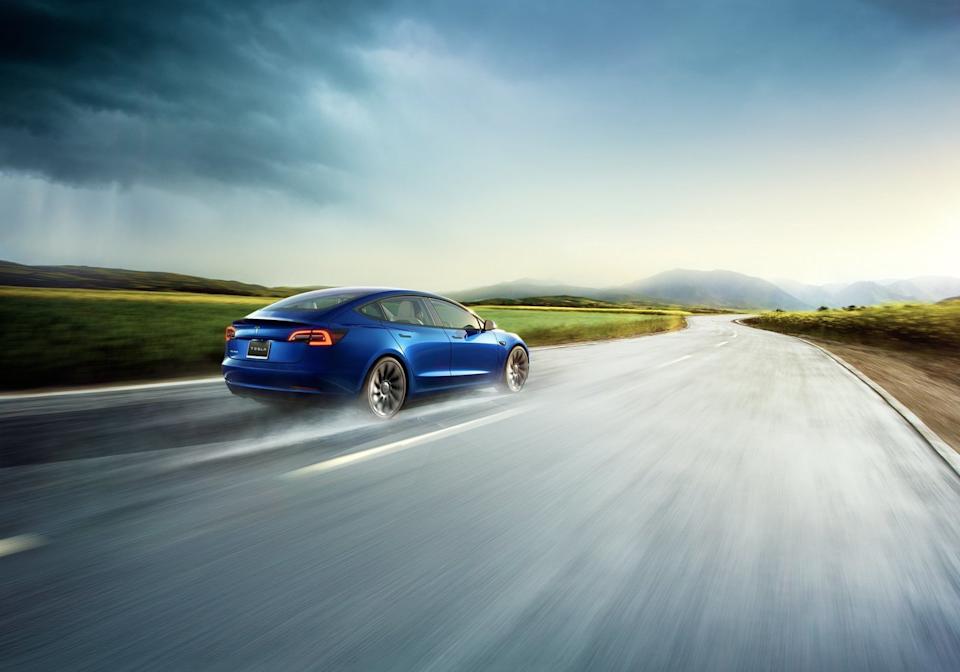 Image source: Tesla.
Tesla is coming off two straight years of declining passenger EV sales. The company delivered 1.79 million cars in 2024 (down 1%) and 1.63 million in 2025 (down an even steeper 9%). The EV business still accounts for over 70% of Tesla’s overall revenue, so the sluggish sales have been a major drag on the company’s financial performance.
Tesla’s automotive revenue plummeted by 10% in 2025, dragging the company’s total revenue down by 3%. But that wasn’t the worst part — since Tesla has been cutting prices to attract more customers, its profit margins have also taken a hit, triggering a 47% crash in its earnings per share last year.
Tesla recently announced it delivered 358,023 EVs in the first quarter of 2026, which was below Wall Street’s estimate of 370,000. However, it represented a 6% year-over-year increase, which suggests the company’s automotive revenue and total revenue likely grew during the quarter. Investors will probably look upon the April 22 report favorably if that proves to be the case.
But for Tesla’s EV sales to continue growing, Musk and his team need a plan for dealing with an increasingly competitive landscape, where low-cost manufacturers like China-based BYD are selling cars at much cheaper price points in important markets like Europe.
As things stand, it appears Musk prefers to shift Tesla’s focus to autonomous vehicles and robotics, which might be the correct long-term move, but it could leave a hole in the company’s financial results in the near term.
Story Continues
During his last quarterly conference call with investors, Musk said the Cybercab robotaxi would enter mass production in April. He is likely to provide an update on that front on April 22, but more importantly, investors will want to know when the robotaxi will offer fully autonomous ride-hailing services outside Austin, Texas, where it’s currently approved to operate without human supervision.
The holdup isn’t the Cybercab itself, but rather Tesla’s full self-driving (FSD) software, which lacks approval for unsupervised deployment in almost every U.S. state. Musk believes the company can win approvals in somewhere between a quarter and half of all U.S. states by the end of 2026, so investors will be watching closely for updates on a quarter-by-quarter basis.
The Optimus humanoid robot, which Musk has previously said could generate $10 trillion in revenue over the long term, is also scheduled to enter production near the end of 2026. It will be manufactured at the company’s Fremont, California, factory, which will have capacity for around 1 million units per year. However, the timeline for achieving that level of scale is unclear, so Musk’s quarterly updates will be crucial for investors from here.
What we do know is that humanoid robots will be versatile. They will have potential applications in households and businesses alike, which is why Musk believes they could outnumber humans by 2040.
Although signs point to a fairly positive first-quarter report on April 22, I don’t think it will be enough to reverse the downtrend in Tesla stock. Despite its 20% decline over the last few months, the stock still trades at a sky-high valuation.
Based on Tesla’s 2025 earnings of $1.08 per share, its stock is trading at a price-to-earnings (P/E) ratio of 327, almost 11 times the Nasdaq-100 technology index’s P/E of 30.8. In other words, Tesla looks way overvalued compared to its big-tech peers.

Hypothetically, Tesla would have to grow its earnings 11-fold for its P/E ratio to align with the P/E of the Nasdaq-100, or alternatively, its stock would have to decline by over 90%. Earnings growth will be hard to come by because of the company’s sluggish EV sales, and the Cybercab and Optimus are still a long way from generating meaningful revenue.
As a result, further downside might be the path of least resistance for Tesla stock from here, so investors who buy it ahead of April 22 in the hopes of catching a strong rebound might be left disappointed.
Ever feel like you missed the boat in buying the most successful stocks? Then you’ll want to hear this.
On rare occasions, our expert team of analysts issues a “Double Down” stock recommendation for companies that they think are about to pop. If you’re worried you’ve already missed your chance to invest, now is the best time to buy before it’s too late. And the numbers speak for themselves:
Nvidia: if you invested $1,000 when we doubled down in 2009, you’d have $515,842!*
Apple: if you invested $1,000 when we doubled down in 2008, you’d have $50,733!*
Netflix: if you invested $1,000 when we doubled down in 2004, you’d have $580,872!*
Right now, we’re issuing “Double Down” alerts for three incredible companies, available when you join Stock Advisor, and there may not be another chance like this anytime soon.
*Stock Advisor returns as of April 13, 2026
Anthony Di Pizio has no position in any of the stocks mentioned. The Motley Fool has positions in and recommends Tesla. The Motley Fool recommends BYD Company. The Motley Fool has a disclosure policy.
Should You Buy Tesla Stock Before April 22? The Answer Might Surprise You. was originally published by The Motley Fool