The surge in fuel prices – for both petrol and diesel – is already having an impact on consumers, and government policy. EV sales have surged to record levels in March, and have created a massive backlog of orders. Second car EV sales, insurance enquiries and even EV rentals have also nearly doubled.
The federal government has responded by halving the cost of the fuel excise, but that has done little to narrow the blowout in costs of fuelling an internal combustion engine compared to powering an electric vehicle.
This has been neatly summed up on a new web page, called e-litre, set up by energy analyst and Climte 200 convenor Simon Holmes à Court.
The website compares how far an EV can travel with $1 of “fuel” (or charge) compared to a petrol vehicle. On the basis of current electricity retail offerings, and the prevailing price of petrol, it is 41.2 kms in the case of an EV, and just 4.9 kms in the case of a petrol car.
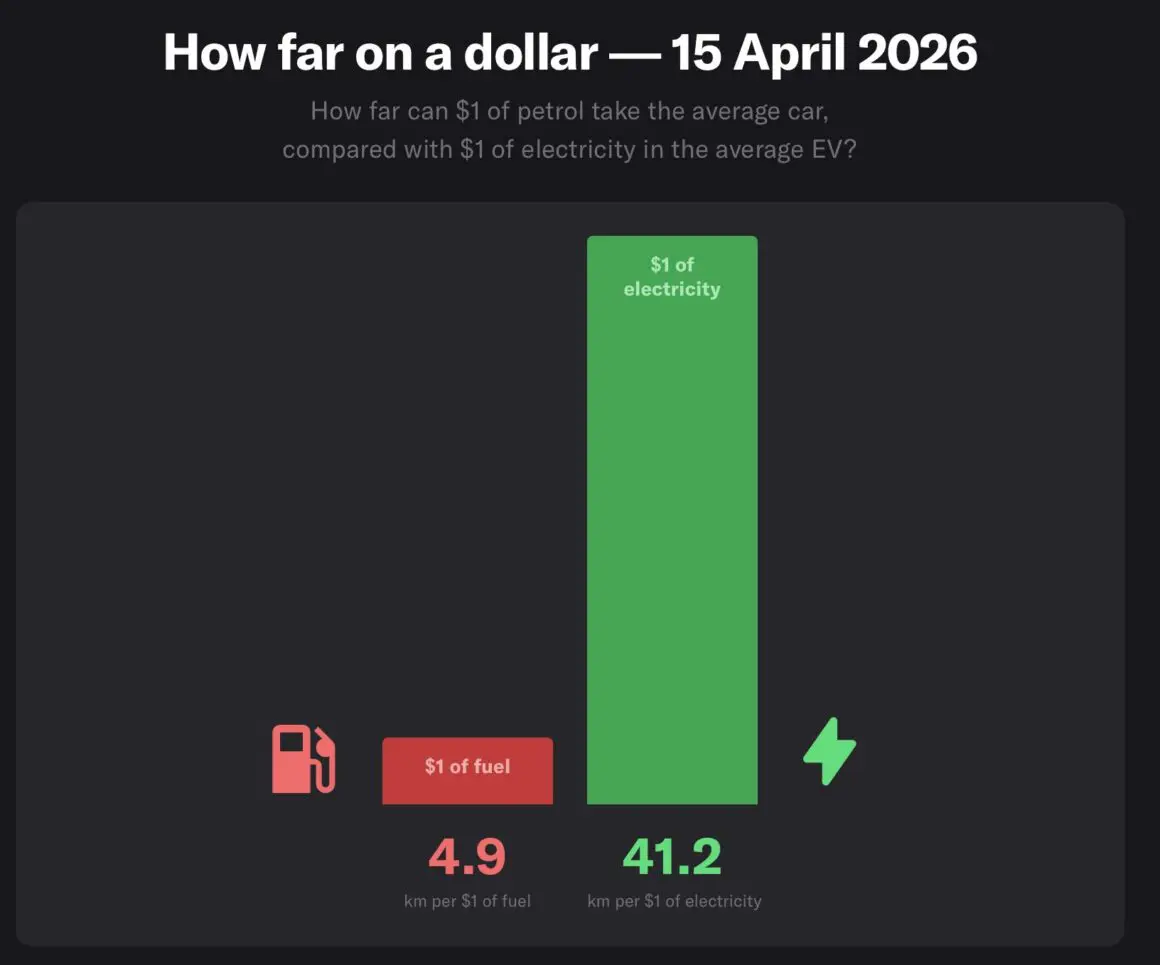
 Source: Elitre.com.au
The difference may actually be greater. For a start, the fuel costs is an average of petrol and diesel prices, and diesel prices are significantly higher than petrol prices at the moment.
Also, the EV distance is calculated on Amber Electric’s Smart charging tariff of 15.5c/kWh. But Amber also points out that its Smartshift tariff for those with solar and battery costs just 4c/kWh, which means that the EV can travel 159.8 kms on a single dollar.
And for those using only their rooftop solar to charge their EVs, then the distance is infinite – unless you count the foregone revenue of solar exports, which would probably work out around the same as Amber’s Smartshift tariff calculation.
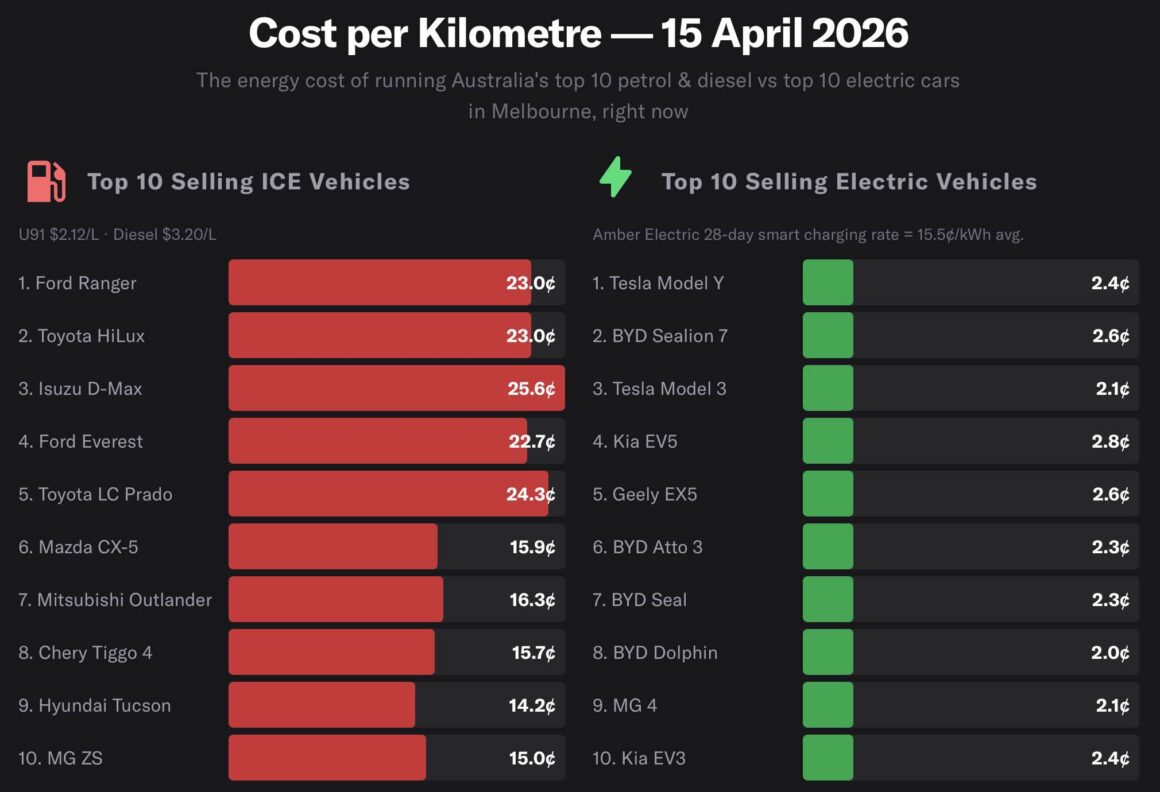
The E-litre website has another cool graph, calculating the average costs per kilometre of the top selling internal combustion vehicles, and the top 10 electric vehicles.
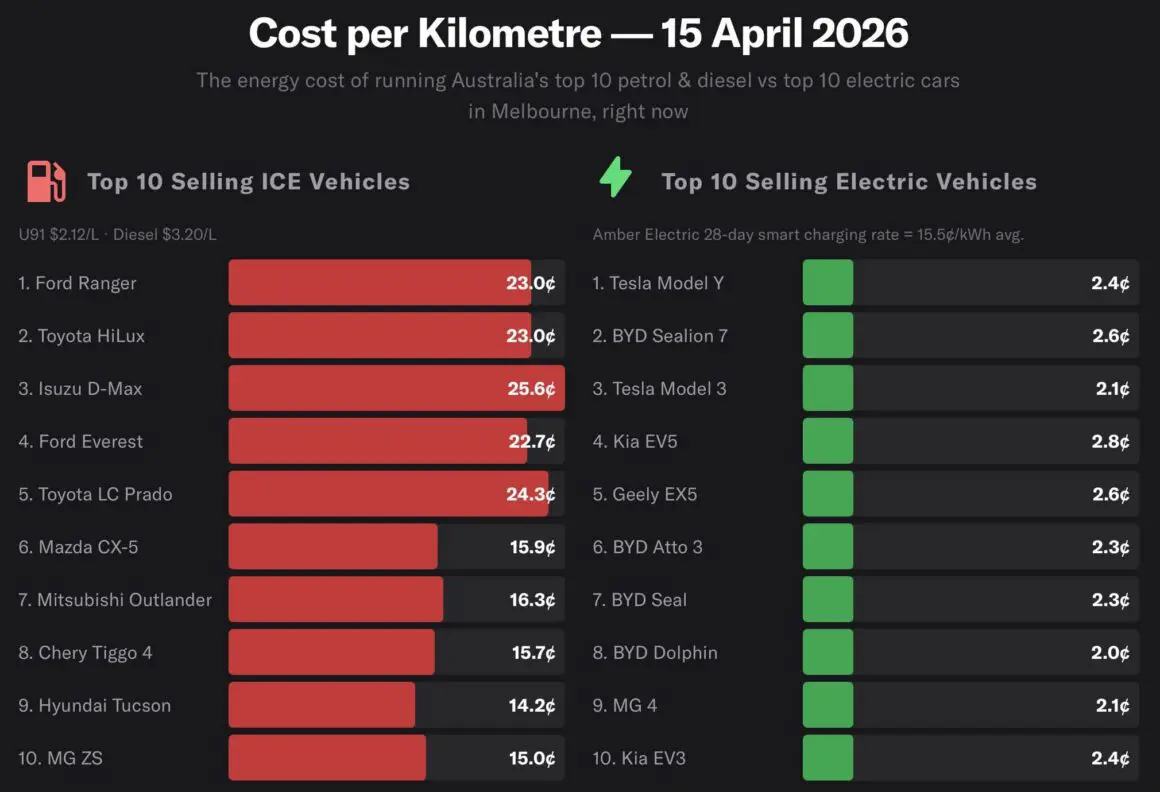
 Source: Elitre.com.au
Needless to say, the EVs win in a canter, with some popular ICE cars costing 10 times more to run per kilometre.
Of the top selling EVs, the BYD Dolphin comes in as the cheapest, at 2.0 cents per kilometre, followed by the MG4 and the Tesla Model 3. That’s thanks to their greater efficiency, as judged by their official WLTP ratings.
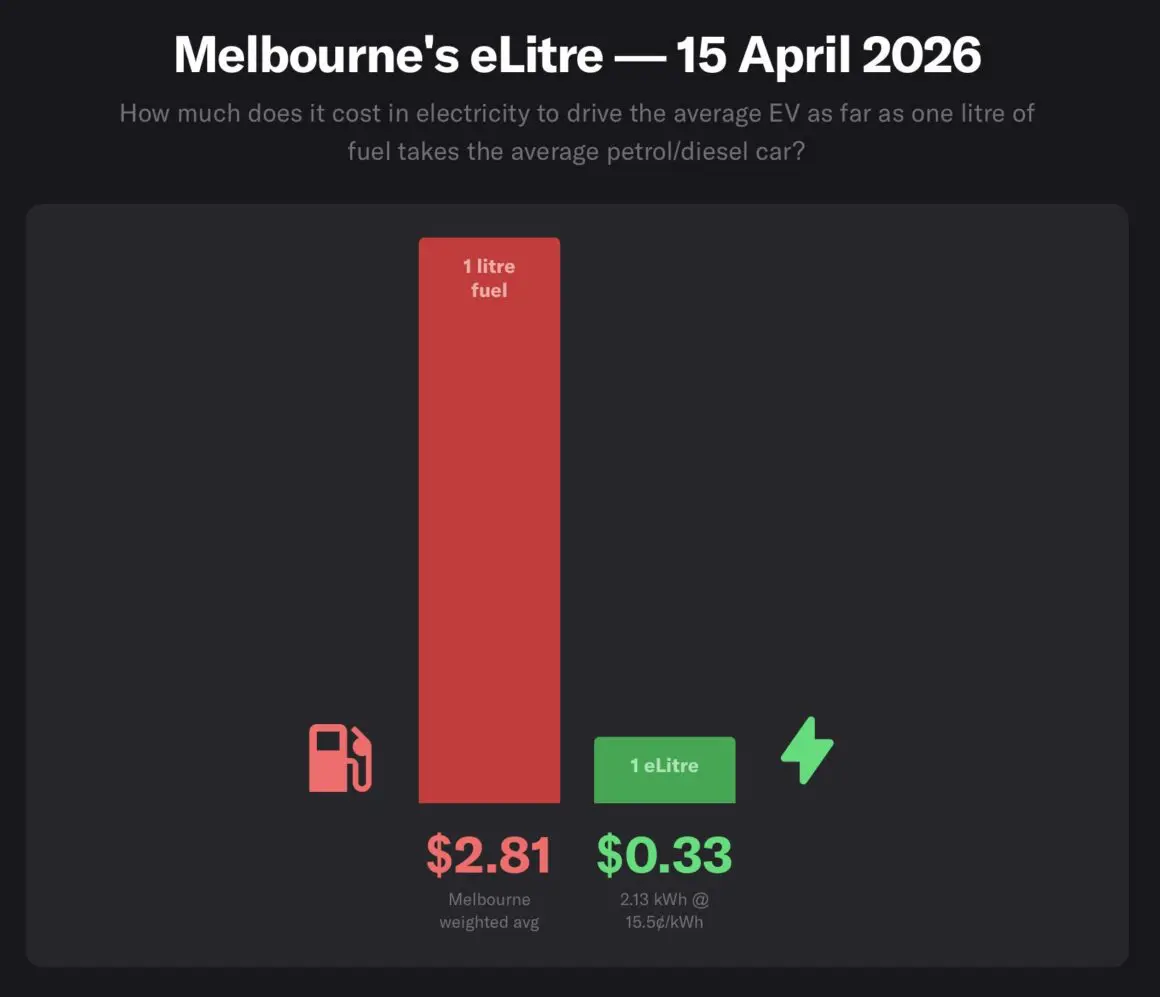
One final graph shows how much it costs to drive an average EV the same distance as a litre of fuel will take the average petrol and diesel car.
 Source: Elitre.com.au
Again, this is based on averages, but the e-litre website puts the cost for an EV of an “e-litre” (hence the website’s name) at just 33 cents, compared to the average $2.81 for an ICE vehicle.
Further information, including the details of how the calculations are made – and they are updated daily – can be found on the e-litre website.
See The Driven’s EV sales data here: Australian electric vehicle sales by month in 2026; by model and by brand
Sign up for The Driven’s free daily newsletter by going to the button on the bottom right of the website’s home page at www.thedriven.io


Giles Parkinson is founder and editor of The Driven, and also edits and founded the Renew Economy and One Step Off The Grid web sites. He has been a journalist for nearly 40 years, is a former business and deputy editor of the Australian Financial Review, and owns a Tesla Model 3.