Manufacturers are converting factories to produce energy storage cells instead of electric vehicle batteries as they seek to capitalise on the AI boom amid slumping EV sales.
Ten North American plants are being retooled to produce batteries more suitable for energy storage systems, after cell makers cancelled enough capacity to produce 2mn EVs, according to market intelligence firm CRU. Of the 10 plants, seven will principally serve the energy storage market.
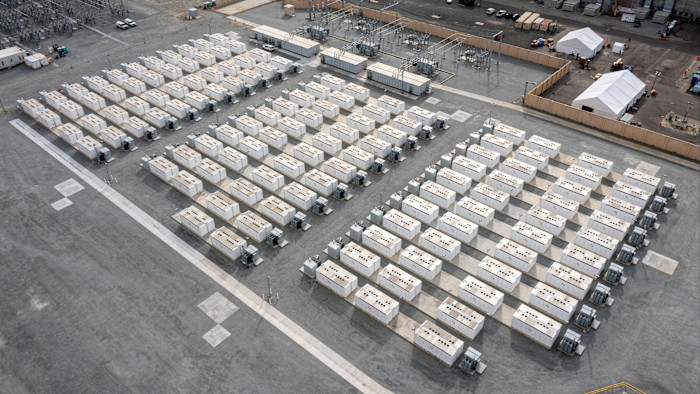
Energy storage systems, consisting of racks of battery modules regulated by management software, help national electricity networks — as well as individual homes, businesses and factories — cope with fluctuating wind and solar energy supplies.
The plants being converted for the ESS market include an EV battery factory in Kentucky that Ford is modifying in response to “surging customer demand for domestic battery energy storage system supply with limited qualified suppliers”.
 The world’s largest utility-scale, ultra-long duration energy storage project in Calistoga, California © David Paul Morris/Bloomberg
General Motors’ battery chief Kurt Kelty also told the FT in a recent interview that the company was considering producing its own energy storage batteries.
Meanwhile, Stellantis and its Korean battery partner Samsung SDI are converting lines at their jointly owned plant in Indiana to produce ESS cells, raising the prospect of all three leading Detroit carmakers emerging as suppliers to Big Tech companies building AI data centres.
Energy storage is crucial for AI data centres, which require uninterrupted power supplies to protect against outages or fluctuations in voltage. With data centre construction booming in the US, that offers EV and battery companies new sources of revenue.
Tesla, which incorporates batteries from a range of suppliers including CATL and LG into its Megapack and Powerwall energy storage systems, reported that energy and generation storage revenues grew 27 per cent year-on-year to $12.8bn — up from $2.8bn in 2021, while its revenues from EV sales fell 9 per cent to $64bn.
The shift to ESS has been accelerated by weakening government support for EVs, after the Trump administration slashed tax credits established in the Biden-era Inflation Reduction Act and moved to cut tailpipe emission rules and state clean-air standards intended to encourage drivers to switch to EVs.

These policy rollbacks led analysts at BloombergNEF to revise down their forecast for EVs’ total share of 2030 car sales from 48 per cent to 27 per cent. EVs currently account for about 8 per cent of US new car sales.
Stellantis is selling its 49 per cent stake in a battery plant just over the Detroit River in Windsor, Ontario, to Korean battery giant LG for just $100, after the European car group announced a €22bn writedown last week tied to its aggressive expansion into EVs. It had invested $980mn in the Windsor facility.
“Companies made big [EV-related] investments in the US because there was a lot of IRA money available,” said Evelina Stoikou, who leads BloombergNEF’s battery technologies and supply chains team. “But some of their targets were overly optimistic.”
Meanwhile, demand for storage batteries is expected to rise as data centres drive up electricity use. Even as the build-out of solar and wind power slows, developers are increasingly adding batteries to store electricity and smooth out their output.
“Balancing intermittent renewables is a big value of storage,” said Charlotte McClintock, a senior analyst with Rhodium’s energy and climate practice.
While the administration has cut consumer tax credits for EVs, President Donald Trump’s flagship One Big Beautiful Bill Act passed last year retained generous production credits for battery manufacturers.
They include a $35 per kilowatt-hour manufacturing credit for battery production, and a 30 per cent investment tax credit for energy storage that will be phased out starting in the 2030s.
The credits, along with US tariffs on Chinese energy storage batteries of close to 60 per cent, mean ESS cells can be produced in the US at prices close to parity with the Chinese imports that dominate the market.
However, Sam Adham, head of battery value chain at CRU, said that battery makers eager to repair the damage inflicted on their bottom line by the EV slowdown are unlikely to pass on cost savings to their customers. That means that ESS battery buyers are still unlikely to be able to access domestic batteries at prices comparable to Chinese imports.
 A lithium battery energy storage system operated by Key Capture Energy in Blasdell, New York. Energy storage is crucial for AI data centres, as they require uninterrupted power supplies to protect against outages or fluctuations in voltage © Ted Shaffrey/AP
Adham noted that Korean companies, which are the biggest producers of energy storage batteries within the US, are less experienced in developing the lithium iron phosphate technology used in ESS batteries compared with Chinese companies. ESS batteries built in the US would be “smaller and inferior in performance” to the cutting-edge equivalents being imported from China.
Recommended

He added that Beijing’s decision to start cutting VAT export rebates on lithium-ion batteries from April had encouraged a rush to secure Chinese supply.
Questions also remain over whether there will be enough ESS demand to absorb all of the additional capacity from converted EV battery lines, in addition to continuing imports from Chinese suppliers.
“We expect margin compression from the increased low-cost competition, impacts to market from policy uncertainty, and the cost of tariffs,” Tesla’s chief financial officer Vaibhav Taneja told investors last month.
Milan Thakore, an analyst in Wood Mackenzie’s EV and battery supply chain team, noted that the consultancy’s data suggests EV demand will continue to absorb a larger share of installations than battery storage through to the end of 2030.
“We don’t expect demand from energy storage systems to ever get near to demand from electric vehicle batteries,” he said. “Even looking at the US market conservatively, if there’s an uptick in demand for EVs, companies switching to ESS might fall behind.”