Audi Q5 e-hybrid plug-in-hybrid – how it works – powertrain-animation
Audi Q5 e-hybrid plug-in-hybrid how it works powertrain-animation
SUV and Sportback as plug-in hybrids with 220 kW or 270 kW system power can travel up to 100 kilometers emission-free
High-voltage battery with larger capacity, increased recouperation, and intelligent hybrid management ensure efficiency and performance
Upgraded standard equipment with 3-zone automatic comfort air conditioning; 270 kW version with LED headlights plus and MMI experience plus
Like the combustion-engine models, the Audi Q5 e-hybrid models have also significantly improved key attributes and offer a comfortable feeling of space – something that people notice right from the moment they get into the car.
The fully adjustable rear seat bench plus is part of the standard equipment of the plug-in hybrid models. It can be moved lengthwise and its angle tilted, increasing the trunk volume or comfort for rear passengers as required. At the same time, the rear bench seats three people comfortably. The SUV has a trunk volume of 438 liters (15.5 cu ft). The Sportback offers 433 liters (15.3 cu ft) of storage space. With the rear seats folded down, the transport volume increases to up to 1,358 liters (48 cu ft) in the SUV and 1,300 liters (45.9 cu ft) in the Sportback.
Other practical features include a larger storage compartment under the center armrest compared to the previous model and numerous smaller storage areas for sunglasses, keys, and other everyday items, a cooled inductive charging tray with 15 watts of charging power in the front center console as well as two USB-C ports in the front and two in the rear. Available as an option, the USB ports in the front support charging capacities of up to 60 watts; the rear ports even support charging capacities of up to 100 watts. This means that larger devices such as laptops can be safely powered and charged while driving.
The upgraded standard equipment in the 220 kW power variant includes the S sports suspension and 3-zone automatic comfort air conditioning. Those who opt for the 270 kW variant will receive the LED headlights plus and LED rear lights pro as standard. The MMI experience plus infotainment system is equipped with the Audi Application Store, a smartphone interface, and Audi sound system. The S interior package with sports seats in a leather/artificial leather combination in black is also included as standard, as are 19-inch ten-arm light-alloy aero wheels and red-painted brake calipers.
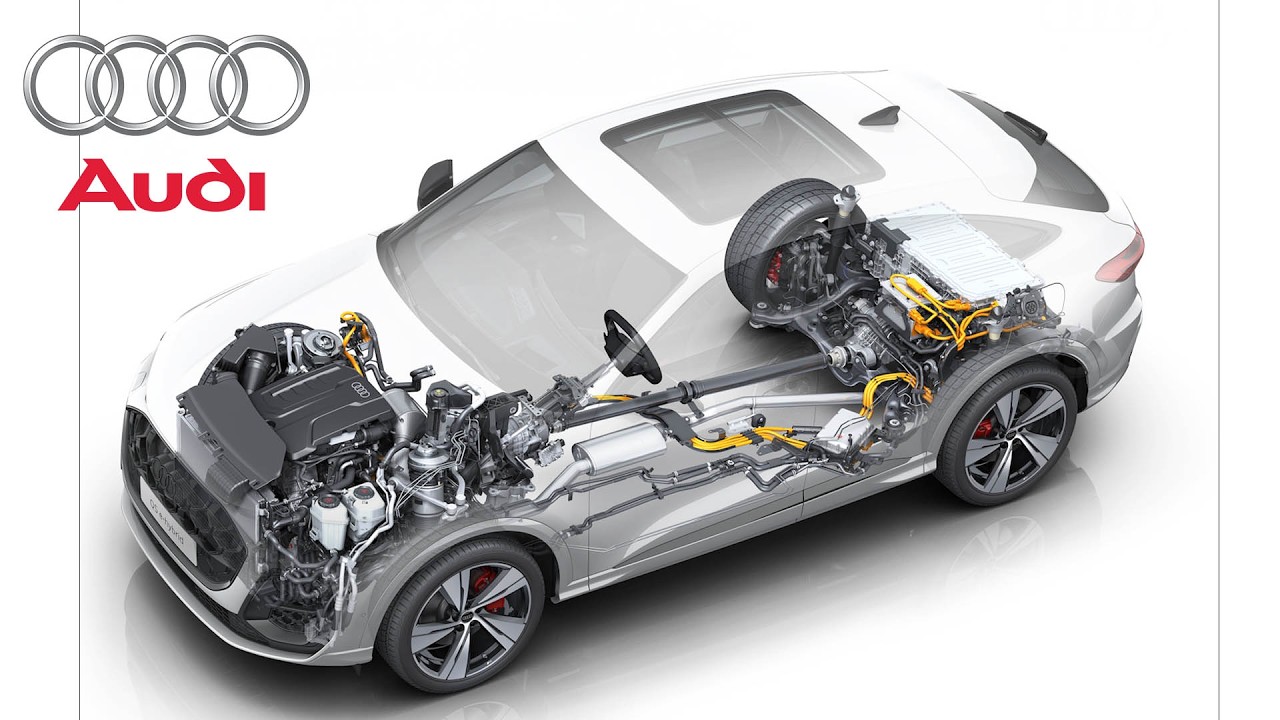
The hybrid management system of the new models is designed for efficiency, flexibility, and maximum customer comfort and automatically selects the optimal operating strategy. The electric drive is provided by a permanently excited synchronous motor with a peak output of 105 kW. The electric motor is integrated into the housing of the seven-speed S tronic. The full system torque is available even at close to idle speed – 500 Nm with 270 kW system output24 and 450 Nm for the 220 kW power variant13.
The power electronics (pulse inverter) used in the plug-in hybrid models of the Q5 are a new development. The pulse inverter is smaller, lighter, and more efficient, thus reducing electrical consumption. Consumption in hybrid mode is therefore also lower.
The heart of the new Q5 plug-in hybrids is the new high-voltage battery (HV battery) at the rear of the vehicle. Audi has boosted its capacity to 25.9 kWh (net 20.7 kWh), roughly 45 percent more than its predecessor. The HV battery is 517 × 880 × 302 millimeters (20.4 × 34.6 × 11.9 in) in size for the best possible integration into the available installation space. The further developed and significantly optimized interaction between the mechanical friction brake and energy recovery via the electric motor has also increased regenerative braking performance.
The battery cells for the Q5 SUV e-hybrid quattro12 and Q5 Sportback e-hybrid quattro34 are arranged on two levels due to the available space and are integrated into the rear section of the car. Each prismatic cell stores approximately 46 percent more energy than the cells previously used in high-floor vehicles in the C segment. Each cell has a charge capacity of 70 ampere-hours (Ah). The raw material composition of the 102 cells enables a higher energy density. Six stacks with 17 cells each form a unit and are connected in series.
As far as the arrangement of the battery cells is concerned, Audi is pursuing a new approach with cell-to-pack. In this process, the cells are no longer placed in a battery module but are glued directly into the battery housing.
Source: audi
Thanks for supporting:
► https://www.buymeacoffee.com/Kondor
►Instagram: https://www.instagram.com/kondorcars/
► Subscribe: https://bit.ly/KondorCars
#
#
#