
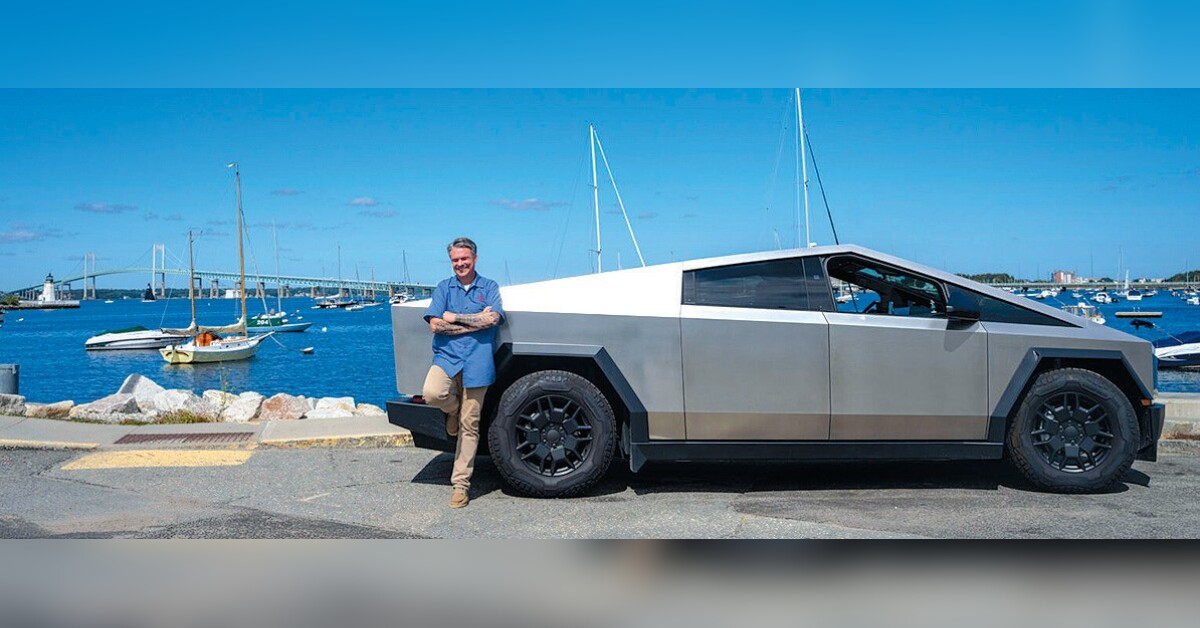

Gresh Laing is shown with his Tesla Cybertruck on the Goat Island Causeway in Newport. The Pell Bridge, across which he commutes each workday, is in the distance. (Photo by Laura Paton/Rhode Island Current)
Gresh Laing’s 2024 Tesla Cybertruck gets plenty of attention on Rhode Island’s roads. Most of it isn’t friendly.
“I get more middle fingers and thumbs-downs and just looks of disdain and hate, having this vehicle drive me around Rhode Island, than I have ever experienced in my entire life,” he said.

The West Virginia native, who served 23 years in the Navy, admits he wasn’t in a rush to buy a Cybertruck when it first hit the market in 2023, saying it looks like “a 6 year old’s drawing of the future.” He wound up buying a pre-owned version after researching EV trucks on the market and quickly came to love the way the Cybertruck drives.
It’s high off the road, packed with safety features, and can self- drive him across the Pell Bridge from his home in North Kingstown to the naval base in Newport where he now helps design training programs for Navy recruits. Laing, 50, also saw the electric truck as a way to help cut emissions, in line with Rhode Island’s lofty climate goals.

Gresh Laing wipes fingerprints from his computer screen before taking a ride in his Tesla Cybertruck through Newport. (Photo by Laura Paton/Rhode Island Current)
Then his E-ZPass account started refreshing more frequently.
“I noticed that it happened twice in one month,” Laing said. “So, I opened up my account to sort of do a forensic analysis of my transponder and saw that it was $4 every time I went across the bridge.”
Rhode Island passenger vehicles with E-Z Passes pay 83 cents to cross the Pell Bridge, a rate the Turnpike and Bridge Authority set when electronic tolling began in 2008. But that discount only applies to vehicles below 8,000 pounds gross vehicle weight.
“Heavier vehicles cause more damage to the bridges so they are not eligible for discounts,” Cara Cromwell, a spokesperson for the Rhode Island Bridge and Turnpike Authority, said in an emailed statement.
Cybertrucks range from 8,199 pounds to 9,169 pounds gross vehicle weight. That heft is partly a product of its battery, explained Christian Roselund, a member of Climate Action Rhode Island’s leadership team.
Roselund said the EV industry has largely settled on two types of lithium-ion batteries: nickel manganese cobalt (NMC) and lithium iron phosphate (LFP). NMC batteries are generally more energy-dense, while LFP batteries, which the Cybertruck uses, have historically required more weight to store the same amount of energy.
But he said LFP batteries are becoming more energy-dense, narrowing that gap with nickel manganese cobalt. For now, though, Roselund said the weight of EV trucks remains a concern for roads and bridges.
“Heavier vehicles disproportionately damage and wear out our roads,” Rosalind said. “Tolling vehicles based upon weight makes sense.”
Laing doesn’t dispute the fact that heavier vehicles wear out roads faster and acknowledges the bridge’s road surface is pocked with patches and rough spots.
But he says it feels backward for a state that’s pushed its residents toward electric cars to continue to charge them extra at the Pell Bridge just because their batteries add more weight, especially since battery-powered EV owners now pay a $200 registration fee as of last year to make up for missing gas tax revenue. Rhode Island’s gas tax is 41 cents per gallon, with proceeds supporting the state’s roads, bridges and mass transit.
“If the state really wants to encourage people to have electric vehicles, then there might be a carveout for the fact that the batteries that operate electric vehicles are heavier,” Laing said.
Over the summer, Laing brought his concerns to his elected officials, who said they would follow up with the Rhode Island Turnpike and Bridge Authority. Rep. Robert Craven, a North Kingstown Democrat who is retiring at the end of the year, said he would like to see the quasi-governmental agency review whether its toll structure makes sense for noncommercial EV trucks.
“He shouldn’t be charged more than you and I for crossing the bridge,” Craven said. “Yes, it probably weighs considerably more, but there are so few of them that this seems to be discriminatory in nature.”
Registration data provided by the Rhode Island Division of Motor Vehicles show 289 electric passenger trucks in the state, of which 24 are Tesla Cybertrucks. Roselund argues there may be a stronger case for exempting electric trucks that are used by tradespeople rather than passenger vehicles such as Laing’s Cybertruck.
Laing says he understands why critics worry about the size and weight of vehicles like his, but safety is the very reason he chose to buy a Cybertruck. It has nine cameras and two artificial intelligence “brains” that constantly scan its surroundings and can handle most of the driving, even detecting when a pedestrian waves it through an intersection.
Laing believes a lot of the anti Cybertruck sentiment has less to do with how the truck performs on the road than with what it looks like and what people think it represents: Tesla CEO Elon Musk’s foray into partisan politics and work with the Trump administration.
But Laing said buyers like him aren’t necessarily thinking about Musk’s politics when they buy one.
“They want a large vehicle that’s capable of towing 11,000 pounds with 3,000 pounds in the bed, and going zero to 60 in 2.9 seconds, and having an autonomous chauffeur,” he said.
Rhode Island Current is part of States Newsroom, the nation’s largest state-focused nonprofit news organization, rhodeislandcurrent.com.