
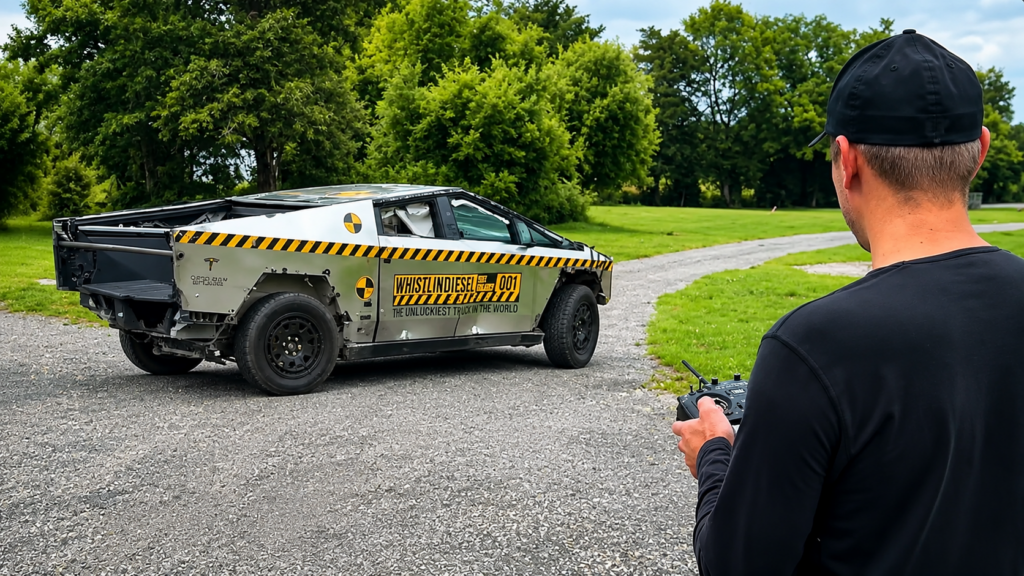
Cody WhistlinDiesel Detwiler spent close to $300,000 and the better part of two years tormenting a Tesla Cybertruck and a Ford F-150 side by side. The finale was exactly what you’d expect from someone who once described handing over a controller as feeling like he’d “gave a chimpanzee an AK-47. Everyone here is in grave danger.”
The capstone stunt required converting the Foundation Series Cybertruck – sticker price $140,000, per the video – into a fully remote-controlled vehicle. Detwiler’s team built the system from scratch over roughly three days using an Arduino-based setup, stepper motors on the steering column, servo actuators on the gas and brake pedals, and a pneumatic dead man’s switch that automatically engages the brakes if the controller loses power or signal. Voltage came straight from the truck’s own mid-voltage battery, which outputs 48V for the steering motor and steps down through onboard transformers for everything else. Detwiler also rigged an FPV camera inside the cab and piloted the truck using goggles – no driver, no seat, just a camera feed and a prayer.
One unexpected wrinkle: the Cybertruck’s interior radar, designed to detect passenger breathing for safety purposes, kept throwing the truck into park when it sensed no one aboard. The fix was as low-tech as the problem was high-tech. They unplugged the module.
The Crash, and What Was Left Afterward
With the RC system dialed in, Detwiler sent the driverless Cybertruck barreling down a drag strip under full acceleration, striking a parked F-150 broadside at a recorded speed of 111 mph. Both trucks were empty. Roughly 30 firefighters were stationed on standby, a measure that proved necessary when the F-150 burst into flames almost instantly upon impact. Detwiler’s own assessment came to: “The F-150 is, like… evaporated. I told you. I said it’s gone. The cab is off the chassis. It’s gone.”
The Cybertruck’s stainless steel exterior held up well on impact, with structural damage confined mainly to the suspension system and wheel spokes. The high-voltage battery pack avoided catching fire despite the severity of the collision – an interesting outcome considering how extensively the frame was deformed on impact. According to IOL Motoring, the forces involved would have been fatal for anyone inside either vehicle, so the structural comparison is more academic than anything else. These weren’t showroom trucks anyway; both had been through nearly two years of deliberate abuse before the cameras rolled on the final stunt.
Detwiler ultimately declared the F-150 the more durable vehicle, even though the Cybertruck appeared to hold up better visually in the crash. The Ford required just a single driveshaft replacement throughout the entire series, whereas the Cybertruck visited Tesla service centers six or seven times and accumulated approximately $53,000 in repair costs while traveling less than 1,000 – albeit hard – miles.
Tesla eventually wrote the vehicle off as a total loss and declined to service it, leaving Detwiler and his crew to carry out the repairs on their own. The Utah desert shoot in Moab ran up roughly $40,000 in setup costs, yet the Cybertruck traveled only about a mile along the trail before its towing module failed. Someone apparently picked it up off the ground and later listed it for sale online.
Detwiler’s verdict on the truck itself was. “I think it’s more of a car. That’s just the best way to describe it. It feels like a beefy Model 3,” he said. He praised the body construction, admitted it dramatically quicker than the Ford, and said the interior was comfortable – his issue was that it doesn’t behave like a work truck. At 111 mph with nobody inside and an F-150 in its path, that distinction stopped mattering pretty quickly.