

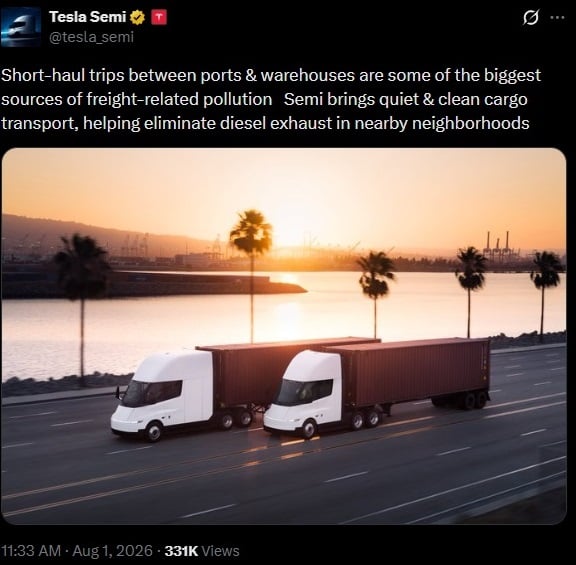
Tesla is finally moving its Semi to production in 2026, with a dedicated plant at Giga Nevada capable of up to 50,000 trucks a year. The spec sheet is impressive. The order book, from WattEV to PepsiCo, is real. And a new post by Tesla Semi just triggered mixed feelings in anyone who covered Toyota’s zero-emissions truck program a decade ago (mostly me alone). You see, the EV truck itself was never the barrier to helping the environment.
Toyota knew this years before Tesla built a single EV Semi. Starting in 2017, I did what I could to cover Toyota’s “shore to store” project at the Port of Los Angeles, where Toyota added ten hydrogen fuel cell EV Class 8 trucks built on a Kenworth platform. That fleet did not exist because of Toyota alone. Toyota partnered with Shell to stand up hydrogen fueling stations in Wilmington and Ontario, brought in UPS and Southern Counties Express as operating partners, and leveraged $41 million in CARB matching funds. The trucks hauled real drayage freight, and they targeted the one duty cycle where zero-emission trucking can make the biggest environmental impact. Short, predictable, return-to-base runs out of a port. The term used by the industry for that is drayage.
A year later, Toyota’s fuel cell semi earned the 2019 Yankee Cup Technology Award at the New England Motor Press Association symposium at MIT, an award I watched presented on the MIT campus. By then, Toyota’s HFCEV zero-emission trucks had been hauling freight in the Los Angeles basin for years. The formula for environmental improvement was already written on the wall: solve the energy delivery, pick the right route, and get the fleets and the fuel supplier to the table. Not rocket science, but the formula was lost on Tesla’s Elon Musk, and nearly every EV fanatic who blindly follows the “Battery-electric vehicles are the one and only solution to all things transportation” mantra.
Watching what Tesla is doing now has me sad. The company is pouring money into a Megacharger network, with dozens of sites planned along major freight corridors, because it learned what Toyota could see more than a decade ago. A semi truck with nowhere to recharge is a very expensive boondoggle. Tesla’s earliest real wins are in the dedicated freight and drayage lanes. The same return-to-base work Toyota initially recognized as the best payoff for the use of chronically limited resources. Whether the energy arrives as electrons from a battery or as electrons from hydrogen passing through a membrane, the playbook is identical. The truck is maybe ten percent of the problem. The network, the duty cycle, and the partnerships are the other ninety.
Advertising
There is a massive missed opportunity here, because these two companies were once close. Back in 2010, Toyota invested $50 million in a still tiny Tesla for roughly a three percent stake, and the same deal handed Tesla the keys to the factory of its future. Tesla acquired the shuttered NUMMI plant in Fremont, the former location of Toyota and General Motors’ joint venture, for about $42 million. That factory became the plant where the Model S was built and later, the Model 3 and Model Y.
Akio Toyoda wanted to help Tesla succeed. He said that after a ride in an EV conversion Lotus (Tesla Roadster) he felt the “wind of the future.” Panasonic was one of Toyota’s partners and decided to come along too. From there, Toyota and Tesla set to work collaborating on the second-generation RAV4 EV’s powertrain, with Tesla supplying much of the EV know-how that made it move.

Tragically for any fan of green vehicles and the environment, the partnerships did not last. The Tesla-powered RAV4 EV ran from 2012 through 2014, teaching Toyota a lot about how EVs worked in the real world of consumer owners. When the RAV4 EV Gen 2 program ended, the relationship between Tesla and Toyota was in a bad place.
Advertising
Watching the unwinding of its partnership, Toyota sold down its Tesla shares from 2014 to 2016, becoming one of the first and only automakers to profit from an EV venture and bowed out. Two companies that had once co-owned Tesla went their separate ways, and they did not part as besties. Toyota continues to move forward globally on all forms of green transportation, including battery-electric vehicles such as the second-generation bZ battery-electric SUV, and the dozens of other EVs it now sells globally, HFCEVs for both private and commercial use, and all forms of hybrid powertrains at a scale that dwarfs any other company today except BYD. Tesla bet everything on BEVs, BEVs, and only BEVs. Elon Musk spent the next decade telling anyone who would listen that Toyota had it wrong. The media sided with Tesla, which now has just two successful models and declining vehicle deliveries.
This 2026 Tesla Semi post is worth pausing on and taking time to think about. Tesla is right that a battery-electric truck can be made to do some things well, and may someday be a viable and profitable business. Or the Semi may well end up like the failed, ultra-low-volume Tesla Models X, S, and Cybertruck. Tiny numbers of six-figure EVs do nothing to help the environment.
The things Tesla is just now discovering – the network, the fueling, the fleet partnerships, the patience – are exactly what Toyota successfully demonstrated at the Port of Los Angeles. Imagine the amazing things that could have come to pass if Tesla had been able to maintain a friendship with the largest and most successful green vehicle transportation manufacturer in human history.
This is a follow-up story inspired by Armen Hareyan’s piece, “Tesla Semi Releases a Corporate Messaging And Says The 2-Mile Drive From The Port To Warehouse Is Worse Than 2,000-Mile Highway.”
About the Author:
John Goreham is a 14-year veteran of Torque News. An accomplished writer and a long-time expert in vehicle testing, Goreham also serves as the Vice President of the New England Motor Press Association and has a growing social media presence. He’s also a 10-year staff writer and community moderator for Car Talk. Goreham holds a B.S. in Mechanical Engineering and an undergraduate Certificate in Marketing. In addition to vehicle and tire content, he offers deep dives into market trends and opinion pieces. You can follow John Goreham on X and TikTok, and connect with him on LinkedIn.
Top of page image courtesy of Tesla, Inc. taken from free use media gallery. Image of the X post courtesy of X and Tesla Semi. Image of RAV4EV charging courtesy of Toyota.
Follow us today…


