
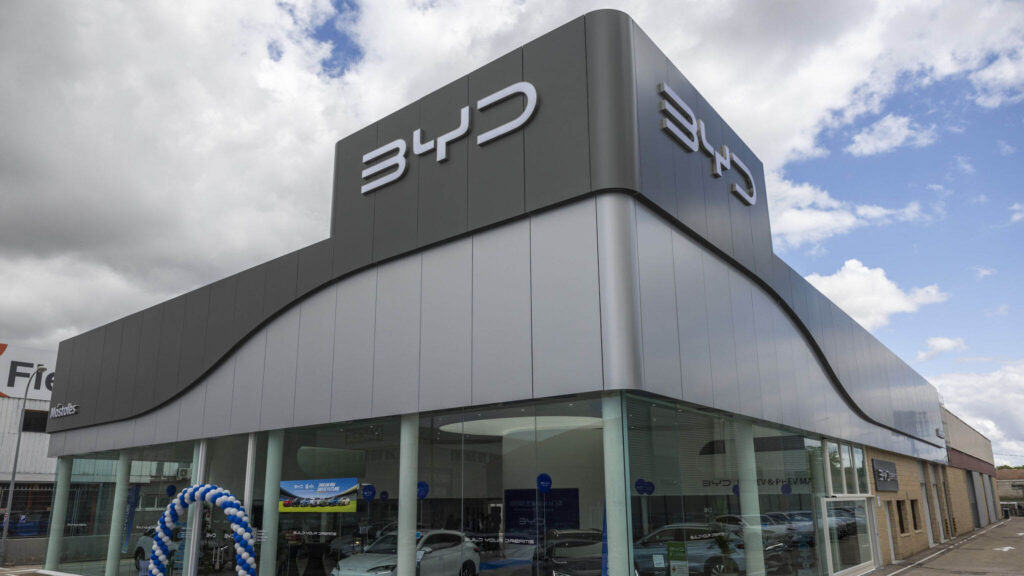
BYD‘s Executive VP Stella Li said on Wednesday that the company will launch the new plug-in hybrid model Dolphin G at the Goodwood Festival of Speed, scheduled to take place in July.
The European launch is scheduled for June.
The model — a B-segment PHEV hatchback designed specifically for European markets — will make its global debut in Berlin in June before crossing the Channel for its UK showing.
Speaking at the Financial Times’ Future of the Car conference in London, Stella Li highlighted that the compact model will be the first it designs for the European markets, noting that “there’s no interest” for it in China.
Last year, BYD followed a similar move in Japan — where it debuted the ‘Racco’ kei car, a much smaller vehicle focused on the Japanese market needs.
“In the future, we have more and more products based on European taste, consumer needs, and then to design for locally here,” she added.
The Dolphin G marks a strategic shift for the Shenzhen-based automaker, which has until now adapted Chinese-market products for European customers.
According to Li, the divergence between what sells in China and what works on European roads has become too large to bridge with a single global product.
“In China, the competition pushes everybody to make the car bigger and bigger. And the chassis is wider and wider. And then it’s become crazy,” the executive stated. “But then in Europe, it’s impossible. You can’t have a bigger car running in Paris, or Milan in Rome, and also in London. People still prefer the smaller-sized car.”
Li described a clear product roadmap emerging from that gap, with BYD now developing separate European-standard vehicles at the B and C segments.
The company’s R&D center in Budapest will play a growing role in that effort over the coming years.
“I saw that in the next three years, a lot of car design will be more based on European design for Europe,” she said. “Don’t look at China. China car to ship to here. We are here with Europe.”
Filling Out the European Lineup
The Dolphin G will arrive alongside the Atto 2 DM-i, a plug-in hybrid sedan that BYD first launched in Europe three months ago.
The model has become a best-seller in Spain, where the Chinese carmaker dominates the plug-in hybrid market.
Li said the two models together will allow BYD to cover the full range of European vehicle segments for the first time.
The lineup expansion comes as BYD‘s European sales continue to accelerate.
The company’s EU registrations rose 169.7% year over year to 50,646 units in the first quarter of 2026, lifting its market share to 1.8%.
Flash Charging
Li devoted a significant portion of her remarks to BYD‘s second-generation flash charging technology, which she positioned as the key to unlocking the remaining internal combustion engine market for electric vehicles.
The system, launched in China on March 5, charges a battery from 10% to 97% in nine minutes under normal conditions — or 12 minutes at minus 30 degrees Celsius.
BYD has committed to deploying 20,000 flash charging stations in China and 6,000 overseas within the next twelve months.
“We make the recharging faster as refueling,” Stella Li stated, adding that these chargers will be “the final barrier for people to jump into the electric car.”
She framed the technology as a market-expansion lever.
In markets like the UK, where EV penetration remains below 30%, BYD has historically been unable to compete for the remaining 70% of buyers who stick with petrol and diesel.
“In the past, BYD only participated. This is like around 52% average, the EV adoption rate,” she said, referring to China. “Then another 48% market will never have a chance to penetrate. But now with the flash charging technology, BYD can now participate in 100% of the market.”
Asked whether the technology could effectively end the internal combustion engine, Li stopped short of declaring victory but said BYD can now compete on equal terms.
“I cannot say [it’s] the cure, but I think it equally can compete with the combustion engine now,” she said.
Manufacturing Push in Europe
Li confirmed that BYD is aggressively expanding its European manufacturing footprint beyond the Hungarian plant in Szeged, where trial production began in January.
“Now it’s very aggressive looking for the second, the third facility in Europe now,” she said. “Our target is we will produce majority products locally here in Europe, for Europe.”
The localization strategy extends beyond final vehicle assembly to component production.
“For us, it’s not only the final assembly. For us, it’s also to produce the components, majority components locally here,” the executive added.
Earlier on Wednesday, Bloomberg reported that BYD is in talks with Stellantis and other European automakers about acquiring underutilized factories across the continent, including in Italy.
When asked whether legacy OEM plants in France or Germany held any appeal, Li said BYD prefers to operate independently.
“With the scope we are, with the craziest investment for future, I think it’s better run by ourselves,” she said. “It’s very hard to partner, to ask permission. We run very fast. We make decisions in five minutes.”
The Chinese giant has been rejecting a business plan that involves a joint venture, either in Europe or in Canada.
Financial Outlook
Li also pushed back on concerns that the prolonged price war in China would erode BYD‘s margins.
The company reported a 55% year-over-year decline in net profit in the first quarter.
“A lot of people are asking me, like in China, price war will kill BYD, your profitability will drop and everything. I said, no,” she noted, describing the margin outlook as “very strong.”
She characterized heavy R&D spending — the company employs 120,000 engineers and files 52 patents per working day — as an investment in securing the next decade of growth.
Stella Li framed BYD as a technology company rather than just a carmaker.
“We are the leader player for battery storage,” she said, as the Chinese carmaker surpassed Tesla for the first time in the segment, “and we’re a leader player for the material science. We’re a leader player for all the software and the intelligent driving.”