
Japanese automotive has hedged its bets on full electrification, and the strategy appears to be paying off. By Stewart Burnett
During its fiscal 2026 earnings call, Mazda confirmed it would cut its electrification investment by 20% to JP¥1.2tr (US$7.6bn) through 2030 and pushing the launch of its first in-house battery-electric vehicle (BEV) back to 2029 at the earliest, having previously delayed the programme from 2027 to 2028 earlier this year. The company has simultaneously lowered its global BEV sales target from 25% of volume to around 15% by the end of the decade, while offsetting this with a significant hybrid expansion.
The new BEV sales target comes out to between around 200,000 and 250,000 units annually. Meanwhile, the automaker will boost its hybrid model lineup from one model to four through 2027, including a hybrid variant of the redesigned CX-5 SUV. Three additional models will be launched between 2028-2030 using a proprietary Skyactiv-Z four-cylinder powertrain. This would suggest that the CX-50 and CX-60 Hybrids—Mazda’s current offerings—are likely among the three set to use the Skyactiv-Z powertrain, otherwise the total number of hybrids in its lineup becomes five.
During the earnings call, Mazda President Masahiro Moro confirmed that the decision was timed to avoid the impairments and write-downs that have burdened rivals including General Motors, Ford, Stellantis, Honda, and others. The latter recently cancelled its Zero series BEV programme entirely; it is simultaneously planning to import its existing China-made Insight series for Japanese consumers.
Indeed, Chinese exports are coming to the fore for Honda. Near-term BEV demand in Europe, Australia, and other markets will be served through models developed with Chinese partner Changan, including the already-released Mazda6e, under what the company describes as a lean-asset strategy. For the year ending March 2027, Mazda forecast net profit of approximately JP¥90bn—up around 160% year-on-year—with net sales rising 12% to JP¥5.5tr and operating profit nearly tripling to JP¥150bn.
That the shift arrives with minimal financial damage is partly a result of how limited Mazda’s BEV commitment had been up until this point. The company sold just 14,526 BEVs in 2025, representing 1.2% of its global volume. Its self-identification as an intentional follower in zero-emission technological development, once interpreted as a strategic liability, is taking on a different quality as competitors absorb the costs of their more aggressive, and expensive, gambles.
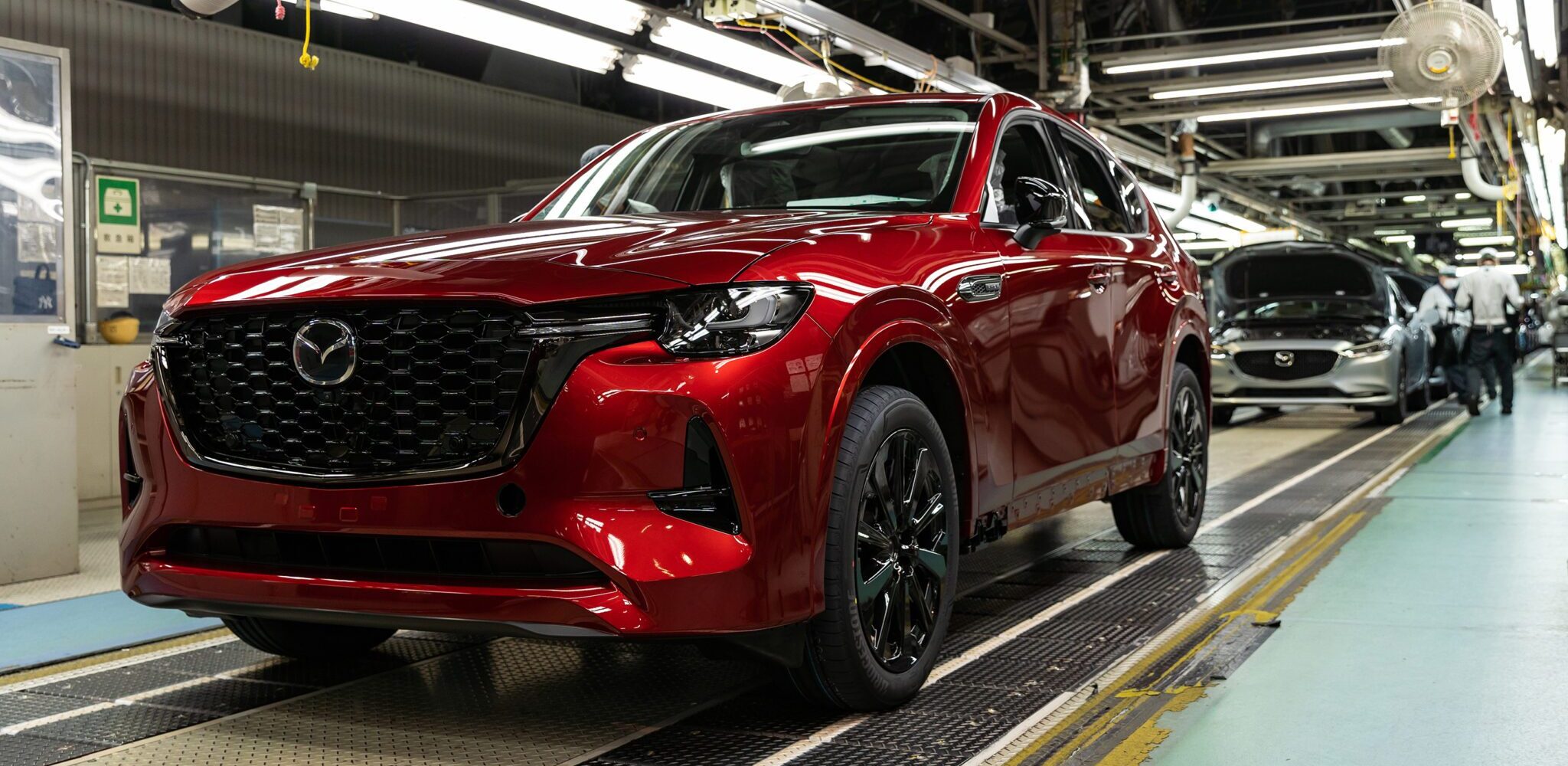 Mazda’s CX-60 SUV hybrid is one of the few electrified options in its existing lineup
Japanese automotive’s broader multi-pathway posture involves a deliberate, and relatively cautious, distribution of investment across hybrid, plug-in hybrid (PHEV), and BEV technology rather than a concentrated push toward full electrification. Widely observed as a laggard on zero-emission technology, even on domestic market share, the strategy is undergoing something of a rehabilitation.
Toyota, Japan’s largest automaker and the world’s best-selling automotive brand, has stuck to its guns on the multi-pathway approach. It took a US$1.2bn hit in 2025 largely attributable to tariff exposure rather than BEV overcapacity, while distributing investments across all powertrains—even hydrogen fuel cells—to ensure its profitability. It recently raised its hybrid and PHEV sales target for 2028 to 6.7 million units annually, 30% higher than its 2026 target.
The global demand picture provides qualified support for that posture. April registrations of BEVs and PHEVs rose 6% Y.o.Y to 1.6 million units globally, according to Benchmark Mineral Intelligence, but the regional breakdown is stark. North American registrations fell 28% to 120,000 units following the elimination of the US$7,500 federal EV tax credit, while US hybrid sales surged 37% over the two months following the outbreak of the Iran conflict in late February, driven by fuel prices peaking above US$4.40 per gallon.
Europe moved in the opposite direction, albeit still in part due to surging pump prices. April BEV registrations up 27% and electrified vehicles—across BEV, hybrid, and PHEV categories—accounting for fully 67.5% of Q1 sales across key markets. The reintroduction of German subsidies also appears to have contributed to an uptick in BEV sales, reaching 25.8% in April 2026 against the 17.5% observed across the first four months of 2025.
For Mazda, with its first in-house BEV deferred to 2029 and its interim BEV supply dependent on Changan-sourced models, the hybrid strategy preserves profitability today at the cost of competitive flexibility in the market where the electrification contest is most advanced.