
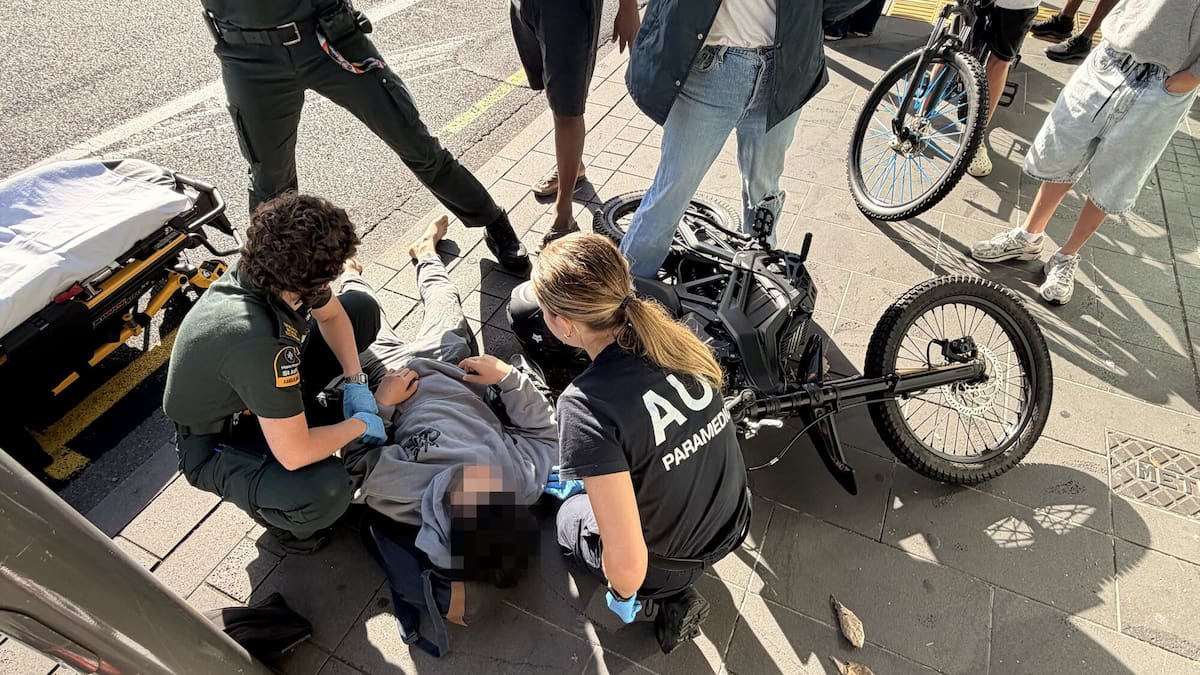
Hato Hone St John confirmed it was notified at 2.15pm of the incident on Broadway, Newmarket. The patient was treated at the scene before being transported to Starship in a moderate condition.
Stu Ross witnessed the electric dirt bike crash and helped keep an injured teenage rider’s airway open until emergency services arrived. Photo / Annaleise Shortland
For Ross, the crash was sudden and shocking. He said he hadn’t heard the near‑silent electric bike approaching and was unaware anyone was in danger until the rider lost control.
“Had his trajectory been slightly different, I or another pedestrian could have been hit and severely injured.”
As a crowd gathered, Ross said he was told the crash occurred when the teenager attempted a wheelie on the road and lost control.
Another bystander accessed the rider’s phone to alert his parents and discovered he was just 14.
The teenager being assisted by ambulance staff. Photo / Stu Ross
The experience left Ross shaken and angry. He was concerned about what he sees as a growing and largely unchecked risk in Auckland’s public spaces.
“These are not e‑scooters. They are not ordinary bicycles,” Ross said.
“Many of these electric dirt bikes are effectively electric motorcycles – capable of serious speed, rapid acceleration and severe injury.”
Ross said he has increasingly seen the bikes ridden on footpaths, through shopping centres, parks and suburban streets, often by minors, with no obvious registration and little protective gear.
“It’s only a matter of time before someone suffers a catastrophic injury,” he said.
‘Confusion’ over rules
Under New Zealand transport rules, only pedal-assisted e-bikes with motors of up to 300 watts are legally treated as bicycles, while e-scooters are classed as low-powered vehicles and are also limited to 300 watts.
Throttle-controlled or higher-powered electric bikes – including electric dirt bikes, which can have power outputs in multiple kilowatts (1000 watts) – are treated more like motor vehicles if used in public, requiring registration and a licensed rider.
Many electric dirt bikes are sold as off-road vehicles that cannot be registered at all, making their use on roads, footpaths or in pedestrian areas illegal.
Retailers say confusion over the rules governing electric vehicles is widespread, with uncertainty extending from customers to parents and even enforcement agencies.
A staff member at Christchurch-based electric motorbike retailer Black Sheep Trading said electric dirt bikes were clearly off-road vehicles not to be used in public areas or roads unless properly registered.
Black Sheep Trading regularly helped customers comply with the rules and was busy making electric bikes road‑legal.
“That’s what we do all day. We build bikes and we take them to VTNZ [Vehicle Testing New Zealand] and we get them compliant,” the staff member said.
Demand for higher‑powered electric bikes had surged, while regulation and understanding had lagged behind, the staffer said.
“The public and the authorities have had an immense time trying to figure out what’s legal and what’s not because of the completely contradictory and just confusing rules and regulations of the NZTA [NZ Transport Agency].”
The word “electric” often led people to assume normal motor‑vehicle rules did not apply.
Electric scooters with a power output higher than 300 watts are widely sold around New Zealand. Photo / Jason Oxenham
He said teenagers would see cyclists, electric skateboard riders and high‑powered scooter users travelling at speed in bike lanes, on roads and on footpaths with little apparent enforcement.
“So in a teenager’s mind, ‘How come all of those people are allowed on the road but I’m not allowed on the road?’
“So a lot of these kids will ride their off-road dirt bike in the bike lane just like every other person on an electric, you know, personal vehicle – whether it be a skateboard, a scooter or an e-bike.
“They’re doing the same speeds but they’re all of a sudden, only recently, found themselves getting chased by police.”
Another retailer, who sells bicycles and e‑scooters but not electric dirt bikes, had seen the power output of electric bikes and scooters grow.
Even standard, pedal-assisted e-bikes were easily exceeding the 300-watt level, he said.
“Those are more like electric motorbikes,” he said.
The retailer said parents were increasingly purchasing powerful electric bikes for children without fully grasping the risks.
“You’ve got 10, 11, 12-year‑olds riding these things,” he said.
“I think there should be regulation – at least an age restriction.”
NZTA said rules regulating electric bikes and scooters were generally understood by retailers, who usually advise customers, but acknowledged rapid changes in the market had created challenges.
Devices exceeding 300 watts fell outside the low‑powered category and concern was growing over the use of higher‑powered electric dirt bikes in public areas, an NZTA spokesperson said.
“Responsibility for compliance ultimately sits with the rider,” they said.
NZTA acknowledged the term “electric” could sometimes be mistakenly associated with being safer or less regulated than petrol‑powered vehicles.
However, safety risk was driven by factors such as speed, weight, power, rider skill and the environments in which vehicles were used, the spokesperson said.
NZTA urged parents to look beyond how electric vehicles are marketed and consider whether a device is legal, appropriate for a child’s age and experience, and suitable for use in public spaces.
“High‑powered electric devices are not toys,” the spokesperson said.
Stu Ross believes education of parents and young people is needed to increase their awareness of the risks high-powered electric bikes and scooters pose. Photo / Annaleise Shortland
The crash left Ross shaken but also determined to speak out before someone is seriously hurt or killed.
He said there needed to be national‑level education to make parents aware of how powerful and quiet electric dirt bikes are, and the risks young, inexperienced riders face.
Responsibility needed to extend to adults buying the bikes and ensuring they were being used appropriately, Ross said.
“I don’t want the next time to be an incident where somebody gets killed.”
Mike Scott has covered stories across New Zealand and internationally for more than 20 years. His work spans writing, photography and video and has won numerous journalism awards.
Sign up to The Daily H, a free newsletter curated by our editors and delivered straight to your inbox every weekday.