
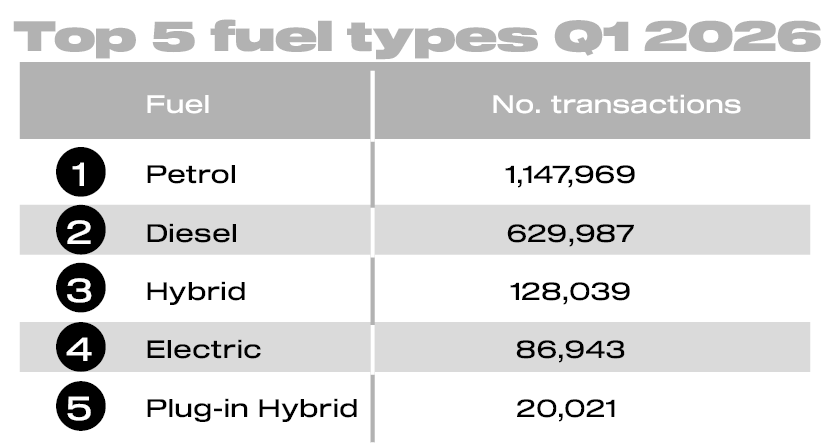
Transactions of battery electric vehicles (BEVs) grew by almost a third (32%) to 86,943 units in Q1, as nearly one-in-23 buyers (4.3%) made the switch, up from around one-in-30 last year.
New figures, published today by the Society of Motor Manufacturers and Traders (SMMT), also show hybrid electric vehicle (HEV) sales rose by 27.6% to 128,039 units, increasing their market share to 6.4%, while plug-in hybrid (PHEV) transactions fell by 8.9% to 20,021 units, comprising 1% of the market.
Combined, electrified vehicles accounted for 11.7% of used cars finding new owners in Q1.
Ensure you always get Fleet News insight. Make us your preferred source on Google
Petrol remained the best-selling fuel type, despite transactions falling by 0.6% to 1,147,969 units, while diesel demand experienced a 6.7% decline to 629,987 units, reflecting reduced supply from the new car market. Even so, conventionally fuelled cars still accounted for 88.2% of total transactions in the first quarter.
Overall used car market flat
Overall, the UK’s used car market was flat during the first quarter of the year, down just 0.2% as 2,016,232 vehicles changed hands.
The performance ended a 12-quarter growth streak, reflecting a subdued March where transactions fell 2.3%. This is in comparison to an exceptionally high performance in March 2025, the only March exceeding 700,000 sales since 2017.
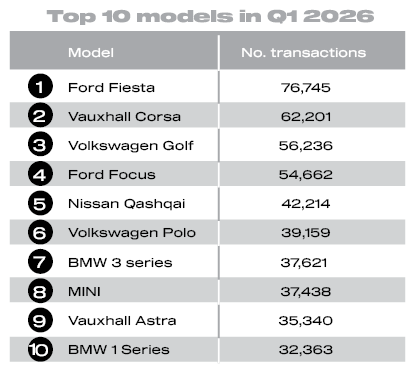
Supermini sales fell by 1%, but at 648,229 units remained the most popular used purchase, accounting for 32.2% of the market.
Lower medium was the next biggest segment, with 546,249 units changing hands, an increase of 0.2% to a 27.1% share.
Dual purpose vehicles saw the highest growth, up 5.4% to 357,295 units, while multipurpose vehicles experienced the sharpest decline, of 6.5%, to 69,886 units.
Best-selling used car colours
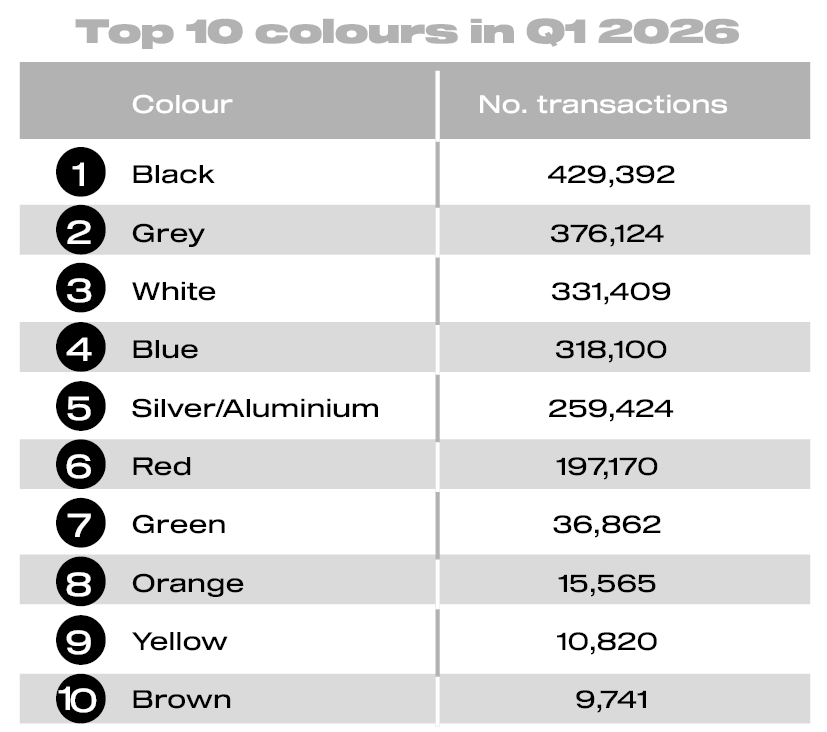
Following the trend in the new car market, black and grey remained the best-selling colours, up 0.4% and 2.8%, with white back in the top three after 3.1% growth to overtake blue.
Cream recorded the strongest growth, up 11.7%, although volumes were small at 1,399 transactions, and pink recorded the steepest decline, down 17.8% to 1,214 units.
Maroon was the least popular, with just 1,108 cars changing hands.
Meanwhile, the average age of the UK vehicle parc now stands at a new high of 9.7 years – up from eight years in 2019.
While the latest industry new car outlook expects the market to rise 3.6% to 2.093 million this year, BEV share has been downgraded to 26.8%, from 28.5%, following an underperforming first quarter.
Mike Hawes, SMMT chief executive, said: “The UK’s used car market remained flat in the first quarter, held back by weakness in March in comparison with a very strong performance in 2025.
“Better news is the record demand for used electric vehicles, as growing choice from manufacturers feeds through into the second-hand market.
“High fuel prices, given the conflict in Iran, may increase demand even further, but to maintain this momentum, every fiscal and policy lever must be pulled to ensure a healthy new car market that delivers zero emission vehicles that can in future flow through to the used market.”
Philip Nothard, insight director at Cox Automotive, believes that, while Q1 2026 transactions again exceeded 2 million, marking only the second such result since 2019, the marginal year‑on‑year decline points to a market beginning to plateau.
“With demand under pressure from broader economic headwinds, sustaining this level of activity may prove challenging without a meaningful improvement in consumer confidence and purchasing power,” he said.
Ian Plummer, Autotrader’s chief customer officer, added: “Despite the broader economic headwinds, the used car market has shown a steady and resilient start to the year.
“Beneath the headline figures, the underlying fundamentals remain strong, with very robust consumer demand and high levels of engagement continuing to underpin activity.
“Pricing is stable, demand is holding firm, and importantly, used cars continue to sell at pace, underlining just how competitive – and supply constrained – the market remains.”
Nick Connor, CEO of the Institute of the Motor Industry (IMI), believes that the data from the SMMT shows Government and industry actions are having the desired effect of increasing EV uptake.
“Now, it is critical that the increase in demand is matched with an acceleration in skills training,” he said. “The latest IMI TechSafe data revealed that only one in four UK technicians are currently qualified to work on electric vehicles, raising concerns about the sector’s readiness to support growing EV adoption.
“However, it’s easy to understand why the sector is not moving at the same pace on skills as EV adoption. Automotive businesses are battling a number of challenges, not least of which there’s still a significant pool of ICE vehicles that must be maintained. So investing in new EV skills can sometimes seem like a future need rather than what’s required today.
“Targeted Government support for training and upskilling is essential to ensure the UK has the capability, confidence and safety standards needed to deliver net zero.
“The IMI continues to work with industry and training providers to expand EV qualifications and support technicians in gaining the skills required for the transition.
“Together, with the right investment in people as well as technology, the UK can lead the way, but skills must be treated as a core part of the infrastructure.”
Matas Buzelis, motoring expert at carVertical, added: “Recent global events have made fuel costs harder to predict, leaving some motorists hesitant to commit. At the same time, there’s a shift in behaviour, with more drivers exploring electric vehicles as a way to reduce running costs. However, many are still taking time before making the switch, especially as home energy costs are expected to rise dramatically over the summer.
“There are some positives, with more used cars coming onto the market following the plate change. But affordability remains a key challenge, and while finance costs have eased slightly, they’re still high enough to make buyers think twice.
“Until fuel prices stabilise and confidence improves, the market is likely to remain cautious, with buyers holding back and negotiating harder when they do decide to purchase.”