
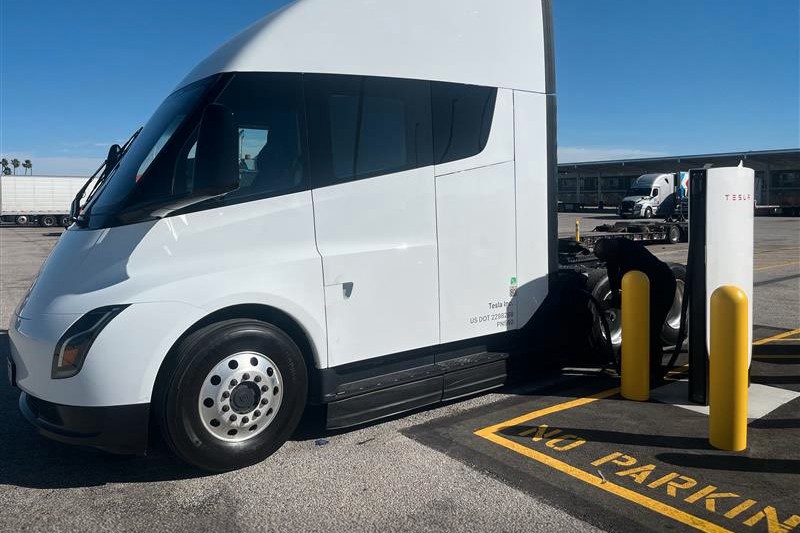
Tesla has officially confirmed the Tesla Semi’s battery capacity after estimates had circulated for some time. The 548 and 822 kWh refer to the battery pack’s rated and usable capacities. Tesla produces both batteries in-house and uses 4680 cells with NCMA chemistry. While Tesla has not officially confirmed it, reports from the US suggest that the Long-Range version houses three battery packs, while the Standard version uses two. Reports also suggest that Tesla equips the longer-range Semi with an extended chassis.
With these confirmed battery specifications, the puzzle surrounding the Semi is now complete. The truck has recently started rolling off the production line in Nevada, and Tesla has simultaneously begun establishing an initially proprietary Megacharger network. Large orders from US customers are also starting to come in.
Whether the advertised 500-mile range (approximately 805 kilometres) is achievable with these batteries remains unclear. When Elon Musk first commented on the Semi’s battery capacity in December 2022, he referred to ‘around 900 kWh.’ Combined with the widely cited energy consumption figure of 1.7 kWh/mile, this roughly matched the claimed 500-mile range. However, the now-confirmed 822 kWh figure no longer supports that calculation. In theory, the battery would deliver 483 miles if the Tesla Semi started fully charged and depleted the battery completely. The production version could, however, prove more efficient than the 1.7 kWh/mile estimate suggests.
The Semi Standard Range, with its 548 kWh battery, correspondingly achieves up to 322 miles, which aligns closely with Tesla’s stated range of ‘around 325 miles’ (approximately 523 km). This version has a tare weight of under 20,000 pounds (around 9.07 tonnes), 3,000 pounds less than the Long-Range version, which weighs 10.43 tonnes. The maximum permissible gross vehicle weight in the US is 82,000 pounds (around 37.2 tonnes) for both versions.
A quick look back: The Tesla Semi has been sporadically seen on US roads for some time. These early units were essentially hand-built on a pilot production line. Most of these pre-production vehicles are believed to be part of Tesla’s own fleet, with an additional 36 units confirmed in PepsiCo’s California fleet. Tesla began producing the first pre-production models of the Semi in the US in October 2022.
Over the following three years, Tesla focused on ‘refining the design, cutting roughly 1,000 lbs from the truck, and building out a dedicated factory adjacent to Gigafactory Nevada in Sparks,’ as Electrek recently reported on the start of series production. In February, the carmaker released the bulk of the final product specifications, confirming two variants: the aforementioned Standard-Range and Long-Range versions. The maximum power output is stated to be 800 kW.
However, the official document from the California Air Resources Board (CARB), from which the exact battery values are now known, lists a maximum power output of only 525 kW for the Standard-Range version. Tesla’s own website, meanwhile, continues to state that both versions can deliver 800 kW. The plan for two powertrain options is not new—what is new is that, according to CARB, the larger battery is only to be combined with the more powerful drivetrain, while the smaller battery is paired with the less powerful one.
Notably, CARB lists the 800 kW and 525 kW figures as both peak and continuous power outputs—highly unusual. Additionally, as mentioned earlier, the ‘usable’ and ‘rated’ battery capacities are stated as identical. This suggests that the figures do not represent the classic gross-net distinction. These discrepancies cannot be fully resolved, but they are worth highlighting.
Regardless, the confirmed battery specifications give the Tesla Semi a significant capacity advantage over all other Class 8 electric trucks currently available in the US. “The Freightliner eCascadia tops out at 550 kWh for just 230 miles of range. The Volvo VNR Electric maxes at 564 kWh for 275 miles. Even the Nikola Tre BEV, which claims 330 miles, can’t match the Semi’s 500-mile Long Range figure,” summarises Electrek.
The economies of scale from mass production are expected to enable Tesla to offer the Semi at prices of $290,000 and $260,000 for the Long-Range and Standard versions, respectively—a highly competitive price range.
arb.ca.gov via insideevs.com, electrek.co