
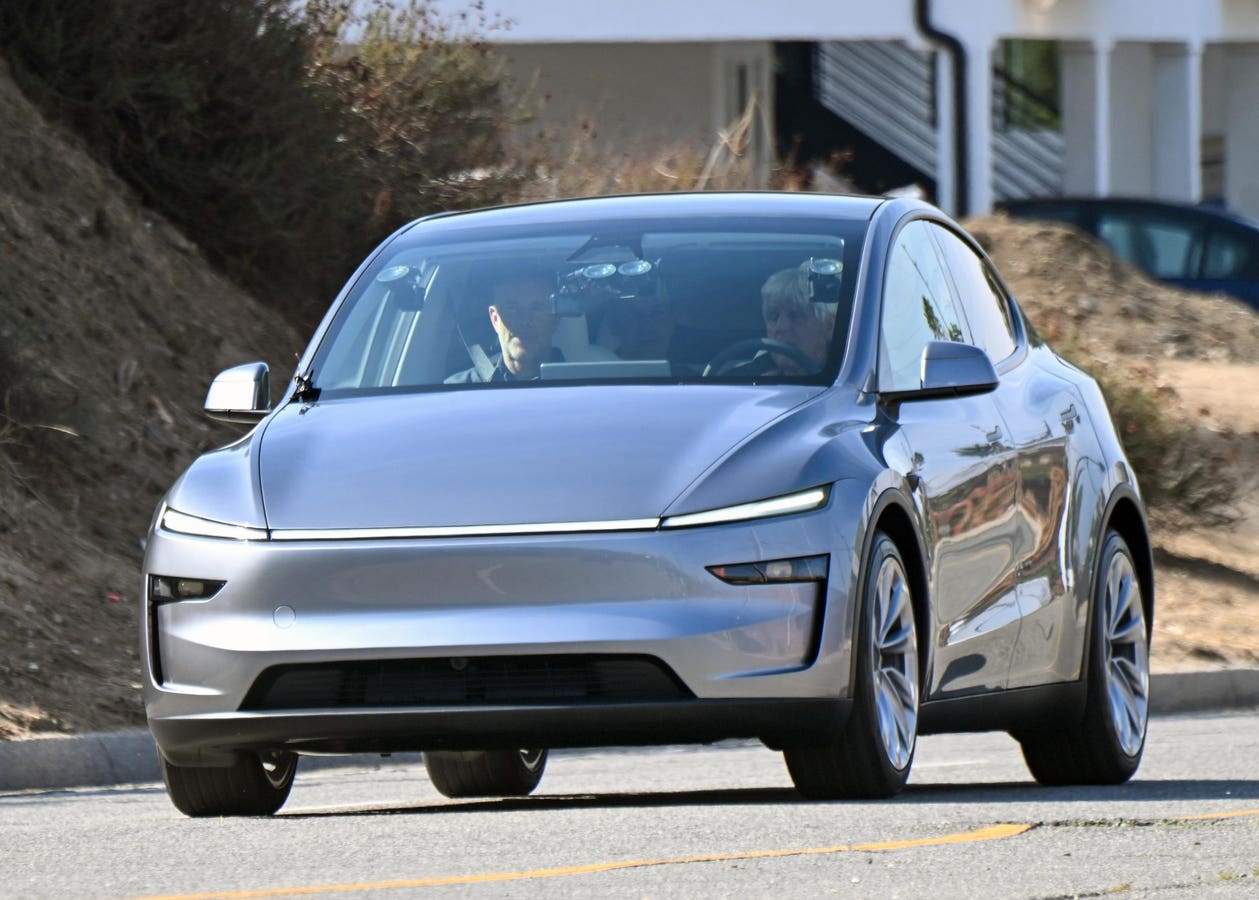
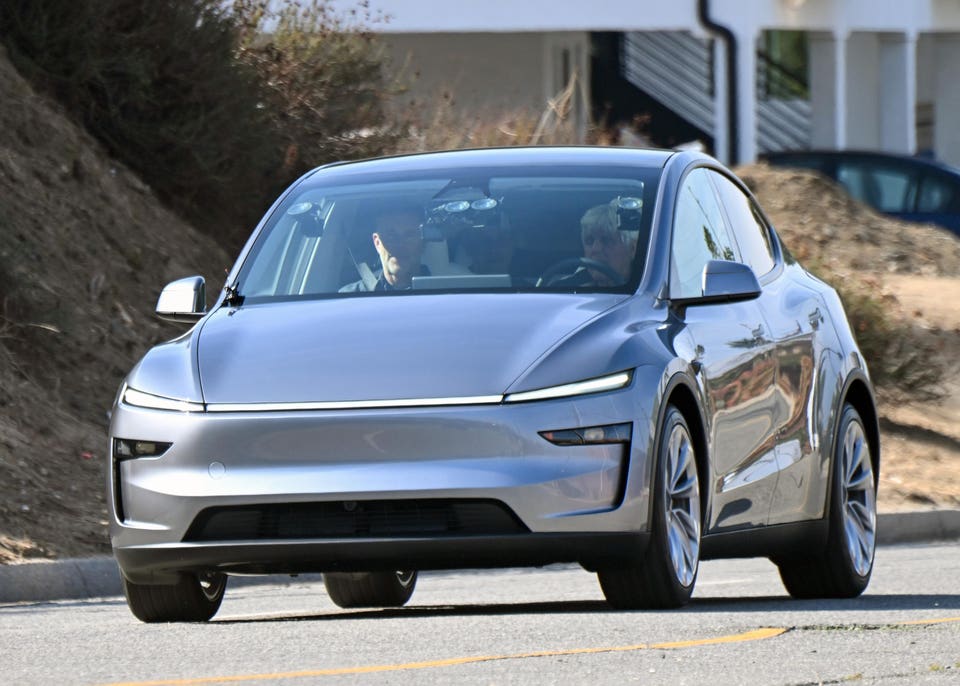
Jay Leno was spotted early in 2025 in new Tesla Model Y while filming for Jay Leno’s Garage in Los Angeles, California. (Photo by MEGA/GC Images)
GC Images
America’s electric vehicle market is no longer a niche experiment populated by quirky eco-cars and expensive luxury sedans. EVs have become fully mainstream, and nowhere is that more evident than in the sales charts. The three best-selling electric vehicles currently on sale in the United States are the Tesla Model Y, Tesla Model 3 and Toyota bZ, a trio that reflects how rapidly the market is evolving. Together, they represent three very different approaches to electrification: Tesla’s software-led dominance, the Model 3’s sporty affordability, and Toyota’s cautious but increasingly successful entry into the EV market.
These strong sales show just how much traction EVs are gaining amongst US buyers, even after the $7500 tax incentive scheme through the Inflation Reduction Act was phased out last September.
Undisputed No 1 seller is the Model Y
The runaway sales leader remains the Tesla Model Y. The compact electric crossover has become not only America’s best-selling EV, but one of the country’s best-selling vehicles overall. During the first quarter of 2026, Tesla sold roughly 78,600 Model Ys in the United States, equating to around 26,000 units per month.
The Model Y’s success is hardly surprising. Americans love SUVs, and the Tesla combines crossover practicality with strong performance, impressive range and access to Tesla’s still-dominant Supercharger network. Buyers can choose between rear-wheel-drive and dual-motor all-wheel-drive configurations, while range varies between 306 miles (Performance spec) to the Premium version’s 327 miles.
The Model 3 is fitted with a full self-driving system. (Photo by Sjoerd van der Wal/Getty Images)
Getty Images
Performance also remains one of the Model Y’s strongest selling points. The high-performance version can accelerate from 0-60 mph in around 3.3 seconds, putting it firmly into supercar territory. Yet it still offers family-friendly practicality with a spacious cabin, generous cargo area and minimalist high-tech interior dominated by Tesla’s 16-inch center touchscreen.
Pricing currently starts at roughly $41,000 and rises to around $55,000 for higher-performance models. That combination of practicality, technology and charging convenience has made the Model Y the benchmark EV crossover in America.
The second-best-selling EV in America is Tesla’s smaller Model 3 sedan. Although SUVs increasingly dominate the U.S. market, the Model 3 continues to attract buyers seeking a sportier and more affordable electric car. Tesla sold approximately 31,700 Model 3s during Q1 2026, or around 10,500 per month.
Like the Model Y, the Model 3 benefits enormously from Tesla’s software ecosystem and charging infrastructure. But its lower price and more agile driving characteristics make it especially appealing to younger buyers and commuters.
The latest Model 3 offers up to 346 miles of EPA-estimated range in AWD dual motor spec, one of the best figures in its class. Buyers can choose rear-wheel-drive or dual-motor all-wheel-drive variants, while the Performance version delivers supercar-like acceleration with a 0-60 mph time under three seconds.
Pricing starts around $38,000 and climbs into the mid-$50,000 range for the most powerful Performance version. The Model 3’s combination of technology, sleek design, performance, quick charging and efficiency continues to make it America’s most popular EV sedan.
One other reason why the two Tesla models are selling so well is due to the brand’s signature 250kW Supercharger network which allows the cars to add over 160 miles added in 15 minutes.
Toyota bZ
Photo courtesy of ToyotaToyota makes ground in EV space with bZ
Perhaps the biggest surprise on the list, however, is the Toyota bZ. Toyota was criticized for moving slowly into the fully electric vehicle market, but the company’s bZ crossover is now gaining significant traction in the US. Toyota sold just over 10,000 bZ models during Q1 2026, or approximately 3,300 per month.
The bZ’s strength lies not in outright performance, but in trust and familiarity. Toyota buyers know the brand for reliability, dealer support and long-term durability, qualities that matter greatly to mainstream consumers considering switching from gasoline over to their first EV.
Available in front-wheel-drive or all-wheel-drive form, the bZ offers between roughly 236 to 314 miles for the entry-level, front-drive bZ model, while the top-spec bZ Woodland AWD version delivers and 282 miles of range depending on specification. The interior emphasizes comfort and practicality with 14-inch touchscreens while Toyota’s extensive safety technology package comes as standard.
Pricing starts at around $34,900, placing it directly against the Tesla Model 3 and Hyundai Ioniq 5.
Together, these three vehicles reveal the direction America’s EV market is heading. Tesla still dominates through technology, charging infrastructure and brand recognition, while Toyota is proving that traditional automakers can still compete by leveraging trust, dealer support and practicality. The result is a rapidly maturing EV market in which electric cars are no longer alternatives to mainstream vehicles.