
The United States electric vehicle (EV) market is entering a transformative decade as consumers, automakers, and policymakers collectively push toward cleaner and more sustainable transportation systems. Once viewed as a niche automotive category, electric vehicles are rapidly becoming a mainstream mobility solution supported by technological innovation, environmental awareness, expanding charging infrastructure, and aggressive government incentives.
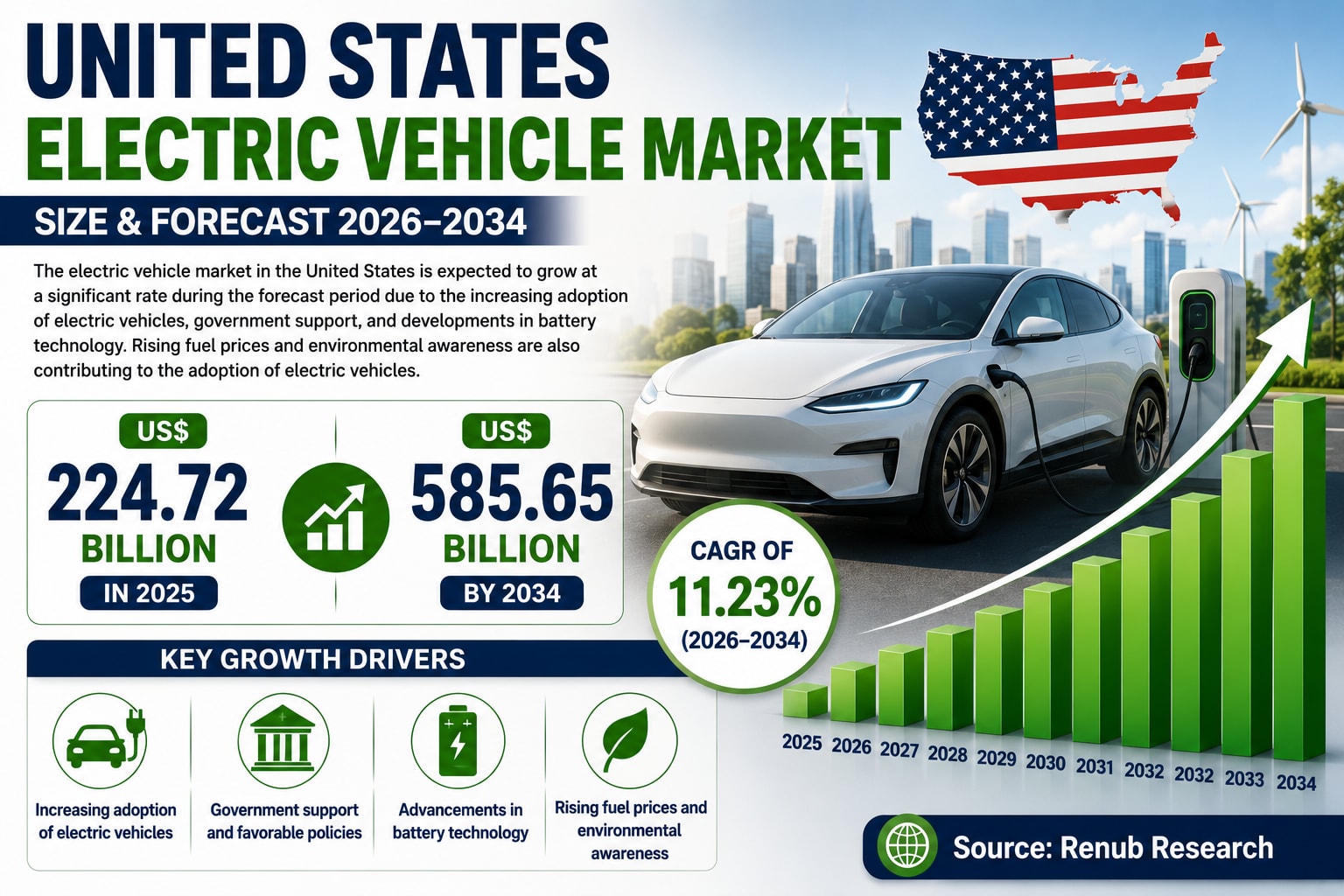
According to Renub Research, the United States electric vehicle market is projected to grow from US$ 224.72 billion in 2025 to US$ 585.65 billion by 2034, registering a robust compound annual growth rate (CAGR) of 11.23% from 2026 to 2034.
The rapid growth of the EV market reflects a major shift in the U.S. automotive landscape. Consumers are increasingly prioritizing fuel efficiency, long-term cost savings, sustainability, and advanced technology features when purchasing vehicles. At the same time, automakers are investing billions of dollars into electric mobility platforms, battery manufacturing, and software-driven vehicle ecosystems.
From passenger cars and SUVs to electric pickup trucks and commercial delivery fleets, electric mobility is steadily reshaping transportation across the United States.
Electric Vehicles Are Becoming Mainstream in America
Electric vehicles are automobiles powered by one or more electric motors using energy stored in rechargeable batteries. Unlike traditional gasoline-powered vehicles that rely on internal combustion engines, EVs operate with little to no tailpipe emissions and significantly lower operating costs.
The market includes several categories of electric vehicles:
Battery Electric Vehicles (BEVs) that operate entirely on electricity
Plug-in Hybrid Electric Vehicles (PHEVs) that combine electric propulsion with internal combustion engines
Hybrid Electric Vehicles (HEVs) that integrate both fuel and electric systems for improved efficiency
Electric vehicles are increasingly popular because they offer quieter operation, lower maintenance costs, improved energy efficiency, and environmental benefits compared with gasoline-powered vehicles.
In the United States, rising fuel prices, growing climate awareness, and expanding charging accessibility are accelerating EV adoption. Consumers are also becoming more interested in advanced automotive technologies such as connected systems, autonomous driving capabilities, and over-the-air software updates, all of which are commonly associated with EV platforms.
Government Incentives Continue to Drive Adoption
One of the strongest growth drivers in the U.S. EV market is government support.
Federal tax credits, state-level rebates, grants, and non-financial incentives such as HOV lane access have significantly lowered the effective cost of EV ownership for many consumers. These programs are designed to accelerate the transition toward cleaner transportation and reduce greenhouse gas emissions.
In addition, stricter emissions regulations and fuel economy standards are encouraging automakers to expand their electric vehicle portfolios. Several U.S. states have announced long-term plans to phase out new gasoline vehicle sales over the coming decades, creating strong momentum for EV adoption.
Infrastructure funding programs are also playing a critical role. The U.S. Department of Transportation and related federal agencies are supporting EV infrastructure development across highways, urban centers, and rural areas.
In 2022, the Joint Office of Energy and Transportation assisted states in developing plans under the National Electric Vehicle Infrastructure (NEVI) Formula Program, helping expand direct-current fast charging corridors nationwide.
Government backing continues to provide confidence for both consumers and manufacturers investing in electric mobility.
Charging Infrastructure Expansion Is Reducing Range Anxiety
The rapid expansion of EV charging infrastructure is another major factor supporting market growth.
One of the earliest concerns surrounding electric vehicles was “range anxiety,” or the fear that drivers would not find charging stations during long trips. However, charging infrastructure in the United States has improved dramatically over the last decade.
Public charging ports have increased more than sixfold, rising from approximately 30,000 in 2016 to nearly 196,000 by January 2025.
Federal and state investments are supporting fast-charging networks along highways, while private companies and automakers are building charging stations in urban centers, workplaces, shopping areas, and residential communities.
Home charging systems are also becoming more accessible, allowing EV owners to conveniently recharge overnight. Workplace charging availability further supports daily commuting needs.
As charging infrastructure becomes more reliable and widespread, consumer confidence in EV ownership continues to increase. This infrastructure ecosystem is critical for supporting long-term market scalability.
Battery Technology Improvements Are Transforming the Industry
Technological innovation remains at the heart of the EV market’s expansion.
Battery technology has improved significantly in recent years, increasing driving range while reducing charging time and production costs. Advances in battery chemistry and energy density are making electric vehicles more competitive with traditional gasoline-powered cars.
Automakers are also improving vehicle software, infotainment systems, driver assistance technologies, and autonomous driving capabilities, making EVs attractive not only for sustainability reasons but also for performance and innovation.
Domestic battery production and EV component manufacturing are becoming increasingly important as the U.S. seeks to reduce dependence on imported supply chains and strengthen industrial competitiveness.
In August 2025, Ford launched a US$ 30,000 electric pickup truck manufactured in America, highlighting how major automakers are targeting more affordable EV segments while expanding domestic production capabilities.
Such developments demonstrate how rapidly EV technology is evolving toward mainstream affordability and broader market penetration.
Battery Electric Vehicles Are Leading Market Growth
Battery Electric Vehicles (BEVs) are emerging as the dominant segment within the U.S. EV market.
Unlike hybrid models, BEVs operate entirely on electricity and produce zero tailpipe emissions. Consumers increasingly prefer BEVs because they offer lower operating costs, simplified mechanical systems, and strong environmental benefits.
Automakers are heavily investing in BEV platforms across multiple categories, including sedans, SUVs, luxury vehicles, and pickup trucks. Improvements in battery range and charging speed are making BEVs increasingly practical for everyday use.
Fast-charging infrastructure growth is also helping eliminate concerns associated with long-distance travel. As carbon reduction goals become more aggressive nationwide, BEVs are expected to remain the leading force driving the EV market forward.
The 151–300 Mile Range Segment Is Becoming the Sweet Spot
Electric vehicles offering a driving range between 151 and 300 miles are among the most popular categories in the United States market.
This range category strikes an attractive balance between affordability, practicality, and performance. Vehicles in this segment are suitable for daily commuting, weekend travel, and medium-distance road trips while avoiding the higher costs associated with ultra-long-range batteries.
Most mid-range electric vehicles currently available fall into this category, making it highly attractive for mainstream consumers. The increasing availability of fast-charging stations further enhances the practicality of these vehicles.
As battery efficiency continues improving, this range segment is expected to remain central to mass-market EV adoption.
Electric Two-Wheelers Are Gaining Momentum
While passenger cars dominate EV discussions, the electric two-wheeler market is also growing steadily in the United States.
Electric scooters, e-bikes, and lightweight urban mobility solutions are becoming increasingly popular due to rising traffic congestion, fuel costs, and demand for sustainable short-distance transportation.
Electric two-wheelers are more affordable than electric cars and are particularly attractive for urban commuting, recreational use, and last-mile delivery services. Government support for urban mobility initiatives is also encouraging adoption.
Advances in lightweight battery systems and charging convenience are expected to further strengthen this market segment in coming years.
Mid-Priced EVs Are Critical for Mass Adoption
The mid-priced EV segment represents one of the most important areas for future growth in the U.S. market.
Middle-class consumers increasingly seek electric vehicles that combine affordability, practical driving range, advanced technology features, and reliable performance. Automakers are responding by expanding their mid-priced electric sedan and SUV offerings.
Declining battery costs, federal incentives, and manufacturing scale improvements are helping make EVs more financially accessible.
Enhanced infotainment systems, advanced driver assistance technologies, and efficient powertrains are also improving the value proposition of mid-priced EVs.
As more affordable EV models enter the market, consumer confidence in electric mobility continues strengthening.
California Remains the Nation’s EV Leader
California remains the largest and most advanced electric vehicle market in the United States.
The state’s aggressive climate policies, zero-emission vehicle mandates, and plans to phase out gasoline-powered vehicle sales have created one of the world’s most mature EV ecosystems.
California benefits from extensive fast-charging infrastructure, strong consumer awareness, and the presence of leading EV manufacturers and technology companies. High fuel prices and traffic congestion also make EV ownership economically attractive.
In May 2024, Amazon deployed 50 heavy-duty electric trucks in Southern California for freight transportation operations as part of broader efforts to decarbonize logistics networks.
California continues serving as a model for EV adoption and infrastructure development nationwide.
New York Is Expanding Urban EV Adoption
New York’s electric vehicle market is growing steadily due to strong state-level climate initiatives and urban mobility needs.
The high population density of New York City makes EVs attractive for ride-sharing services, delivery fleets, and short-distance commuting. Investments in charging stations at apartment complexes, workplaces, and public locations are helping address urban infrastructure challenges.
The state is also expanding EV use in public transportation systems and government fleets as part of broader emissions reduction goals.
Although winter weather conditions can affect battery performance, technological improvements are helping mitigate these concerns.
Washington and Arizona Highlight Regional Growth Opportunities
Washington State’s EV market benefits from strong environmental awareness and access to renewable hydropower resources. Consumers are highly receptive to clean transportation technologies, and cities such as Seattle continue expanding public charging infrastructure.
Arizona represents another rapidly growing EV market driven by population growth, urban development, and increasing charging infrastructure investment in cities like Phoenix and Tucson. The state’s abundant solar resources also support long-term sustainable EV adoption.
These regional markets illustrate how EV adoption is expanding well beyond traditional coastal technology hubs.
Supply Chain Risks and Grid Readiness Remain Challenges
Despite impressive momentum, the U.S. EV industry still faces several major challenges.
The industry depends heavily on critical minerals such as lithium, cobalt, and nickel, which are vulnerable to geopolitical risks and supply chain disruptions. Building domestic mining, processing, and recycling capacity will take significant time and investment.
Grid readiness is another important issue. As EV adoption accelerates, electricity demand will increase substantially, especially during peak charging periods. Grid modernization and renewable energy integration will be necessary to ensure reliable long-term growth.
Affordability also remains a concern for many consumers. Although lifetime operating costs are often lower, EVs still generally carry higher upfront purchase prices compared with gasoline vehicles.
Addressing these challenges will be essential for sustaining rapid market expansion.
Final Thoughts
The United States electric vehicle market is undergoing one of the most significant transformations in automotive history.
Driven by government incentives, charging infrastructure expansion, battery innovation, and changing consumer preferences, EVs are steadily moving into the mainstream transportation market.