
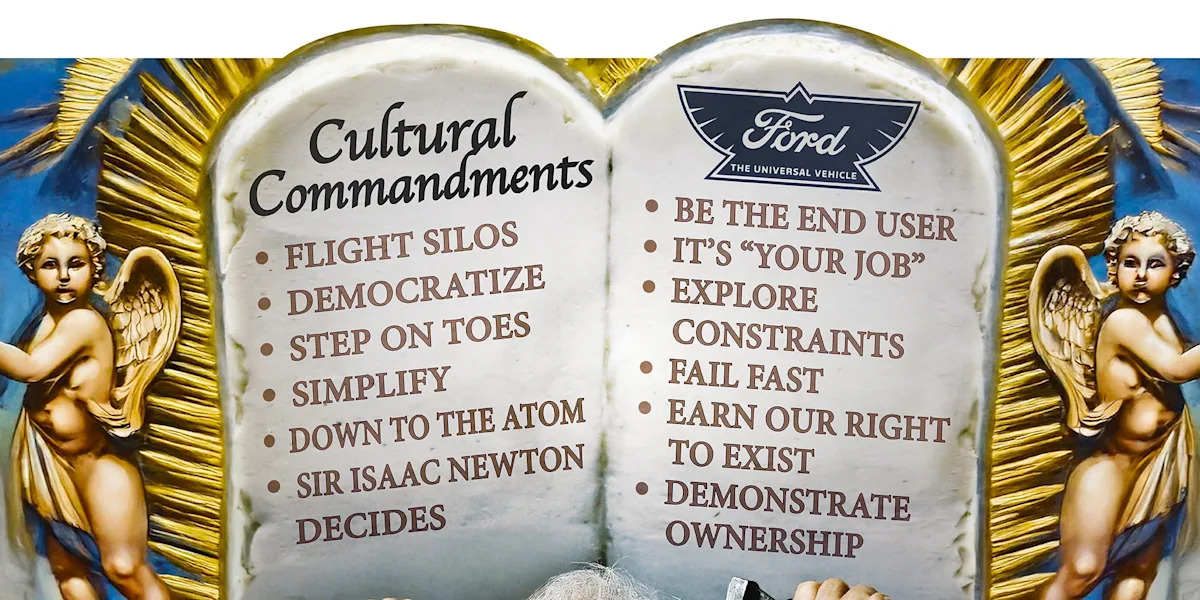
We recently toured Ford’s electric vehicle development center (EVDC), in Long Beach, California, where no journalists had ever been invited before. We were not allowed to bring any cameras into this shiny, new EV center of excellence. Even the cameras on our trusty iPhone needed to be taped over. While we waited for this to happen, we spied a set of 12 “cultural commandments” printed on a poster on a wall in the lobby, next to the coffee machine. Being both nosy and industrious, we copied them down:
Ford EVDC Cultural Commandments:
Alan Clarke, Ford vice president of advanced project development.Ford – MotorTrend
(Ford – MotorTrend)
Per Alan Clarke, who heads up Ford’s EVDC, these 12 commandments are unique to the facility and crafted by his team.
“I have a really smart team, and my founders and I, from day one, we started writing these down, in a way that we could grow them over time. We call them the cultural commandments, and they’re shared on multiple internal web pages. At every all-hands [meeting] we have, we put these on repeat through the whole thing. It’s not a weird chant or anything, but it’s something we expect everyone to have a good understanding of, in terms of how we operate,” said Clarke.

Ford Electric Vehicle Development Center (EVDC) in Long Beach, California.MotorTrend – MotorTrend
(MotorTrend – MotorTrend)
While inflected with the laws of physics, tech speak, and a smattering of corporate team building jargon, EVDC’s commandments were, according to Clarke, also influenced by a different industry from another era, the legendary Lockheed Martin Skunk Works division that built the most badass fighters, bombers, and spy planes the world has ever seen, including the legendary U-2 and SR-71 Blackbird, and later the F-117 Nighthawk, F-22 Raptor, and F-35 Lightning II.

One of the greatest machines the world has ever known, the SR-71 Blackbird.MotorTrend – MotorTrend
(MotorTrend – MotorTrend)Kelly Johnson’s Skunk Works
On the surface level, there are many parallels between Skunk Works and the aspirations of Ford’s universal electric vehicle (UEV) team. Officially titled Advanced Development Program, but known throughout the aviation industry by its cartoon skunk logo, Skunk Works served as Lockheed Martin’s highly classified research and development arm.
According to legend, its elite group of engineers worked in secret and with a high degree of autonomy, free from the red tape and constraints of its parent company, thanks to the iron-fisted leadership of its founder Kelly Johnson and the clever maneuverings of his successor, Ben Rich. Skunk Works is part of the aerospace lore in Southern California, with its original headquarters situated in a series of concrete buildings located next to the Burbank Airport.

Lockheed Martin’s U-2 spy plane was developed for high-altitude overflights of the Soviet Union, and still is in service today.MotorTrend – MotorTrend
(MotorTrend – MotorTrend)
Similarly, EVDC is a dedicated facility for the separate, start-up-like group within Ford, tasked with building the company’s next-generation electric vehicles, on Ford’s new UEV platform. EVDC is also located just outside the Long Beach Airport. Oh, and Clarke’s official title? Vice president of advanced development projects. Sounds like more than just a coincidence, but we’ll refrain from further comparisons between Ford’s new startup and the history-altering, regime-changing, cold-war-busting Skunk Works.
As crisp and clear as EVDC’s 12 commandments may be, until Clarke and his UEV team deliver their first product—a small, all-electric pickup priced at $30,000 and rumored to be named Ranchero—they are but words on a poster, by the coffee machine.
For comparison, here are Kelly Johnson’s 14 rules of Skunk Works, as shared by Lockheed Martin.
Kelly Johnson’s 14 Rules for Skunk Works:
The Skunk Works manager must be delegated practically complete control of the program in all aspects and should report to a division president or higher.
Strong but small project offices must be provided both by the military and industry.
The number of people having any connection with the project must be restricted in an almost vicious manner. Use a small number of good people (10% to 25% of normal systems).
A very simple drawing and drawing release system with great flexibility for making changes must be provided.
There must be a minimum number of reports required, but important work must be recorded thoroughly.
There must be a monthly cost review covering not only what has been spent and committed but also projected costs to completion. Avoid late reporting and surprises.
The contractor must be delegated and must assume more than normal responsibility to get good vendor bids. Commercial bid procedures are often better than military ones.
The inspection system should meet military requirements but push more responsibility to subcontractors and vendors. Avoid duplication of inspection.
The contractor must be delegated authority to test the final product in flight and must test in early stages to maintain design competency.
The specifications for hardware must be agreed upon well in advance. Clearly state any items that will not be complied with and why.
Funding must be timely so the contractor does not need to finance government projects.
There must be mutual trust between the military and contractor, with close daily cooperation to minimize misunderstandings.
Access to the project and personnel must be strictly controlled with appropriate security.
Because teams are small, performance must be rewarded based on contribution, not the number of people supervised.