
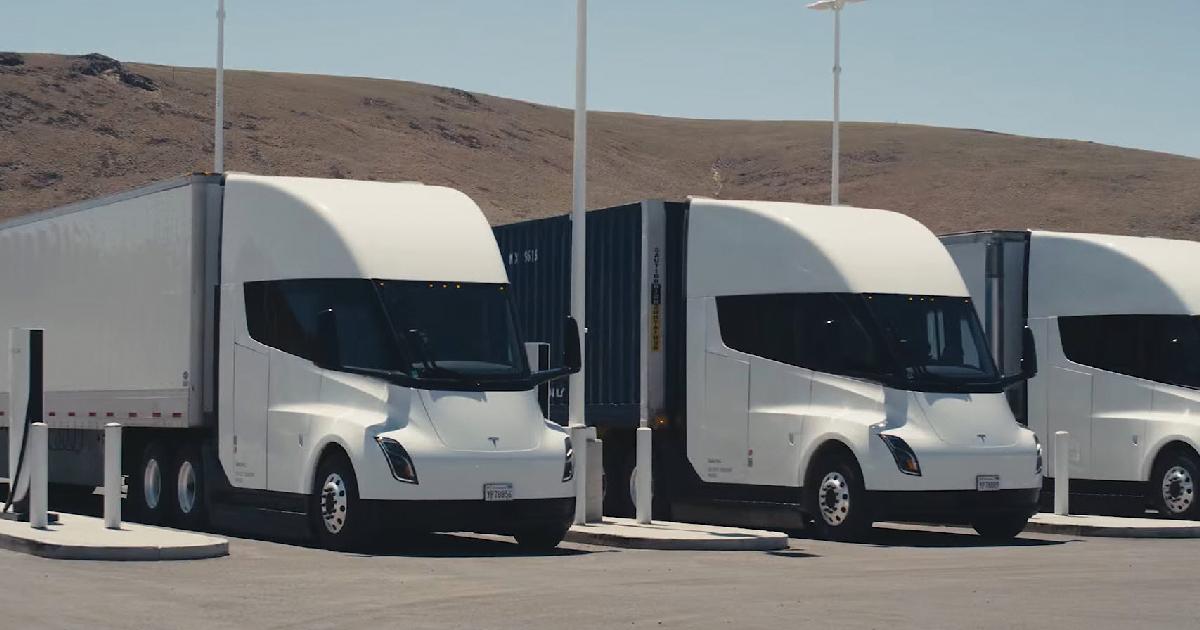
A standard truck will have a range of about 325 miles, while a long-range version’s range will be around 500 miles. (Tesla)
April 30, 2026 2:40 PM, EDT
Key Takeaways:
Tesla said its first Semi rolled off the company’s high-volume production line in Reno, Nev., on April 29.Tesla says the Reno factory can produce up to 50,000 Class 8 battery-electric tractors per year.Tesla previously said Semi volume manufacturing would ramp up in 2026 after the factory finished and production line installation was completed.
The first Tesla Semi rolled off the company’s high-volume production line in Reno, Nev., on April 29, the company announced in a social media post.
Tesla previously said volume manufacturing of the long-awaited Class 8 battery-electric tractor would ramp up in 2026 after construction of the factory finished in October and installation of the production line was completed in the first quarter of 2026.
Site work started in 2023 at the facility next to Tesla’s existing Gigafactory Nevada.
Tesla first unveiled the Semi in 2017. At the time, the company slated it for a 2019 production launch.
The Semi factory in Reno can produce up to 50,000 vehicles per year, according to Tesla.
First Semi off high volume line pic.twitter.com/fI1AdQrJFH
— Tesla Semi (@tesla_semi) April 29, 2026
On Feb. 8, Tesla CEO Elon Musk wrote on the social media platform X that “Tesla Semi starts high volume production this year.”
Also in February, the world’s most valuable automaker promised to offer two versions of the tractor — standard and long-range options.
Details on the options available to customers interested in the truck were closely held until Tesla publicly released specifications for the tractor Feb. 8.
A standard truck will have a range of about 325 miles, while a long-range version’s range will be around 500 miles.
The standard option has a curb weight of less than 20,000 pounds, while the long-range option tips the scales at 23,000 pounds. Each has a powertrain comprising three independent motors on rear axles and drive power of up to 800 kilowatts. Both can charge up to 60% of their range in 30 minutes and achieving energy consumption of 1.7 kilowatt-hours per mile.
A view from the cab of a Tesla Semi on display outside TMC’s 2026 Annual Meeting in Nashville, Tenn. (Seth Clevenger/Transport Topics)
The lower an energy consumption rating, the greater the potential returns a carrier could wring out of a battery-electric truck, proponents say.
Fleets including ArcBest, DHL Supply Chain and PepsiCo have been testing the Semi in their operations.
ArcBest ranks No. 13 on the Transport Topics Top 100 list of the largest for-hire carriers in North America. DHL Supply Chain (North America) ranks No. 12 on the TT Top 100 list of the largest logistics companies in North America. PepsiCo was Tesla’s first test partner and ranks No. 2 on the TT Top 100 list of the largest private carriers in North America.
Earlier in April, the International Council on Clean Transportation published a report on Class 8 battery-electric truck appetite in California, noting that the median price for a long-range Tesla Semi was $290,000.
For comparison, the ICCT research found the median price of alternative Class 8 battery-electric tractors available under California’s Clean Truck & Bus Voucher incentive program was between $428,000 and $514,000.