
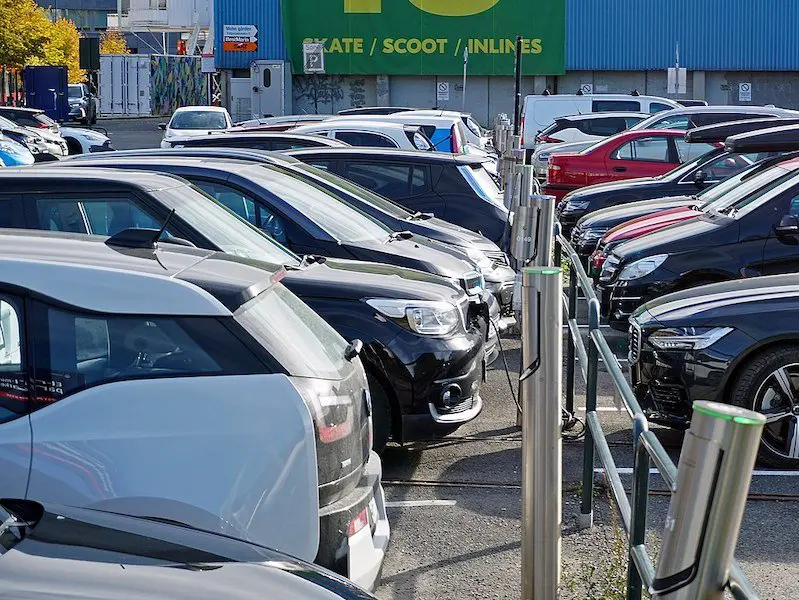
As domestic sales of electric vehicles rev up across Europe and Asia, juiced in part by high gasoline prices, car manufacturers are scrambling for traction in a still uncertain market. Many are pursuing collaborations with China as it continues to dominate global EV supply chains.
Throughout it all, speculation abounds that an EV tipping point approaches.
New battery-electric vehicle (BEV) registrations in Europe took off in the first quarter of 2026, rising by nearly 30% from a year ago, as the U.S.-Israel war in Iran spiked gas pump prices to levels not seen in years, reports Reuters. BEV registrations (a proxy for sales) jumped more than 50% in March alone.
Pedal to the Metal on EV Sales
Estimates are that more than 21% of all new cars registered in March in the EU and EFTA (the European Free Trade Association, whose member countries are Iceland, Liechtenstein, Norway, and Switzerland) were electric.
Meanwhile, the UK’s BEV market grew 12.8% in the first three months of 2026, with BEVs accounting for 22.5% of new car sales.
While high gas prices have been a major driver of BEV sales, new—and pre-existing—policy supports also played a role.
“Generous government incentives” spurred the 50% year-on-year uptake of EVs in France, reports the Guardian.
That Nordic countries continue to outstrip their southern neighbours in BEV uptake—98% of all new cars sold in Norway in March were BEVs, “followed by Denmark at 76% and Finland at almost 50%”—owes in part to “higher wages, generous subsidies, and extensive [public] charging infrastructure.”
Gas pump prices appear to be behind Italy’s full-throttle acceleration into the EV market, with that country experiencing a 65% year-on-year increase in EV sales in March.
Gas price concerns are also fueling EV demand across Asia, with Japan—or rather, Toyota—offering a case in point. Toyota sold almost 3,500 EVs in March, “an increase of 4,117%” over the same month last year, writes Electrek.
EV Tipping Point Ahead
“Rapid innovation, decline in cost and a rise in popularity” are all driving EV sales towards a tipping point “where uptake becomes self-propelling,” and EVs “irreversibly replace internal combustion engine vehicles,” write the authors of a study published in early December in Nature Communications.
A combined effort by researchers from the University of Exeter, the University of Macao, and the World Bank, the study found that even as the sale of gas-fueled vehicles began to decline in 2019 (the study period ran 2016-2023), EV + hybrid sales increased exponentially, with the global fleet doubling every 1.5 years. Sales in the EU doubled every 1.3 years, while China saw EV + hybrid sales double every year.
“Our data and analysis provide evidence that several European markets and China have begun tipping towards EV dominance, although this is not convincingly the case for the U.S.,” the research team writes.
But a degree of uncertainty about the timing of the shift remains, even for strong EV markets.
“Once investment is sunk into converting production lines, a return to [internal combustion vehicles] becomes comparatively expensive, irrespective of the oil price,” they write. The “imposition of new tariffs” remains the wildcard, they warn.
All Eyes on China
Your average EV battery contains four basic components: the cathode (some combination of metals, often including lithium), the anode (typically graphite), the separator that keeps cathode and anode from touching explosively, and an electrolyte solution. As Bloomberg explains , China corners the market on all four.
It is also leading the charge on battery innovation. China’s latest iteration of its lithium ion phosphate battery now rivals its far more expensive kin, the nickel manganese cobalt battery, in energy density. According to its makers, the lithium ion phosphate battery can recharge “in about the same amount of time as it takes to refuel a gas car.”
China’s battery innovations extend far beyond improving the lithium ion phosphate one, however.
Chinese battery manufacturing giant CATL has just made public “six stunning new battery technology innovations, including an electric vehicle battery with driving range of up to 1,500 kilometres and the third generation of its Shenxing Superfast Charging Battery that it says can charge from 10% to 90% in six minutes and 27 seconds,” reports Zecar.
And China’s pre-eminence doesn’t end with batteries: Momenta (autonomous driving), Huawei (super-rapid charging EV systems, among other things), and Alibaba (“intelligent cockpits”) are all headquartered there.
Meet the 2026/2027 BMW iX3
Western automakers have lost huge amounts of ground in China as new domestic high–flyers like BYD seize market share. Western brands like BMW and VW held just 32% of the market this year, down from 64% in 2020, reports the Financial Times.
BMW is among those seeking to regain traction in the huge Chinese market, and it is doing so through direct collaboration with its hosts.
Enter its BMW iX3, an electric sport-utility vehicle equipped with a CATL battery and the latest technology from Momenta, Huawei, and Alibaba.
While Germany’s second-largest auto manufacturer intends to sell the iX3 abroad, it is also laser-focused on the domestic Chinese market.
“Developed ‘in China, for China, and with China,’” the iX3 “has been deeply localized for China,” BMW states in a January release.
“Tailored to local traffic conditions and usage scenarios, the system is designed to deliver highly capable driver-assistance functions optimized for complex urban environments, highways, and long-distance travel in China, further enhancing safety, comfort, and driving confidence,” the car manufacturer adds.
Volkswagen—Germany’s largest car manufacturer—is also looking to collaborate with China. VW “plans to launch 50 plug-in hybrid and EV models in China by the end of the decade to rejig its petrol-heavy lineup with vehicles designed and engineered locally as part of its ‘in China for China’ strategy,” reports the Financial Times.