
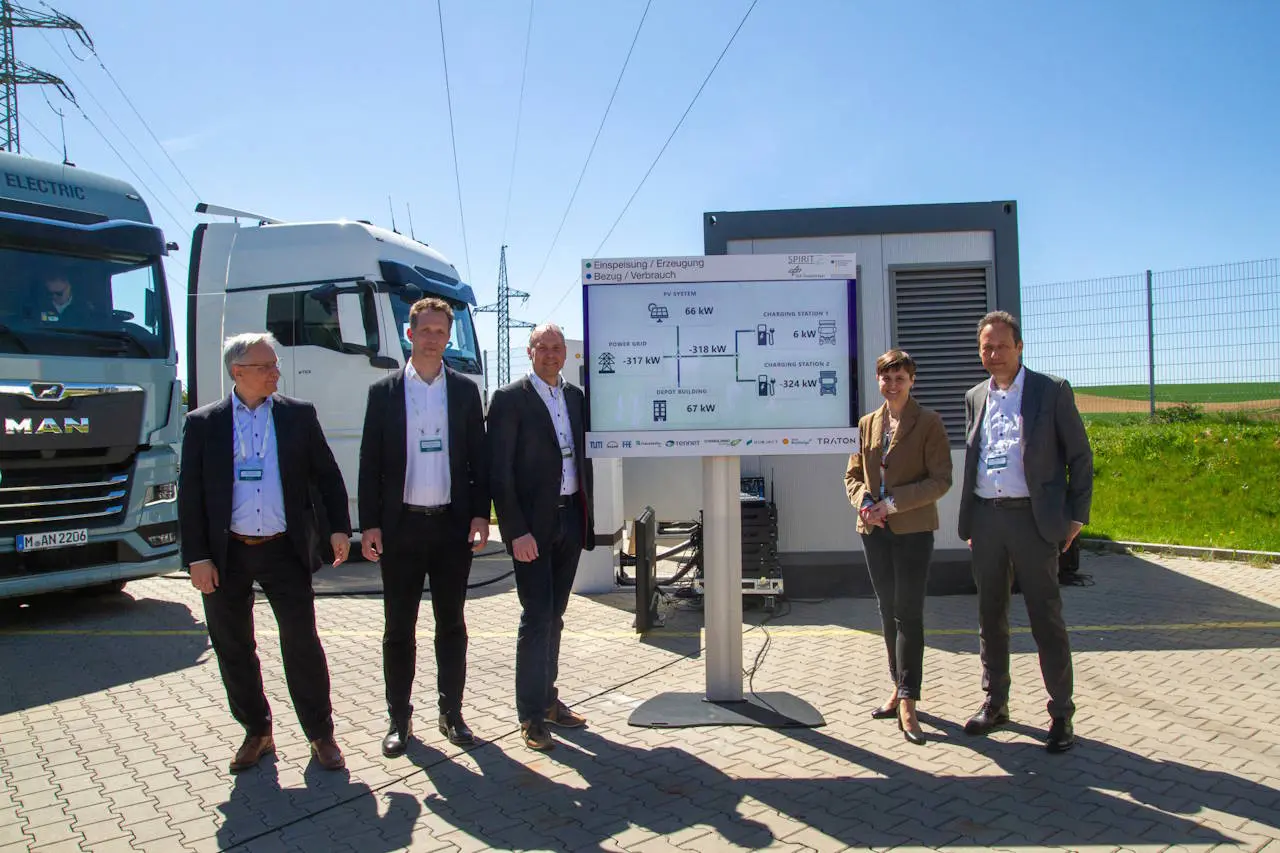
German commercial vehicle manufacturer Man Trucks has demonstrated bidirectional charging under real-world conditions on an electric truck, becoming the first European commercial vehicle manufacturer to do so.
The Man demonstration featured one of its eTGX heavy-duty battery-electric trucks, which has a 480 kilowatt-hours (kWh) battery, and the company says it can be used for vehicle-to-site (V2S), Vehicle-to-Vehicle (V2V) as well as Vehicle-to-Grid (V2G) applications.
According to MAN, applications for trucks with bidirectional charging include vehicle-to-site (V2S) and Vehicle-to-Vehicle (V2V) as well as Vehicle-to-Grid (V2G).
The first two applications could see trucks supply electricity to their company’s own facilities, or other vehicles – to avoid peak loads, increase self-consumption of solar PV electricity, or even support building infrastructure. The V2G option would see electric trucks feed electricity back into the grid, essentially turning them into what MAN describes as “flexible energy storage systems”.
“Bidirectional charging is transforming the role of the electric truck,” said Georg Grüneißl, head of product strategy at Man Truck and Bus.
“Our eTrucks effectively become power banks on wheels that can help lower energy costs while strengthening the energy system as a whole.”
Man says that electric trucks with bidirectional charging could save companies around 10 to 20 per cent on electricity costs when used in either V2S or V2V scenarios, contributing significantly to improving a vehicle’s total cost of ownership, especially when compared to comparable diesel models.
But it is the larger role of V2G that could significantly alter the landscape for truck operators, creating an additional revenue stream for feeding electricity back into the grid during periods of high electricity prices or demand and to support grid stability.
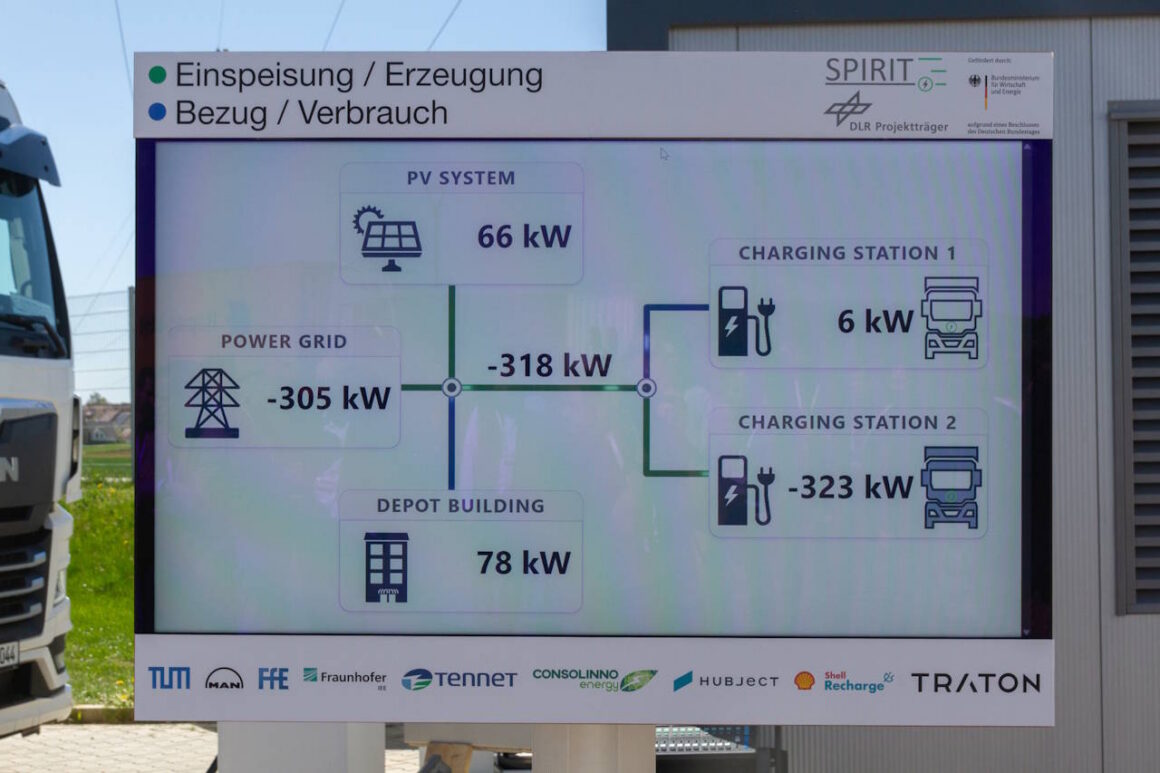 Image Credit: MAN Truck & Bus
The demonstration is the first time a commercial vehicle manufacturer has functionally demonstrated bidirectional charging technology within a research project.
The Spirit-E project, launched in 2024, is funded by the German government and is led by the Technical University of Munich (TU München) in partnership with MAN Truck & Bus, the Research Centre for Energy Economics (FfE), SBRS, the Fraunhofer Institute IEE, Hubject, Consolinno Energy, and TenneT.

Joshua S. Hill is a Melbourne-based journalist who has been writing about climate change, clean technology, and electric vehicles for over 15 years. He has been reporting on electric vehicles and clean technologies for Renew Economy and The Driven since 2012. His preferred mode of transport is his feet.