
 Joy in the Twisties
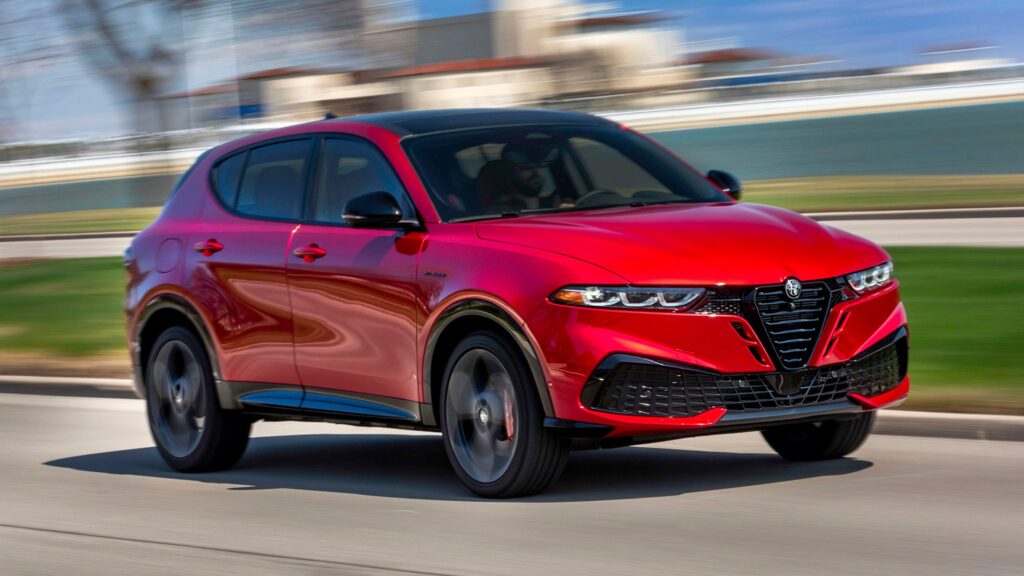
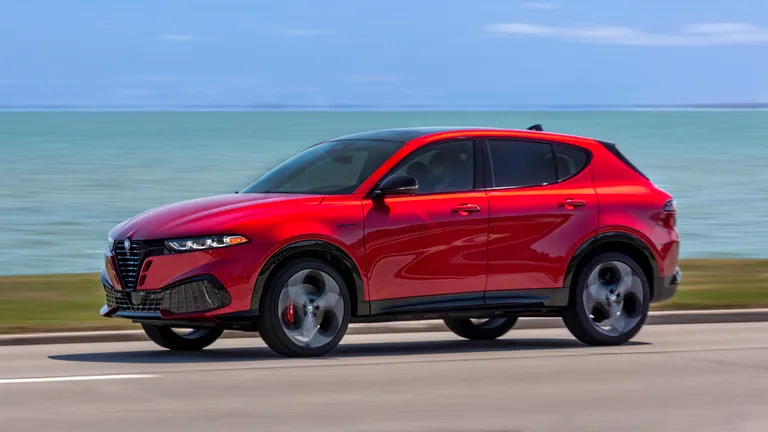
Here again, the Alfa’s skidpad and figure-eight performance runs just behind the BMW/Mini contingent and ahead of its other higher-ranked competition. Braking is a slightly different story, where the Tonale’s 134-foot stop from 60 mph underperformed pretty much the entire competitive set (by between 12 and 35 feet). That one’s a bit of a head-scratcher, given that the Michelin Pilot Sport All Season 4 tires muster class-competitive handling-g numbers, though the test team noted some unusual yaw during the braking test that largely self-corrected. They attributed it to the short wheelbase (it’s 0.7–2.6 inches shorter than all but the Lexus), and heavy weight transfer forward could account for the yawing and for the rear brakes not contributing fully.
The Tonale telegraphs its eagerness through its low 13.6:1 steering ratio, which only takes 2.3 turns to get from lock to lock. That number is lower than that of its competition, and the variable ratio remains faster just off center. So it presents as eager, by comparison with whatever other car you most likely just climbed out of. Of course, it’s still electrically assisted, and this is a front-heavy transverse front-drive-biased car (as are all of the stated competitors), so there’s not a ton of road feel, and there’s a strong inclination toward understeer.
 An Alfa 4C Wagon?
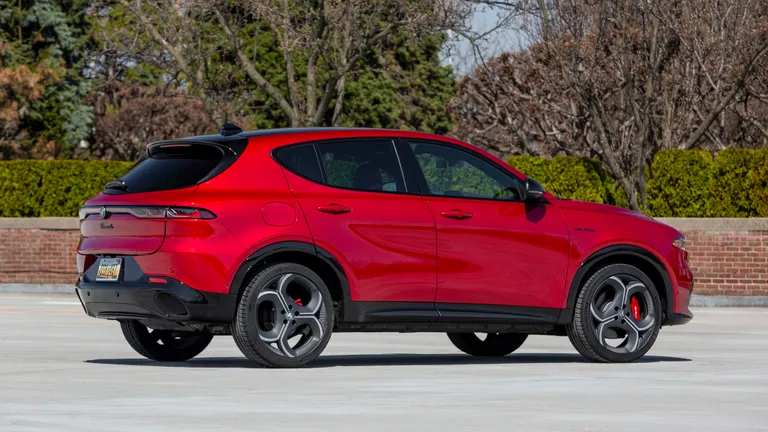
Our test team could feel a heritage link back to the Alfa Romeo 4C two-seater in the Tonale’s heavy steering, its extra firm brake pedal, and its snorty-sounding four-banger. You also see it in the giant, glorious aluminum shift paddles. All of this serves to distinguish the Alfa from its European and Japanese competition. But, they noted, this illusion fades when you push the Tonale hard.
ADVERTISEMENT – CONTINUE READING BELOW
Body roll isn’t particularly well controlled, and the handling balance is nothing special. A BMW is much more responsive to throttle inputs and trail braking. That makes sense when you consider the Tonale’s front-heavy underpinnings. It’s easy to imagine this could be a really special vehicle if it rode on a proper longitudinal-engine architecture with rear-biased torque distribution. Giulia/Stelvio dynamics with Tonale theatrics would be a real mini-ute banger. Instead, we got a loud and stiff car that somehow lacks the true dynamic payoff.