
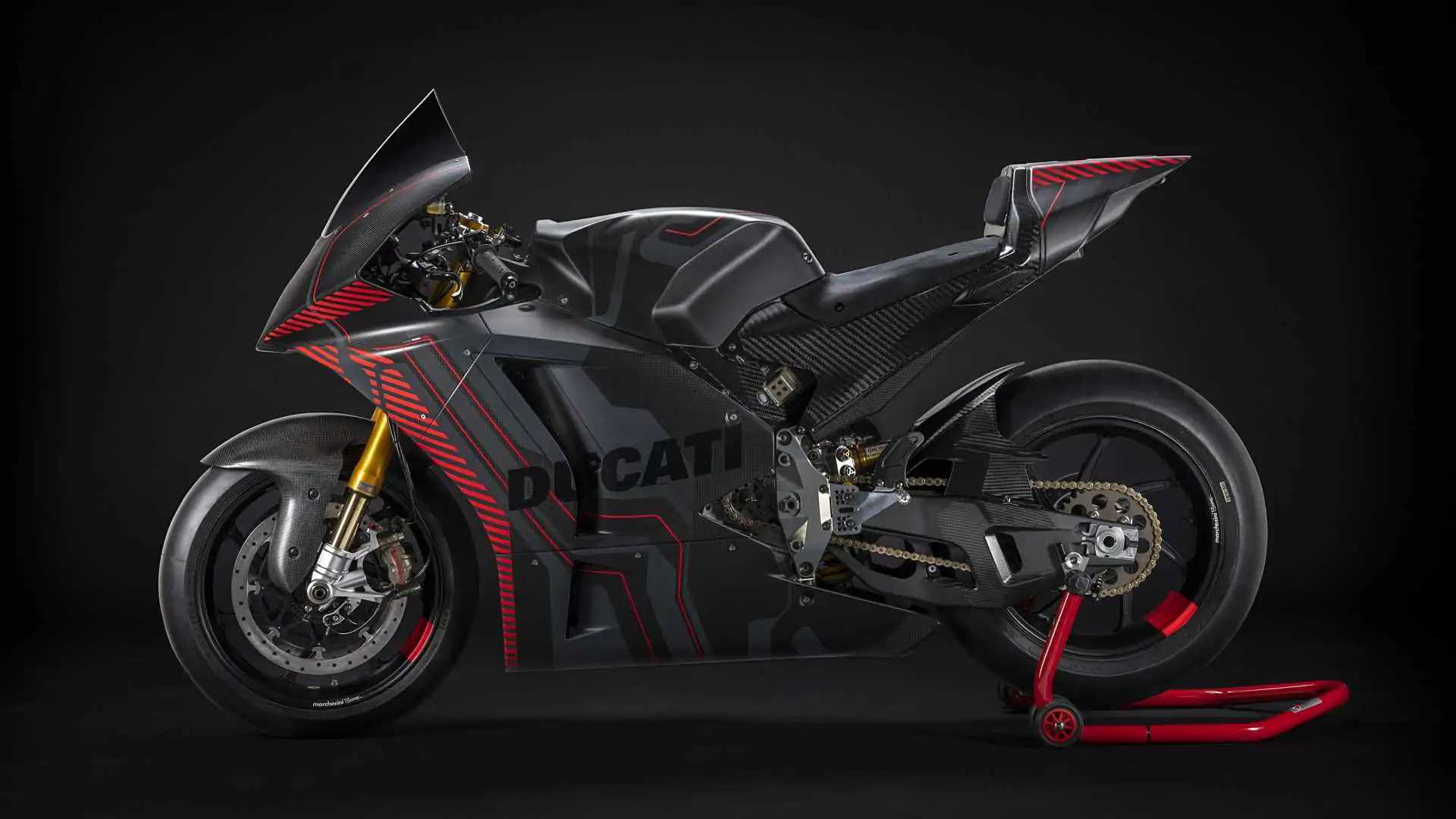
Ducati just filed a new patent for an electric motorcycle drivetrain. It looks technical at first glance, but once you dig in, it actually answers one big question everyone’s been asking: Is Ducati finally getting serious about a street-focused electric motorcycle?
Because when you dig into that patent, you’ll realize right away that this isn’t some half-hearted commuter setup developed just so Ducati could say it has an electric street bike. The layout shows a transversely mounted electric motor spinning at up to around 18,500 rpm, feeding into a proper multi-stage gear reduction before sending power through a chain to the rear wheel. That alone already tells you what kind of bike this wants to be. It’s an electric motorcycle that’s trying to behave like an internal combustion one.
And that’s where things get seriously interesting.
One of the biggest problems with electric motorcycles is packaging. Batteries are big, motors are chunky, and before you know it, the bike ends up wider than it should be. That kills lean angle, ruins ergonomics, and makes the whole thing feel off compared to an internal combustion bike. Ducati clearly knows this, because the entire patent revolves around fixing that exact issue.

While not a direct answer to whether or not Ducati is making a street EV motorcycle, the patent is proof that it’s refining its EV tech even further.
Photo by: Ducati
Instead of bulking up the motor with additional hardware, they move one of the most critical components somewhere else entirely. You see, electric motors rely on position sensors to know exactly where the rotor is at any given moment. That’s how the system controls torque delivery, efficiency, and overall smoothness using techniques like field-oriented control. Normally, that sensor sits directly on the motor shaft. Simple, accurate, but it adds width. And Ducati really does not want width.
So they do something clever. They take that sensor and mount it on the transmission instead. Specifically, on one of the gearbox shafts downstream of the motor.
Now instead of directly reading the rotor, the system reads a gear and calculates rotor position based on the known gear ratios. It’s indirect, which sounds like a compromise, but it solves the packaging problem in a big way. The motor can stay tight and compact, the bike stays slim, and the overall proportions stay closer to what you’d expect from a Ducati.
By repositioning the sensor (15) to a gear in the transmisson, the motor housing can be much slimmer.
Photo by: Ducati
Of course, this isn’t a free win. Reading position through the gearbox introduces potential error. Gear lash, tolerances, and mechanical play all come into the equation. That’s not ideal when you’re trying to precisely control torque at thousands of rpm. But if there’s one company that’s comfortable trading mechanical simplicity for performance and software complexity, it’s Ducati. They’ll just engineer around it.
There’s more going on here, too. The gearbox itself is designed to stay compact by stacking gears across multiple planes instead of spreading them out in a single wide layer. In simple terms, they’re building the transmission taller instead of wider. Again, everything points back to one goal. Keep the bike narrow.
Put all of this together and the direction becomes pretty clear. Ducati isn’t experimenting with weird EV layouts. They’re doubling down on familiar ones. Mid-mounted motor. Gear reduction. Chain final drive. Tight chassis packaging. This is the same recipe they’ve used for decades, just electrified.
Ducati’s V21L used in MotoE is the most likely place that we will see this patent put to the test.
Photo by: Ducati
And that lines up perfectly with what we’ve seen with the V21L used in MotoE. Those bikes aren’t built like appliances. They’re built like race bikes that just happen to be electric. High revving motors, serious power delivery, and a chassis that still prioritizes feel. This patent looks like the next logical step, taking that knowledge and figuring out how to make it work in a road bike without turning it into a bloated science project.
So is this proof that a Ducati electric street bike is right around the corner? Not exactly.
Patents solve problems, not timelines. This one solves a very specific problem about width and packaging. It doesn’t tell us when or even if we’ll see it on a production bike. But it does show where their head is at, and that matters. They’re not asking if they should build an electric street motorcycle. They’re asking how to make it ride like a proper Ducati when they do.
We want your opinion!
What would you like to see on Rideapart.com?
– The RideApart Team