
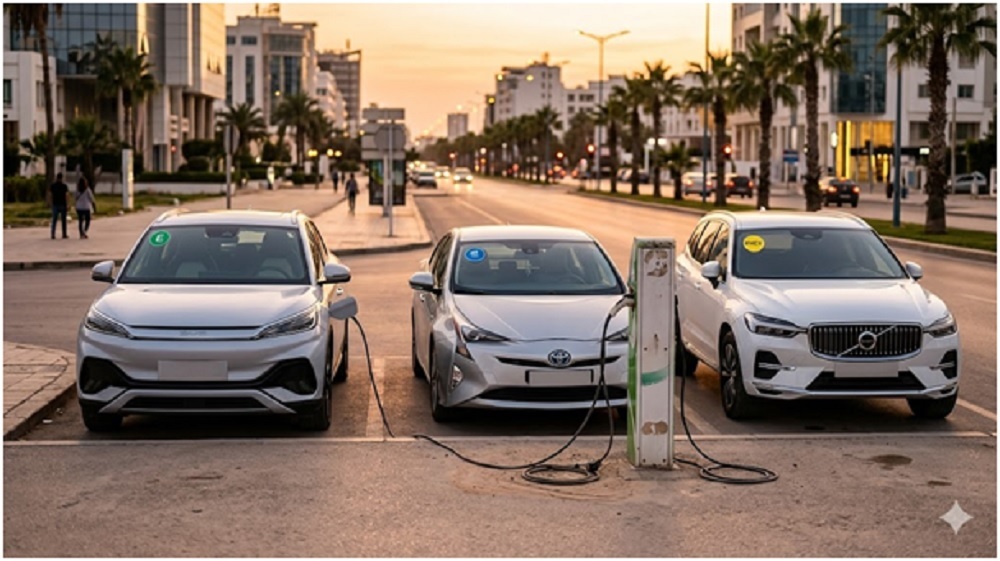
In three months, 1,506 vehicles with alternative powertrains (electric, hybrid, or plug-in hybrid) were registered in Tunisia.
A still modest figure in a total market of over 21,000 units, but one whose composition reveals deeper trends, raising questions about the energy transition, taxation, the parallel market and the country’s industrial sovereignty.
PHEVs lead, China in control
Contrary to expectations, plug-in hybrids (PHEVs) dominated the trio in the first quarter of 2026 with 573 units, ahead of fully electric vehicles (491 units) and conventional non-plug-in hybrids (442 units).
Overall, alternative powertrains accounted for about 7% of Tunisia’s total market during the period—a still small but steadily growing share.
The first takeaway is as much geopolitical as it is industrial: China dominates the two most dynamic segments.
In the electric market, Dongfeng leads with 161 units, followed by BYD (103) and MG (65). These three Chinese brands alone account for 67% of the electric segment.
In PHEVs, BYD confirms its leadership with 189 units, closely followed by Omoda & Jaecoo (a Chery Group brand) with 187 units. Lynk & Co (Geely Group) completes an all-Chinese podium with 70 units.
Conventional hybrids: the only segment where Japan holds ground
Conventional hybrids (HEVs) are the only segment where Japanese and Korean brands maintain their dominance. Toyota, pioneer of hybrid technology with the Prius, remains the clear leader with 170 units, or 38% of the segment alone.
MG (108 units) ranks second, followed by GWM (65 units), before Honda (27), Hyundai (27), and Kia (7) round out the list.
Toyota’s position at the top is no coincidence. Its hybrids, RAV4, Corolla Cross, Yaris Cross, are precisely the models heavily re-imported from Europe through the Grey Market, as shown by re-registration data from Q1: Toyota totaled 345 units in the parallel circuit, more than double its official new sales. Toyota hybrids have become a form of “soft contraband” before being showroom products.
BYD: the standout winner on two fronts
BYD deserves special attention. The Shenzhen-based brand is the only one performing strongly in two segments simultaneously: 103 units in full electric and 189 in PHEVs, totaling 292 units for the quarter. It is by far the leading player in Tunisia’s automotive energy transition across all categories.
This dominance is no accident. BYD has established an official distribution network in Tunisia, offering a wide range from B-segment cars to premium SUVs at competitive prices compared to equivalent European and Japanese brands. Its surge in the Grey Market (+733% in re-registrations, according to March 2026 data) also shows that parallel importers have spotted the opportunity.
Europeans: present, but in supporting roles
European brands are active in this market, but largely on the defensive. BMW recorded 56 PHEV units and 4 electric, totaling 60 units, mainly driven by its X3 and X5 plug-in hybrid SUVs. Mercedes-Benz recorded 16 units across all powertrains, Volvo 16, Land Rover 12, Porsche 12, and Audi 11.
These figures highlight a commercial reality: European premium brands are part of Tunisia’s energy transition, but in a niche segment. Despite benefiting from customs duty exemptions, their vehicles remain priced beyond the reach of most Tunisian buyers, unless purchased through the Grey Market, where the same models are often more affordable.
The fiscal paradox: the state funds the transition… for whom?
This is where economic analysis meets public policy debate. Tunisia has made a clear choice: fully exempt electric vehicles from customs duties and reduce VAT to 7%, compared to 40% customs duties and 19% VAT for comparable internal combustion vehicles.
The intention is commendable, encourage the energy transition, reduce dependence on imported fossil fuels, and lower the national energy bill.
But Q1 2026 figures raise an uncomfortable question: who truly benefits from these tax advantages? Of the 491 electric vehicles registered, most are models priced above 120,000 dinars, well beyond the average consumer’s reach. The same applies to the 573 PHEVs.
For now, Tunisia’s energy transition largely benefits wealthier households, financed by lost tax revenue borne by all taxpayers.
More concerning, a significant portion of these vehicles enters via the Grey Market, capturing tax benefits without contributing to traceability, after-sales service, or legal guarantees that protect consumers.
What these 1,506 vehicles reveal about the future
Taken together, the 1,506 alternative-power vehicles registered in Tunisia in Q1 2026 signal a transition that has begun, but lacks the means to succeed. Demand exists, driven by tax incentives and genuine shifts in consumer preferences. Supply exists, dominated by Chinese manufacturers who recognize Tunisia as a promising market.
What’s missing is a framework. A framework that distinguishes genuine energy transition from tax optimization. One that protects consumers when brands lack proper service networks. One that addresses charging infrastructure, battery end-of-life, and long-term sustainability. And a fiscal system that no longer treats a short-term reseller the same as a household investing in a vehicle for ten years.
Without such a framework, Tunisia risks missing its energy transition just as it has missed other industrial policies: by creating opportunities for rent-seeking without building the foundations of a sustainable economy.
Sources: ATTT — Sales statistics by powertrain, Q1 2026. Automobile.tn. AfricanManager analysis.