
Toyota EV SUV Hits 60 MPH as Quick as a Manual SupraMarc Urbano – Car and Driver
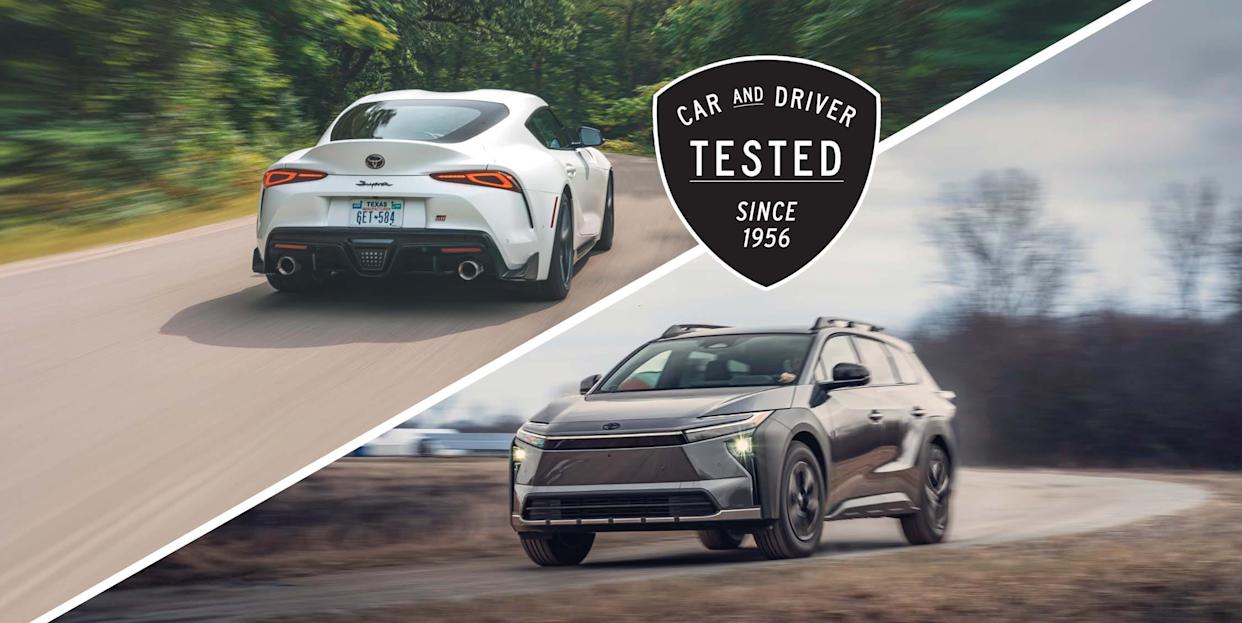
Toyota’s EV SUV has less power and weighs considerably more than the Supra, but the bZ’s instant torque and all-wheel-drive traction helped it overcome the extra mass.
The Woodland joins a growing cohort of family-oriented SUVs with electric powertrains that redefine the parameters of a quick car.
Welcome to Car and Driver’s Testing Hub, where we zoom in on the test numbers. We’ve been pushing vehicles to their limits since 1956 to provide objective data to bolster our subjective impressions (you can see how we test here).
By now, it’s news to almost no one that electric cars tend to be quick. Power figures that would have been exclusive to only the most expensive sports cars 10 years ago can now be found in three-row SUVs from just about every mainstream automaker. Despite a rather extensive knowledge on the subject, we’re comfortable admitting that we were shocked to discover that a 2026 Toyota bZ Woodland we tested matched a 2023 GR Supra in the sprint to 60 mph.
Marc Urbano – Car and Driver
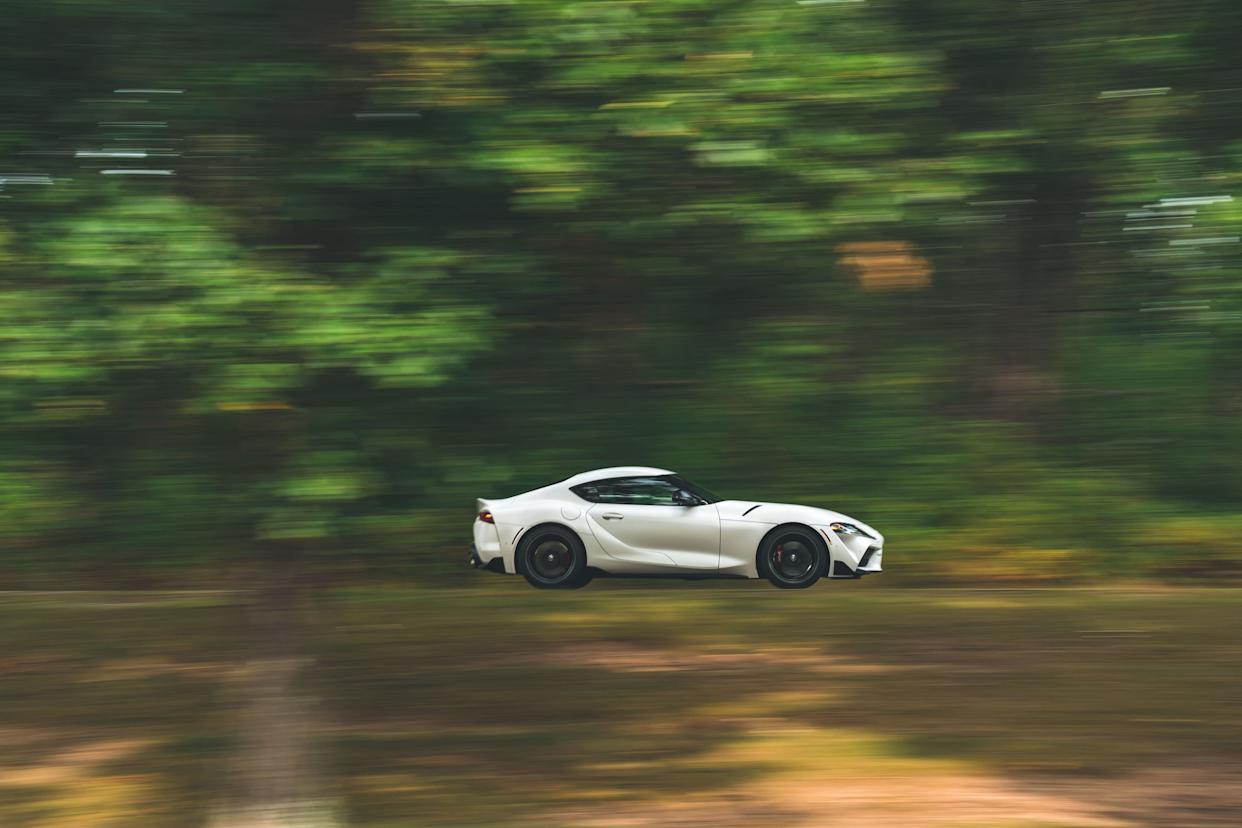
Toyota’s new electric family SUV and its iconic sports car both reached the mile-per-minute mark in 3.9 seconds. We should qualify that the Supra we’re describing is the 382-hp turbo-six version with a six-speed manual transmission. The Supra 3.0 equipped with the eight-speed automatic that we tested, which posted a 3.7-second run to 60 mph, was quicker than the bZ Woodland.
Still, it’s surprising that the electric crossover managed to tie the Supra despite being down on power. Like all gas-powered engines, the Supra’s turbocharged 3.0-liter inline-six needs time to hit max power. The Supra reaches its peak of 368 pound-feet of torque early in the rev range at 1800 rpm, but its engine doesn’t make the full 382 horsepower until 6500 rpm. On the other hand, the bZ Woodland’s powertrain, which features two electric motors that generate a combined 375 hp, immediately provides maximum torque to all four wheels.
The instant torque and all-wheel-drive traction, as well as the absence of gearchanges, are enough to overcome the bZ Woodland’s considerable extra mass (4570 pounds compared with the Supra’s 3343-pound curb weight). Once the cars are at speed, the Supra fights its way to the lead by reaching 100 mph in 9.6 seconds and finishing the standing quarter-mile in 12.4 seconds. Meanwhile, the Woodland needs 10.1 seconds and 12.5 seconds, respectively, to perform the same tasks.
Of course, acceleration alone does not make a performance car—and the Supra handily outperformed the bZ Woodland in every other metric. Between the sports car’s wider and stickier tires (a set of Michelin Pilot Super Sports), along with its lower center of gravity and suspension geometry, the Supra posted a 1.02-g effort on our skidpad versus the Woodland’s 0.78 g. Then there are the intangibles such as driver engagement, steering feel, brake feel, and everything else that a sports car does to put a smile on your face.
 Skip the lot. Let Car and Driver help you find your next car.
You Might Also Like