
Make better investment decisions with Simply Wall St’s easy, visual tools that give you a competitive edge.
Tesla, NasdaqGS:TSLA, has completed the tape out for its new AI5 chip, marking the final design phase for its latest in house AI processor.
The company has also outlined progress on its follow up AI6 chip and Dojo3 system, highlighting a faster cadence in custom AI hardware development.
Management framed these advances as core to future autonomy, robotics and data center products, including Optimus and potential autonomous services.
Tesla’s AI5 milestone arrives as the stock trades at $391.95, with a 62.4% return over the past year and a 140.5% return over three years. Those gains contrast with a 10.5% decline year to date, which underlines how sentiment around new product and technology updates can matter as much as near term trading swings for NasdaqGS:TSLA.
For investors, Tesla’s move deeper into custom AI silicon speaks directly to its ambitions in autonomy and robotics, as well as its aim to rely less on external chip suppliers. How effectively the AI5, AI6 and Dojo3 roadmap is executed, and how visibly it feeds into products and services, is likely to shape how the market frames Tesla’s role in AI heavy mobility and robotics over time.
Stay updated on the most important news stories for Tesla by adding it to your watchlist or portfolio. Alternatively, explore our Community to discover new perspectives on Tesla.
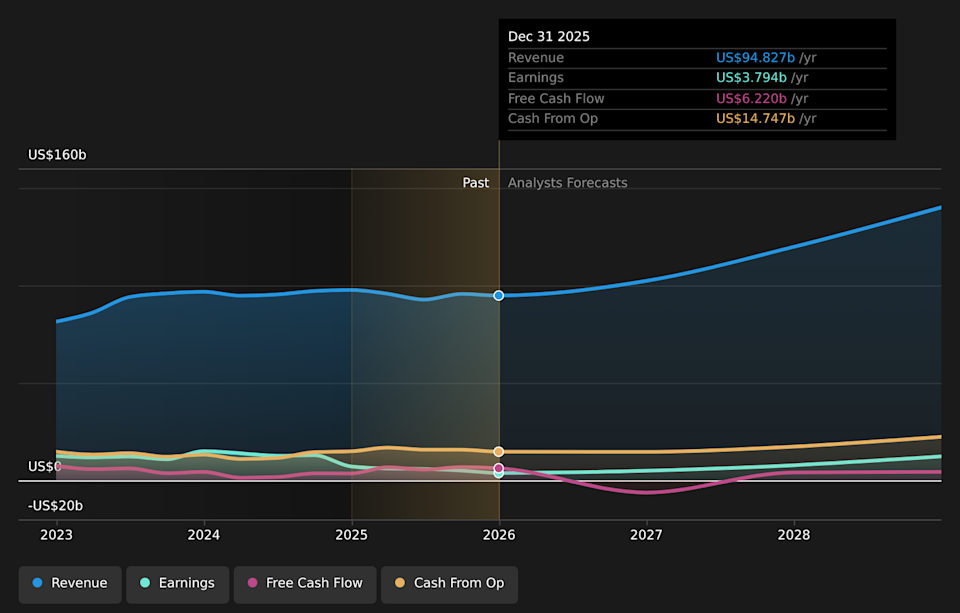 NasdaqGS:TSLA Earnings & Revenue Growth as at Apr 2026
 Beyond the headline: 2 risks and 1 thing going right for Tesla that every investor should see.
Tesla’s AI5 tape-out and visible progress on AI6 and Dojo3 give more substance to its physical AI story at a time when the core EV business is under pressure. Recent data points show 408,386 vehicles produced and 358,023 delivered in Q1 2026, along with 8.8 GWh of energy storage deployments, so custom AI chips are arriving while Tesla is still working through softer auto demand and higher inventory. For you as an investor, proprietary silicon that targets Full Self Driving, Optimus robots and data-center training could help reduce reliance on third party suppliers and refine performance for autonomy-heavy products. The flip side is that chip design and Terafab style manufacturing plans add to an already heavy capital-spending load, which several analysts have highlighted as a concern alongside weaker EV appetite and slower robotaxi progress.
AI5, AI6 and Dojo3 line up directly with the narrative that real world AI, in house inference chips and vertical integration are central to Tesla’s push into autonomy, robots and high margin software.
The need for substantial AI and chip investment while deliveries have lagged expectations and margins have been pressured challenges the cleaner story that software and autonomy can quickly offset headwinds in the auto segment.
The narrative focuses on AI chip design and robotaxi scaling but does not fully reflect the practical questions around manufacturing ramp, supplier dependence and how quickly these chips find their way into a large share of the 1.6 million plus vehicles UBS expects Tesla to deliver in 2026.
Knowing what a company is worth starts with understanding its story. Check out one of the top narratives in the Simply Wall St Community for Tesla to help decide what it’s worth to you.
 Capital expenditure linked to AI chips, Terafab, robotaxis and Optimus comes on top of a core auto business that has missed some delivery expectations, which could keep free cash flow tight if ramps or adoption underperform.
Analysts have flagged 2 key risks for Tesla, including shareholder dilution and lower profit margins compared with last year, which raise the execution bar for new AI heavy projects.
 A proprietary AI5 and AI6 stack tailored for vehicles, robots and data centers could help Tesla differentiate from EV rivals such as BYD, NIO and traditional automakers that lean on third party chips.
If AI5 powers Full Self Driving, Optimus and data center training as planned, it can support the narrative of Tesla as a broader physical AI and energy platform rather than only an EV manufacturer.
From here, watch how quickly AI5 moves from tape-out to production, when it starts replacing the current AI4 hardware in cars, and what Tesla shares about performance and cost per unit. On the financial side, pay attention to capex guidance on AI and Terafab during the upcoming Q1 2026 earnings call, and how management balances this with vehicle volumes, pricing and energy storage deployments. It also helps to track progress on the Austin robo-taxi rollout and Optimus timelines, since these are the products most directly tied to Tesla’s custom AI hardware push.
To ensure you’re always in the loop on how the latest news impacts the investment narrative for Tesla, head to the community page for Tesla to never miss an update on the top community narratives.
This article by Simply Wall St is general in nature. We provide commentary based on historical data and analyst forecasts only using an unbiased methodology and our articles are not intended to be financial advice. It does not constitute a recommendation to buy or sell any stock, and does not take account of your objectives, or your financial situation. We aim to bring you long-term focused analysis driven by fundamental data. Note that our analysis may not factor in the latest price-sensitive company announcements or qualitative material. Simply Wall St has no position in any stocks mentioned.
Companies discussed in this article include TSLA.
Have feedback on this article? Concerned about the content? Get in touch with us directly. Alternatively, email editorial-team@simplywallst.com