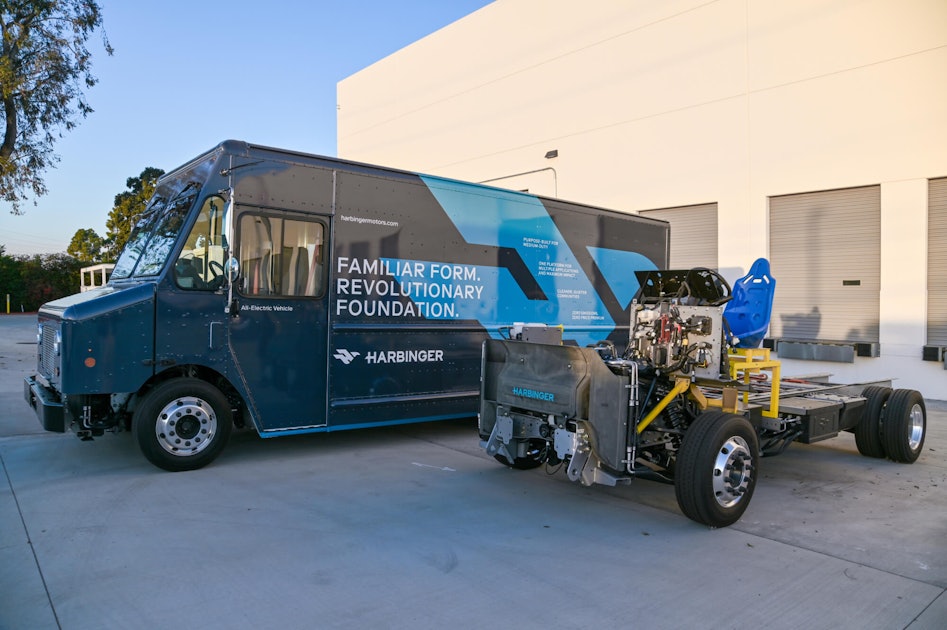
What you need to know:Commercial EV sales growth is rising sharply as Harbinger reports volumes doubling even after federal EV incentives endedFleet electrification economics are the main driver of adoption as operators prioritize fuel savings and lower operating costs over subsidiesDiesel parity commercial trucks and limited OEM competition are accelerating market share gains in the medium duty EV segmentUS medium duty EV market expansion is reflected in Harbinger’s 2025 results, with 733 vehicles sold exceeding total prior year national registrations
Harbinger is proof the battery-electric commercial vehicle market is alive and well, despite a series of policy changes from the Trump administration.
The Garden Grove, California-based OEM of electrified medium-duty commercial vans is reporting a counterintuitive trend in its commercial EV business: sales increased after the expiration of federal EV incentives under the Biden administration’s Inflation Reduction Act (IRA), with quarterly volumes roughly doubling following the policy change.
The development runs against the prevailing narrative that EV demand is primarily driven by subsidies, and it has surprised even some investors who have been closely watching the segment.
[Related: Harbinger Motors raises $100M in Series B funding]
Post-incentive sales accelerate
Harbinger says its sales momentum actually strengthened after IRA incentives ended, with quarterly EV truck sales roughly doubling quarter over quarter.
The company attributes the shift to a combination of structural market forces rather than policy support. Fleet operators, it says, are under intense margin pressure, which makes operating cost reductions especially valuable in day-to-day decision-making. In that context, electrification becomes less about policy incentives and more about survival-level efficiency improvements.
Harbinger also points to a lack of strong competition in the medium-duty EV segment. Some programs have been slowed or deprioritized by legacy OEMs, and there has been limited fresh investment in the category from major manufacturers. This has left a relatively open market for companies that are actively scaling production.
At the same time, pricing has improved significantly. Harbinger says its vehicles are now approaching cost parity with comparable diesel trucks, including equivalent Freightliner models, which removes one of the biggest historical barriers to adoption in commercial fleets.
[Related: Harbinger guarantees EV pricing amid IRA credit uncertainty]
“People assume incentives are what drive EV adoption, but what we’re seeing in the medium-duty market is much more fundamental,” Harbinger CEO John Harris told Clean Trucking.
“Fleet operators are under real margin pressure, and when you can offer a solution that saves roughly $14,000 per year per vehicle in fuel alone, that becomes a lifeline for businesses. At the same time, when our vehicles are cost-competitive with diesel, the value proposition is impossible to ignore.”
The company also notes that legacy players have left gaps in the segment. General Motors has scaled back momentum in its commercial EV efforts, including the unexpected discontinuation of its BrightDrop commercial van last October, while other OEMs have shown limited new investment in medium-duty electric trucks.
2025 sales performance
Harbinger reports strong growth throughout 2025, including multiple key milestones. The company says its fourth-quarter EV sales were roughly double its third-quarter volumes, reflecting accelerating momentum even after the policy shift away from federal incentives.
For the full year, Harbinger sold 733 commercial EVs, including a significant order from FedEx. These sales represent approximately $87 million in vehicle revenue, based on invoiced purchase orders rather than reservations or pre-orders.
By comparison, S&P Global data indicates that only 460 Class 4–6 electric vehicles were registered across the entire U.S. market in 2024. On that basis, Harbinger alone sold more medium-duty electric vehicles in 2025 than the total number of such vehicles registered across all manufacturers in the prior year.
A market moving past incentives
What makes Harbinger’s results notable is not just the growth rate, but the direction of causality it suggests. While EV adoption is often framed as dependent on government incentives, the company’s performance points to a different driver: unit economics.
If sustained, the trend could indicate a broader shift in the commercial EV market—from policy-supported adoption toward demand driven primarily by cost savings, vehicle availability, and near-parity pricing with diesel alternatives.
[Related: 2025 was a tough year for commercial ZEVs, but the transition still moves forward in 2026 and beyond]
Harbinger’s recent debuts
Harbinger has been keeping busy recently with fresh product debuts.
In late March, Harbinger and Frazer announced a partnership to develop electrified mobile healthcare vehicles for emergency and commercial fleets. Frazer will integrate Harbinger’s plug-in hybrid chassis and battery systems into EMS and mobile clinic platforms to support clinical-grade reliability.
The collaboration targets next-generation hybrid medical vehicles and power systems made in the U.S., aiming to improve emissions performance, uptime, and onboard power reliability for uninterrupted patient care.
Also in March, at Work Truck Week, the OEM introduced its HC Series Cab, a low cab forward (LCF) medium-duty truck available in both electric and plug-in hybrid configurations. The vehicle is designed to help fleets lower operating costs while also serving as a mobile power source on job sites.
Its range-extended hybrid system offers extended driving range along with up to 15 kW of exportable onboard power, allowing work crews to operate tools and equipment directly from the truck.
Jay Traugott has covered the automotive and transportation sector for over a decade and now serves as Senior Editor for Clean Trucking. He holds a drifting license and has driven on some of the world’s best race tracks, including the Nurburgring and Spa. He lives near Boulder, Colorado and spends his free time snowboarding and backcountry hiking. He can be reached at [email protected].