
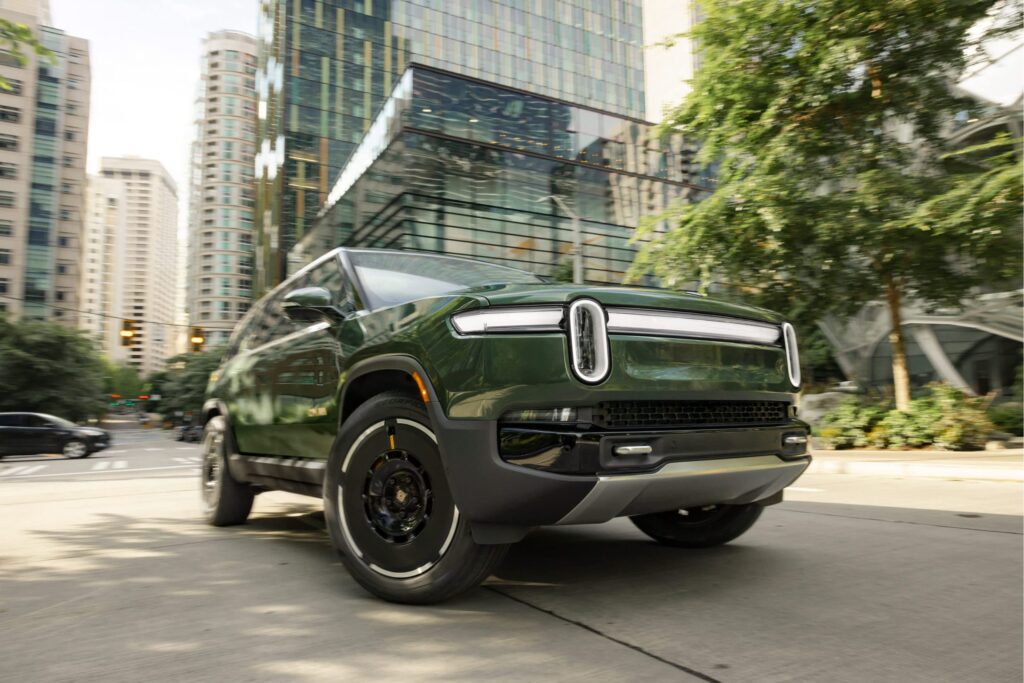
The 2026 Rivian R1S is the three-row halo of Rivian’s lineup, the most expensive vehicle the company builds in full production, and the model that taught the rest of the industry what serious off-road engineering looks like on a 400-volt skateboard. It is also the only large SUV from an American automotive company on the 2026 IIHS TOP SAFETY PICK+ list.
The Gen-2 refresh that arrived for the 2025 model year carries forward into 2026 with a new oil-cooled Quad-Motor drive unit built in Normal, Illinois, putting 1,025 combined horsepower through four wheels. The Quad-Motor R1S will ford 43 inches of water, walk across rocks at up to 15 inches of ground clearance on its air suspension, and hit 60 mph in a Rivian-claimed 2.6 seconds.
It also has a native NACS charge port.
This is what a seven-seat electric family SUV looks like when the people who built it spent the early model years proving they could race it up Pikes Peak and win.
Key Takeaways
Pricing spread: $83,990 to $121,990 base MSRP on Rivian’s own site for the 2026 R1S, pre-destination. Add $1,895 destination per Consumer Reports for an all-in starting point around $85,885.
Trim walk: Dual Large is the new entry trim now that Rivian is phasing out the Dual Standard ahead of the R2 launch. Tri Max sits in the middle at $106,990 base. Quad Max tops the order form at $121,990 base with 1,025 horsepower.
Range best case: 410 EPA miles on the Dual Max Pack, the highest range in the 2026 R1S lineup and one of the longest in any three-row EV on sale today.
Seating: seven across three rows, with the third row realistically suited to children and shorter trips for adults. Cargo runs from 18 cubic feet behind the third row up to 91 cubic feet with both rear rows folded, plus a 10-cubic-foot frunk.
Gen-2 highlights carried into 2026: in-house Rivian Enduro drive units, zonal electrical architecture, LFP chemistry on the Standard pack, a quieter cabin per Consumer Reports, rewritten software platform, and a structural pack improvement set that targets the complaint categories early owners reported.
2026 IIHS TOP SAFETY PICK+: the highest designation the agency awards, and Rivian notes the R1S is the only large SUV from an American automotive company to earn TSP+ in 2026. NHTSA has never crash-tested a Rivian under its NCAP program.
Native NACS charging port on every 2026 R1S, with a complimentary CCS adapter included. Supercharger access, 220 kW peak DC on the Max pack.
Dual Standard phase-out: Electrek reported on March 11, 2026 that Rivian is sunsetting the $76,990 Dual Standard trim ahead of the R2 launch. Treat the Dual Large Pack as the new entry point.
Right buyer: a three-row family that wants real off-road hardware, genuine American-assembled engineering, and an EV with a legitimate warranty and software pipeline, and is willing to pay R1T-plus money for the third row and the range.
What the 2026 Rivian R1S Is
The R1S is Rivian’s full-size three-row electric SUV. It shares its skateboard, its drive units, and most of its hardware with the R1T pickup. Same 43-inch water fording. Same up-to-15-inch adjustable ground clearance on air suspension. Same approach and departure angles that belong on something painted in rally colors. Same Quad-Motor option with Rivian’s in-house oil-cooled Enduro drive units.
Where the R1T carries its cargo in a bed and a gear tunnel, the R1S packages seven seats and 91 cubic feet of total cargo volume inside a closed cabin.
The 2026 R1S is a continuation of the Gen-2 refresh that arrived for the 2025 model year rather than a new vehicle.
The Gen-2 changes, announced in June 2024 and covered in TWD’s original Gen-2 announcement coverage, rewrote the parts of the vehicle that early owners had the most trouble with: wiring, drive units, battery cell chemistry on the entry pack, cabin sound, and the software platform. Those changes carry forward into 2026 unchanged.
What 2026 adds on top is the return of the Quad-Motor option with an all-new Rivian-designed oil-cooled motor, a native NACS charge port in place of the old CCS port, and the IIHS TOP SAFETY PICK+ award for the 2026 model year. Rivian also followed up its 2024 Pikes Peak Hill Climb win and its 2023 Rebelle Rally run with competition-derived Rad tuner drive modes that ship on the Quad.
If you want the shortest description of where the R1S sits in the market, it is the premium American family SUV for a buyer whose other candidates are a Volvo EX90, a Kia EV9, a Mercedes EQS SUV, or a Tesla Model X.
It is not cross-shopped against a Chevy Tahoe. It is not a budget play.
It is a six-figure halo product that happens to also be the vehicle that landed Rivian on the 2026 IIHS Top Safety Pick+ list.
2026 Rivian R1S Price and Trim Walk
Rivian publishes the R1S trim walk on rivian.com/r1s, and Car and Driver and Consumer Reports each publish a slightly different view of the same lineup because they add the destination fee or break out the battery-pack variations differently. Here is the set of base MSRP figures as Rivian lists them, pre-destination.
Trim
Base MSRP (pre-destination)
Drive
0-60 (Rivian claim)
EPA Range
Dual Large
$83,990
Dual motor AWD
4.5 sec
329 mi
Dual Large with Max Pack upgrade
~$92,885 as-shown (C&D)
Dual motor AWD
4.5 sec
410 mi
Tri Max
$106,990
Tri motor AWD
2.9 sec
371 mi (405 in Conserve)
Quad Max
$121,990
Quad motor AWD
2.6 sec
374 mi (400 in Conserve)
Add Consumer Reports’ listed $1,895 destination fee to every line for the all-in figure. Car and Driver’s as-shown numbers land at $85,885 for the Dual Large, $108,885 for the Tri Max, and $123,885 for the Quad Max, which confirms the destination charge within rounding.
The Quad Max Launch Edition, which Rivian sold in limited numbers for the 2026 launch window, lists at $127,885 delivered on Car and Driver’s page. A Dual Large Pack with Max-pack upgrade, the one to order if you want the 410-mile headline range without stepping up to Tri or Quad, lands at roughly $92,885 delivered per C&D.
Dual Standard is being phased out
Until March 2026, Rivian listed a Dual Standard trim at $76,990 base as the entry point of the R1S lineup. Electrek’s Scooter Doll reported on March 11, 2026 that Rivian is sunsetting that trim ahead of the R2 launch. Rivian notified subscribers by email and required the final lease offers to be approved by March 19 with delivery by March 31. If you see the Dual Standard still quoted in older third-party coverage, treat it as historical context, not a live order. The new entry trim for buyers walking in now is the Dual Large Pack at $83,990 base. This is also why the R1S pricing table in this guide starts at Dual Large rather than Dual Standard.
The pricing gap between a Dual Large and a Quad Max is almost forty thousand dollars before destination. That spread is there for a reason.
A Dual Large R1S is a fast, quiet, long-range three-row family SUV. A Quad Max R1S is the same vehicle plus an 1,025-horsepower drivetrain, four individually controlled in-house motors, Rad tuner off-road modes, Kick Turn, and what Rivian quotes as a 2.6-second run to sixty.
Most families do not need Quad. Some do.
Range and Powertrain
The 2026 R1S range picture is the cleanest it has ever been.
The Max pack delivers the headline number of 410 EPA miles on the Dual, one of the longest figures in the three-row EV market, and the Tri and Quad give up some of that range in exchange for more motors and more speed. Rivian’s own site breaks the trims down by battery pack; the Max pack gets the highest number on the Dual because fewer motors and less drag work in its favor.
Spec
Dual Large
Dual Max
Tri Max
Quad Max
Drive
Dual motor AWD
Dual motor AWD
Tri motor AWD
Quad motor AWD
Horsepower
533 hp
533 hp
850 hp
1,025 hp
Torque
Not published
Not published
1,103 lb-ft
1,198 lb-ft
0-60 mph (Rivian claim)
4.5 sec
4.5 sec
2.9 sec
2.6 sec
EPA range
329 mi
410 mi
371 mi (405 Conserve)
374 mi (400 Conserve)
Battery
Large pack
140 kWh Max pack
140 kWh Max pack
140 kWh Max pack
Peak DC charge
220 kW (Max), 200 kW (Std)
220 kW
220 kW
220 kW
Onboard AC
11.5 kW
11.5 kW
11.5 kW
11.5 kW
Charge port
Native NACS + CCS adapter
Native NACS + CCS adapter
Native NACS + CCS adapter
Native NACS + CCS adapter
Max tow
7,700 lb
7,700 lb
7,700 lb
7,700 lb
A couple of details are worth pulling out of that table. The Dual Max with 410 EPA miles is the range leader, not the Tri or the Quad. If the deciding spec for your purchase is how far you can drive without stopping, the Dual Large Pack with the optional Max upgrade is the order you want to write.
Consumer Reports measured 358 miles on its own 70-mph highway range test on a Gen-2 Dual Large R1S, which is a road-tested figure on Consumer Reports’ own instrumented run rather than an EPA cycle. The Max pack’s 220-kilowatt peak DC rate is a full industry-standard figure for a 400-volt EV of this size, and the Gen-2 battery pack delivers it on a charge curve that owners have found predictable.
The Quad Motor R1S is the model with Rivian’s all-new in-house oil-cooled motors in 2026, which Rivian says are more powerful and more efficient than the original Quad. Car and Driver’s estimate for the Quad R1S is 2.6 seconds to 60, 6.9 seconds to 100, a 10.6-second quarter mile, and a 130-mph top speed, though C&D notes that the R1S Quad is not yet fully instrumented.
Towing capacity is a meaningful delta between the R1S and the R1T. Every R1S trim tops out at 7,700 pounds with a weight-distributing hitch, versus 11,000 pounds on an R1T Max Pack. That is not a Gen-1-to-Gen-2 change. It is a result of the body-on-skateboard packaging of a seven-seat SUV versus a crew-cab pickup.
If you need to tow more than 7,700 pounds, the answer in the Rivian lineup is an R1T with the Max pack, not an R1S.
Payload on the R1S runs close to R1T figures and is consistent across trims.
Seating and Cargo

The R1S seats seven in a two-plus-three-plus-two configuration. The second row is fine for adults. The third row is meant for children and works well for that purpose; Car and Driver calls it “a bit of a squeeze to get access, but shouldn’t be a problem for children, who are best suited to its limited space.”
Anyone over about five-foot-ten in the third row on a long drive is going to notice.
Families shopping the R1S as an everyday seven-seat hauler should test-fit their actual passengers before the order goes in, the same way they would with any three-row SUV.
Cargo numbers break down like this. Behind the third row with all seven seats up, there are 18 cubic feet for luggage. Fold the third row flat and you open up 49 cubic feet. Fold the third and second rows flat and the R1S gives you 91 cubic feet of total cargo volume. The frunk adds another 10 cubic feet up front.
Car and Driver’s own carry-on luggage test fit six bags behind the third row, 18 with the third row folded, 32 with both rows folded, and another two in the frunk.
The overall packaging is on par with a large gas-powered three-row SUV like a Chevy Tahoe or Jeep Grand Wagoneer on everything except the frunk, which exists because an electric skateboard does not need a gas engine up front.
Interior material quality on the Gen-2 R1S is a step up from the early cars. The cabin uses a mix of leather, wood, and large displays. The standard 15.6-inch center touchscreen is paired with a reconfigurable digital gauge cluster in front of the driver.
Audio is a 12-speaker system standard, with an optional 19-speaker setup that adds Apple Spatial Audio and Dolby Atmos. Every R1S includes two 120-volt outlets, eight USB ports, two wireless chargers, and a Wi-Fi hotspot for up to eight devices.
No glovebox. Unlike the R2, the R1S does not have one at all; Rivian used the space for other storage.
Key Features: What Gen-2 Changed
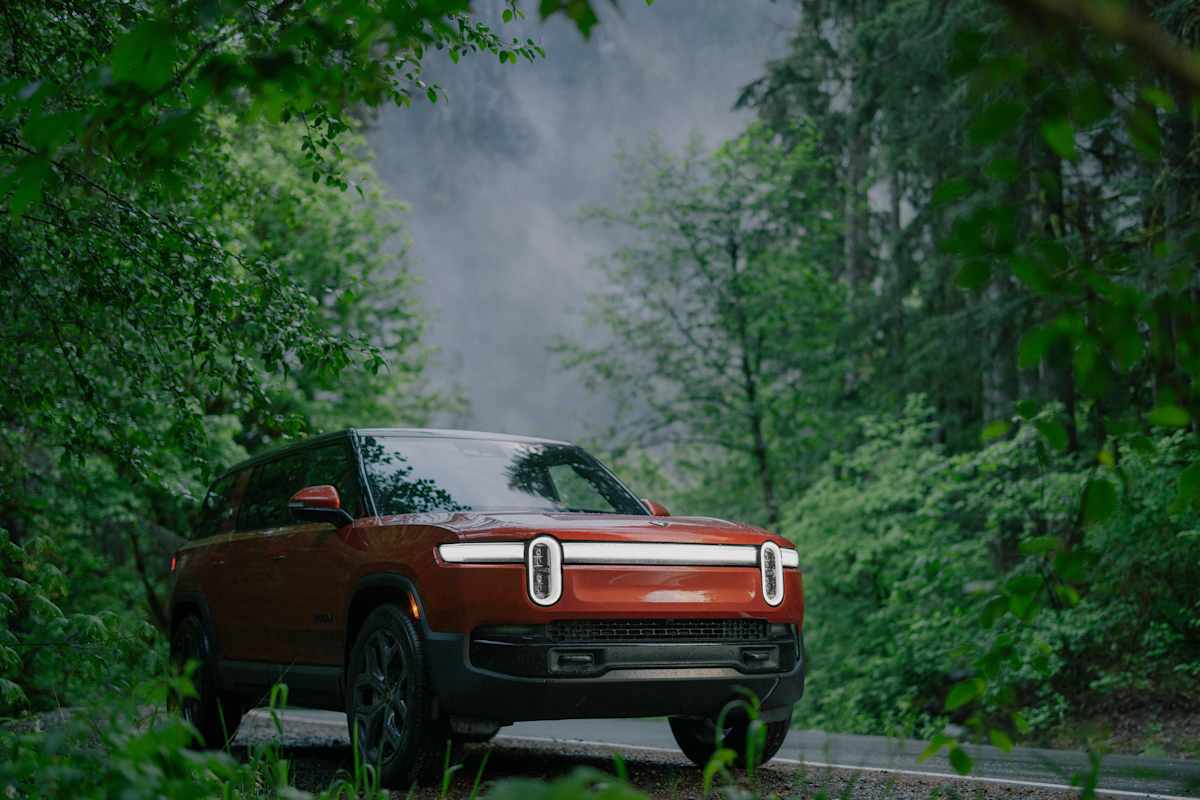
The Gen-2 R1S is the vehicle on sale in 2026, and the scope of the refresh matters enough to walk through it in plain language.
Rivian did not do a mid-cycle facelift on the R1 lineup. Rivian rewrote large parts of the vehicle.
Zonal electrical architecture is the headline structural change. Earlier Rivians ran a traditional long wiring harness back to a central ECU. Gen 2 adopts a zone-based architecture that shortens the harness, cuts the total wire count, simplifies OTA delivery, and reduces the surface area for the electrical faults that generated a meaningful chunk of the early NHTSA complaint record.
Less wire to fault, fewer connectors to loosen, and a shorter blast radius if a single component fails.
This is the kind of change that does not show up on a spec sheet but shows up in the service record three years later.
In-house Enduro drive units replaced the co-developed units that shipped on Gen-1 Rivians. All Gen-2 R1S motors are now designed and built at Rivian’s Normal, Illinois plant, serviced through Rivian’s own network, and supported by Rivian’s own parts supply chain. That is a reliability argument as much as a performance argument; the company owns the part.
For 2026, the returning Quad-Motor adds an all-new Rivian-designed oil-cooled motor that the company describes as more powerful and more efficient than the original. Combined Quad output is 1,025 horsepower and 1,198 pound-feet.
Car and Driver’s instrumented test of the 2026 Quad-Motor R1T (mechanically equivalent in drivetrain) ran 2.6 seconds to 60, 10.6 seconds in the quarter at 128 mph, 0.90 g on the 300-foot skidpad, and a 6,987-pound curb weight. Expect the R1S to behave in the same neighborhood.
LFP chemistry on the old Dual Standard battery pack brought a cell with better calendar life and less sensitivity to top-charging habits. The Max pack and Large pack still use traditional nickel-chemistry cells optimized for energy density and the 410-mile range figure.
The structural pack itself got refinements that Rivian has not broken out in detail, and Consumer Reports reports a noticeably smoother powertrain and a quieter cabin compared with the 2024 car.
Native NACS charging is new for 2026 across the R1 lineup. Earlier Rivians used CCS and needed an adapter to plug into Tesla Superchargers. The 2026 R1S ships with a factory NACS port that works on every Supercharger in North America without an adapter, and Rivian includes a complimentary CCS adapter for fast-charging at non-Tesla DC stations.
This is the charging reliability upgrade that early Gen-1 owners have been asking for. It is also the single biggest usability change in 2026 for anyone who road-trips.
The software platform was rewritten for Gen 2 and continues to ship OTA updates roughly every month. Rivian’s update pipeline is among the fastest in the industry, and several NHTSA recall campaigns on 2024 and 2025 cars were remedied entirely via OTA without an owner ever visiting a service center.
New in 2026, the Quad-Motor R1S gains the Rad tuner set of drive modes with Desert Rally and Hill Climb presets, plus Kick Turn, a production version of the Tank Turn concept that spins the wheels in opposite directions to pivot the vehicle in place at up to 12 mph. Kick Turn is exclusive to the Quad.
Interior and Tech
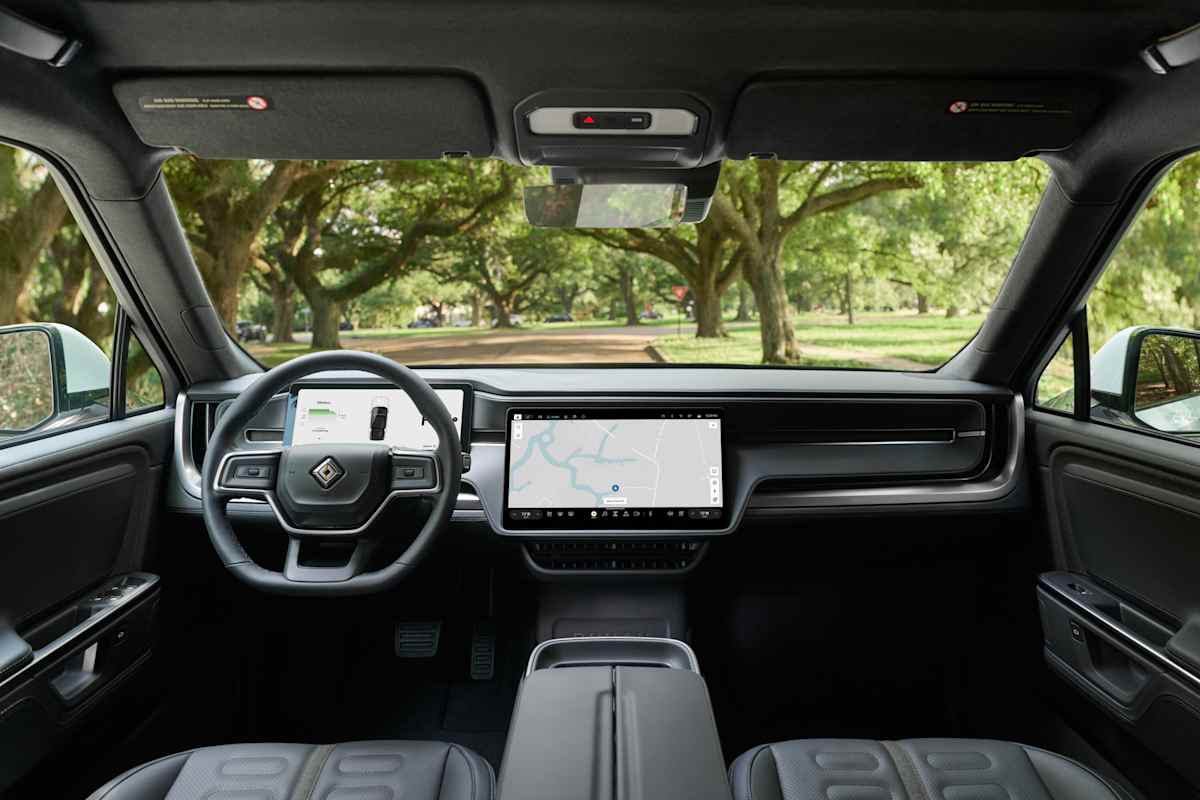
The R1S infotainment stack is Rivian’s own, not Google’s or Apple’s.
The 15.6-inch center touchscreen runs a rewritten Gen-2 software stack, the driver display in front of the steering wheel handles vehicle information, and neither Apple CarPlay nor Android Auto is available. Rivian has been public and consistent about this: the company intends to own its in-vehicle experience end to end, which means buyers who treat CarPlay as non-negotiable should know before the order goes in that the R1S will not ever be that vehicle.
This is the same position Tesla and GM’s Ultium lineup have taken. For a buyer who lives in Apple Music or Google Maps on a phone, the Rivian approach is a trade-off worth weighing.
Rivian’s OTA update pipeline is part of the value proposition. The company ships named software releases nearly every month, and those releases add features, fix bugs, and address regressions from previous updates. New off-road drive modes, new car-wash mode behaviors, new charging-session handshake fixes, and recall remedies have all arrived via OTA since 2022.
It is the opposite of the static software you buy with a gas SUV. Whether that feels like a feature or a risk depends on the buyer.
Material quality on the 2025-plus cars is a notable step up from the first 2022 builds. The wood is upcycled. The leather is proper. Panel fit is more consistent than early Gen-1 owners reported on rivianforums.com and r/Rivian. Cabin noise is lower per Consumer Reports.
The 19-speaker audio upgrade with Apple Spatial Audio and Dolby Atmos is worth the money for anyone who cares.
The controls-through-touchscreen approach is still the R1S’s biggest usability friction point; Consumer Reports calls the setup “extremely distracting” because most tasks, including adjusting the air vents, route through the center screen. That is a fair criticism that buyers should sit with before ordering.
Safety: 2026 IIHS TOP SAFETY PICK+
The R1S earned an IIHS TOP SAFETY PICK+ for the 2026 model year, the highest designation the agency awards. Rivian’s own announcement, posted at stories.rivian.com on March 24, 2026, notes that the R1S is the only vehicle in the large SUV category built by an American automotive company to earn the 2026 TSP+ designation.
Three separate IIHS cycles. Three TSP+ awards: 2023, 2025, and now 2026.
The R1T on the same Gen-2 platform holds a 2025 IIHS TOP SAFETY PICK+ on its 2025 model year file; IIHS tightened its 2026 criteria and did not re-award the R1T in this cycle.
IIHS strengthened its criteria for 2026 around rear-seat occupant protection and pedestrian safety. Vehicles earning TSP+ in this cycle had to clear both. The award is worth naming out loud because it is the most concrete crash-safety data point the 2026 R1S has on its record.
NHTSA has never crash-tested a Rivian under its New Car Assessment Program. There is no star rating from NCAP on any R1S or R1T of any model year.
For a buyer cross-shopping three-row SUVs on IIHS-versus-NHTSA comparisons, the honest answer is that IIHS is the only agency that has run a Rivian through a crash structure test, and the R1S has now cleared the highest bar IIHS offers three times.
How the R1S Compares: Kia EV9, Volvo EX90, Tesla Model X
These are the three three-row electric SUVs most shoppers cross-shop against the R1S. The Kia EV9 starts roughly ten thousand dollars cheaper than the R1S, the Volvo EX90 slots in slightly below it, and the Tesla Model X base AWD pushes past it into its own six-figure tier with Tesla’s Supercharger posture baked in. Here is how the four vehicles line up on the numbers shoppers compare.
Spec
Rivian R1S Dual Large
Kia EV9 GT-Line AWD
Volvo EX90 Twin Motor
Tesla Model X
Starting price (pre-destination)
$83,990
~$73,000
~$78,000
~$91,630
Seating
7
6 or 7
6 or 7
5, 6, or 7
Drive
Dual motor AWD
Dual motor AWD
Dual motor AWD
Dual or Tri motor AWD
Horsepower
533 hp
379 hp
402 hp
670 hp (Plaid 1,020)
EPA range (headline)
329 mi (410 on Dual Max)
~270 mi
~305 mi
Up to 352 mi (335 Plaid)
0-60 mph (manufacturer claim)
4.5 sec
~5.3 sec
~5.7 sec
~3.8 sec (base), 2.5 sec (Plaid)
Ground clearance
Up to 15.0 in (air)
~7.8 in
~8.5 in
5.4 to 8.9 in (air)
Charging
Native NACS, 220 kW DC
Native NACS, 800V, ~210 kW
800V NACS via adapter, ~250 kW
Native NACS, ~250 kW (Supercharger)
Max tow
7,700 lb
~5,000 lb
~5,000 lb
5,000 lb
A note on those competitor numbers: the Kia EV9, Volvo EX90, and Tesla Model X figures in the table above are listed at typical configurations from each manufacturer’s public model pages and are provided as a cross-shop starting point. Exact pricing, range, and power figures vary by trim and year, and a buyer serious about any of them should pull the current configurator before comparing. The R1S figures in the leftmost column are the ones this article stands behind.
What the comparison actually shows is that the R1S is priced at the top of the segment because it brings the most hardware the segment has.
The Kia EV9 is the value play: big, spacious, well packaged, shorter on range and well short on ground clearance. The Volvo EX90 is the luxury play: quiet, cosseting, built around Volvo’s safety reputation, also short on off-road hardware. The Tesla Model X is the performance play: quick, Supercharger-native, and well into its second-generation product cycle, with a falcon-door packaging solution that buyers either love or do not want to think about.
The R1S is the capability play.
It is the only vehicle in this set that will ford 43 inches of water, climb to 15 inches of ground clearance on an air suspension, and run the Dual Max to 410 EPA miles. It also cleared the 2026 IIHS TOP SAFETY PICK+ bar, which Rivian notes makes it the only large SUV from an American automotive company on this year’s TSP+ list.
A buyer whose life includes snow, mud, gravel, or Forest Service roads should put the R1S at the top of the shortlist above any of the three.
A buyer whose life is a suburb in California and a drive to Tahoe twice a year may be happier with an EV9 and the savings. A buyer who wants to slip into a pre-established Supercharger routine and does not need the off-road hardware is the Model X’s target.
R1S Reliability
A thorough look at R1S reliability belongs in a dedicated article, and TWD’s 2026 Rivian reliability piece is the companion read.
The short version here is that TWD’s own reliability database rates the R1S at 2.6 out of 5, a “caution” tier rating driven by above-average complaint volume in safety-systems and electrical categories on the NHTSA record, normalized against the large SUV segment median.
The context that matters: the algorithm weights historical complaint data, which means 2022 and 2023 owner complaints are still in the denominator. The Gen-2 refresh arrived for the 2025 model year. Structural improvements from the refresh will not fully move the score until enough 2025 and 2026 complaint data accumulates to displace the early cars in the window.
The complaint categories that pushed the R1S into the caution tier are the same categories the Gen-2 zonal electrical architecture and in-house drive units were engineered to address. Rivian’s OTA update pipeline has also remedied a fair chunk of the 2024 and 2025 recall campaigns via software rather than a dealer visit.
Eight distinct NHTSA recall campaigns affected the 2025 R1S, and one of them, campaign 26V009000, extends into 2026 model year R1S second-row seat belt retractor bolts. A full recall inventory, the component-level breakdown, the TWD algorithm explanation, and the data-source appendix all live in the 2026 Rivian reliability article.
A prospective R1S buyer should read it alongside this buyer’s guide. “Caution” is not the same as “unreliable.”
Who Should Buy the 2026 Rivian R1S
The R1S makes sense for a specific kind of buyer, and the shortest way to describe that buyer is someone who needs three rows and trail-ready off-road hardware and is willing to pay for both. Families whose trips end at a trailhead, not a hotel valet, are the obvious fit.
The decision is not really “R1S versus Kia EV9.” It is “R1S versus a loaded Tahoe” or “R1S versus a gasoline Grand Wagoneer” or “R1S versus waiting two more years for another premium three-row EV that matches the off-road hardware.”
None of the other obvious electric three-rows do. That is the whole point.
It is the right answer for you if:
You need seven seats and you actually use the third row. The R1S is a functional three-row family vehicle with 91 cubic feet of max cargo and real adult space in the second row.
Your definition of “SUV” includes dirt. 43 inches of water fording, up to 15 inches of ground clearance on the air suspension, and Rad tuner drive modes on the Quad are not cosplay. They are in the chassis.
You want an American-assembled premium EV with a native Supercharger port, a real OTA pipeline, and a six-figure warranty backstop from a company that owns its drive units.
The 2026 IIHS TSP+ matters to you and you are cross-shopping three-row EVs where safety data is uneven.
It is probably not for you if:
Your budget stops under eighty thousand. The Kia EV9 is the better answer.
You need to tow more than 7,700 pounds. Look at an R1T Max Pack for 11,000 pounds, or a gas-powered body-on-frame three-row.
Apple CarPlay is non-negotiable. Rivian does not offer it and has said it will not.
You want a vehicle proven reliable over a decade. No EV startup has that record yet. A Toyota or Honda hybrid three-row is the safer bet on that criterion alone.
Frequently Asked Questions
What is the price of the 2026 Rivian R1S?
The 2026 Rivian R1S starts at $83,990 base MSRP for the Dual Large Pack, which is the new entry trim now that Rivian is phasing out the Dual Standard. The Tri Max sits at $106,990 base, and the Quad Max tops the order form at $121,990 base. Add roughly $1,895 for destination to every line. Car and Driver’s as-shown pricing lands at $85,885 for the Dual Large, $108,885 for the Tri Max, $123,885 for the Quad Max, and $127,885 for the Quad Max Launch Edition.
What is the range of the 2026 Rivian R1S?
The Dual Max Pack is the range leader at 410 EPA miles, the highest figure in the 2026 R1S lineup. The Dual Large gets 329 EPA miles. The Tri Max is rated 371 EPA miles, or 405 in the Conserve drive mode. The Quad Max is rated 374 EPA miles, or 400 in Conserve. Consumer Reports measured 358 miles on its own 70-mph highway test on a Gen-2 Dual Large R1S, a useful road-tested figure.
How many seats does the R1S have?
The R1S seats seven in a two-plus-three-plus-two configuration across three rows. The second row is comfortable for adults. The third row is realistically sized for children and works for them without issue. Adults can fit in the third row for short trips but will notice the space on longer drives. Car and Driver describes the third row as “a bit of a squeeze to get access, but shouldn’t be a problem for children, who are best suited to its limited space.”
What are the key features of the 2026 R1S?
The 2026 R1S is a Gen-2 platform with native NACS charging, a returning Quad-Motor option with Rivian’s in-house oil-cooled drive units delivering 1,025 horsepower, the Rad tuner off-road drive modes on the Quad, Kick Turn (a production Tank Turn that pivots in place at up to 12 mph), a 15.6-inch center touchscreen running Rivian’s own software, a 12-or-19-speaker audio system, and 2026 IIHS TOP SAFETY PICK+ credentials. Three rows and seven seats are standard across the lineup.
What did the Gen-2 update change on the R1S?
The Gen-2 refresh, announced in June 2024 and shipping on 2025 model-year vehicles, rewrote the R1S electrical architecture, replaced co-developed drive units with Rivian’s own in-house Enduro motors, added LFP chemistry on the old Standard pack, rewrote the software platform, and improved cabin noise isolation and ride absorption per Consumer Reports. For 2026, Rivian added native NACS charging, a new Quad-Motor with oil-cooled in-house motors, and competition-derived Rad tuner drive modes.
How does the R1S compare to the Kia EV9?
The Kia EV9 is the value play in the three-row electric SUV segment. It starts around twenty thousand dollars cheaper than an R1S Dual Large, gives up roughly 60 miles of range at the headline trim, and does not match the R1S on horsepower, ground clearance, or off-road hardware. The R1S brings hardware the others cannot match, a longer headline range on the Dual Max, and 2026 IIHS TOP SAFETY PICK+ credentials. The EV9 is the right answer for a buyer whose life is paved and whose budget matters. The R1S is the one for a buyer whose life runs past the pavement.
Is the R1S worth the price?
For a buyer who needs three rows, real trail hardware, and 410-mile range in the same vehicle, the R1S is the only electric SUV on sale in 2026 that delivers all three. The pricing is consistent with premium three-row EVs from Volvo, Mercedes, and Tesla, and the 2026 IIHS TOP SAFETY PICK+ is a credible safety anchor. Buyers who do not need the off-road hardware can save twenty thousand on a Kia EV9 and will be satisfied. Buyers who do need it will find nothing else that matches.
Should I wait for the R2 instead?
The 2026 Rivian R2 is a five-seat, two-row electric SUV on an all-new mid-size platform, priced from $48,490 base with Spring 2026 deliveries on the Performance Launch trim. It is a genuinely different vehicle. If you need three rows, the R2 is not the answer. If you only need five seats and off-road hardware is more nice-to-have than must-have, the R2 saves roughly thirty thousand dollars. The R2 is not a smaller R1S; it is a cleaner-sheet vehicle for a different buyer.
Does the R1S support Apple CarPlay?
No. The 2026 R1S does not support Apple CarPlay or Android Auto, and Rivian has stated it does not plan to add either. The center 15.6-inch touchscreen runs Rivian’s own software, which integrates Spotify, Apple Music, Tidal, Alexa, and video streaming via Google Cast. Buyers who treat CarPlay as non-negotiable should know this before ordering.
What is the towing capacity of the R1S?
Every 2026 R1S trim is rated at 7,700 pounds maximum towing with a weight-distributing hitch. Without one, the rating drops to 5,000 pounds. The R1T, by contrast, tops out at 11,000 pounds on the Max battery pack. Anyone cross-shopping the R1S specifically for heavier towing should look at the R1T Max Pack instead.
How reliable is the R1S?
TWD’s own reliability database rates the R1S at 2.6 out of 5, a “caution” tier rating driven by above-average complaint volume on the 2022 through 2024 NHTSA record. The Gen-2 refresh on 2025 and later cars addresses several of the component categories that drove the early rating. The full data, methodology, recall inventory, and the context that matters live in TWD’s 2026 Rivian reliability article. A prospective buyer should read it alongside this guide.
What is the 0-60 of the Quad Motor R1S?
Rivian claims 2.6 seconds to 60 mph for the 2026 Quad Motor R1S. Car and Driver lists the same 2.6-second figure as an estimate; C&D has not yet fully instrumented the R1S Quad. The mechanically equivalent Quad-Motor R1T, which C&D has tested, ran 2.6 seconds to 60 on the track. Combined output is 1,025 horsepower and 1,198 pound-feet of torque.
Does the 2026 R1S have a heat pump?
Yes. The R1S has had a heat pump throughout its production run and continues to ship with one on the 2026 model year. This is a meaningful difference from the Launch 2026 Rivian R2, which ships without a heat pump per Rivian’s EPA certification filing reported by Electrek on April 6, 2026. R1S buyers in cold-weather markets get the thermal management hardware the R2 Launch trim does not.
Bottom Line
The 2026 Rivian R1S is the capability play at the top of the three-row electric SUV segment. It took home a 2026 IIHS TOP SAFETY PICK+, the only large SUV from an American automotive company to do so this year. Dual Large starts at $83,990 base and opens at $85,885 delivered, the Dual Max reaches 410 EPA miles, and the Quad Max runs to 60 in a claimed 2.6 seconds on Rivian’s all-new in-house oil-cooled motors. The native NACS charge port is standard, the software platform is rewritten, and the Gen-2 engineering changes target the complaint categories that mattered on the early cars. Pair this guide with TWD’s 2026 Rivian reliability piece before ordering, and walk into the configurator with eyes open on the trim walk, the 7,700-pound towing limit, and the absence of Apple CarPlay. For the full picture across Rivian’s 2026 lineup, see the 2026 Rivian lineup guide.
Sources
Rivian R1S product page
Rivian Newsroom
Rivian Stories: 2026 IIHS Top Safety Pick+ for R1S (March 24, 2026)
Car and Driver: 2026 Rivian R1S (Andrew Wendler)
Consumer Reports: Rivian R1S model page
Electrek: Rivian Phasing Out R1S Dual Standard (Scooter Doll, March 11, 2026)
IIHS: 2026 Rivian R1S safety ratings
EPA Fuel Economy and Environment Label data
Kia EV9 product page
Volvo EX90 product page
Tesla Model X product page
The Weekly Driver: Rivian Unveils Second-Generation R1S and R1T (June 2024)
The Weekly Driver: Rivian CEO Announces Level 3 Eyes-Off Autonomous Driving Plans (January 2025)
The Weekly Driver: 2026 Rivian Reliability
The Weekly Driver Reliability Database: Rivian R1S
The Weekly Driver Reliability Database
Article Last Updated: April 11, 2026.

Michael Kahn is the publisher of The Weekly Driver, serving as writer, photographer, and content creator. With a keen eye for storytelling and a passion for adventure, he specializes in uncovering the stories and experiences of automobile enthusiasts. Michael’s work is inspired by his love for off-the-beaten-path road trips, global exploration, and the pursuit of exceptional culinary experiences, all captured through the lens of a world traveler and automotive enthusiast.