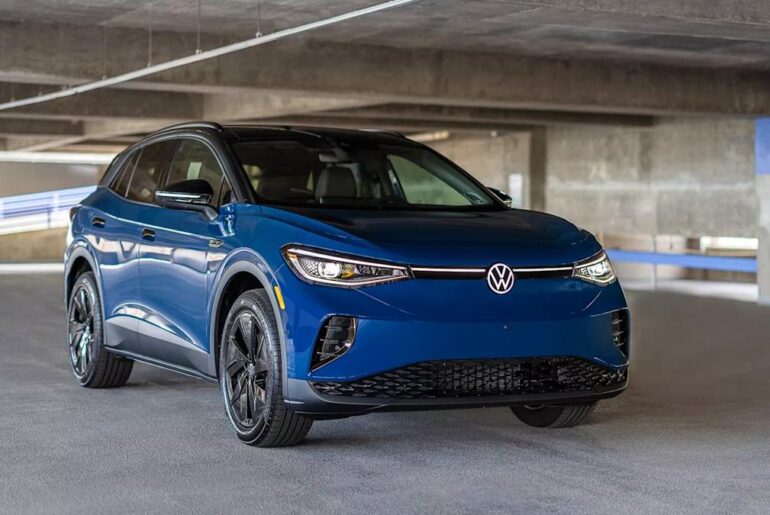
Volkswagen will cease production of the ID.4 at its plant in Chattanooga this month amid headwinds facing the market for electric vehicles.
The German automaker will instead shift its focus to the Atlas and the Atlas Cross Sport. That includes the 2027 model of the Atlas, which the company recently unveiled during an auto show in New York.
“The Chattanooga plant has been, and will continue to be, a cornerstone of Volkswagen’s strategy in the United States,” Volkswagen Group of America President and CEO Kjell Gruner said in a press release issued by the company. “This strategic shift underscores the company’s commitment to Chattanooga and its workforce as we position the plant for long-term success and future product opportunities.”
Michael Lowder, a spokesperson for VW, said the plant is redirecting its attention to higher-volume models that will help sustain the company’s growth in North America.
“Atlas has historically been one of our brand’s most important vehicles in the U.S.,” Lowder said by phone. “It’s been our second-best-selling model for the last three years. We’re really focusing on that vehicle and the Atlas Cross Sport. The EV market has really continued to challenge the industry, really requiring measured decisions. There’s just been a lot of unpredictability over the last few years.”
SALES FIGURES
Volkswagen of America sold more than 71,000 units of the Atlas in the U.S. in 2025, a slight decline from the roughly 75,500 in 2024. The Atlas Cross Sport also saw a dip in sales, dropping from 38,900 in 2024 to almost 31,600 in 2025. Overall, VW’s car sales in the U.S. decreased from 379,178 in 2024 to 329,813 in 2025.
The ID.4 saw an increase in sales in 2025, rising from 17,000 in 2024 to 22,400. Those figures were bolstered by buyers seeking to purchase an electric vehicle before federal tax credits for the automobiles expired Sept. 30. But in January, after the credits expired, the company CarEdge said the electric SUV was the slowest-selling vehicle in the United States, estimating it would take 527 days to sell out the existing inventory.
The new generation of the Atlas will begin production this summer and will be available at dealerships in the fall. The 2026 model year of the ID.4 will remain available to customers in the U.S. through current inventory, which the company expects will support customer demand until 2027.
(READ MORE: Volkswagen reveals 2027 model of Chattanooga-made Atlas)
VW said it is planning a future version of the ID.4 for the North American market. Details will be shared at a later date, the company said.
Volkswagen of America sales for the ID.4, Atlas and the Atlas Cross Sport
–––
ID.4
2021: 16,742
2022: 20,511
2023: 37,789
2024: 17,021
2025: 22,373
–––
Atlas
2021: 72,384
2022: 53,545
2023: 60,859
2024: 75,516
2025: 71,044
–––
Atlas Cross Sport
2021: 43,303
2022: 28,480
2023: 34,816
2024: 38,871
2025: 31,564
Source: Volkswagen
PROTECTIONS
The company informed employees in Chattanooga and the United Auto Workers union of the changes. VW will transfer hourly employees working on the ID.4 to other positions at the plant based on seniority. The company said it will do this in consultation with the local union. VW will offer a special early retirement program for eligible employees.
“Thanks to UAW members fighting for layoff protections in their recently ratified collective bargaining agreement, workers at the plant aren’t being left behind,” Kevin Gotinsky, director of the UAW Transnational Department, said in a statement Thursday. “All workers will remain employed while the company determines the path to the next model. A union contract is only as strong as its job security clause — and this hard-fought agreement delivers.”
Josh Epperson, a 14-year VW employee who cochairs the local UAW bargaining committee, said VW’s announcement underscored the importance of the union and the recently approved contract, which helped to preserve jobs. The recent shift in production priorities has been handled better than prior changes at the plant, he said.
“While it’s not perfect, at the end of the day, if you’re still able to get 40 hours and go home and provide for your family and yourself, that’s why we did what we did,” Epperson said by phone. “I just hate having to use it so soon after getting it.”
Volkswagen is the city’s fourth-largest employer with 3,937 workers as of Dec. 31, according to a list maintained by the Chattanooga Area Chamber of Commerce.
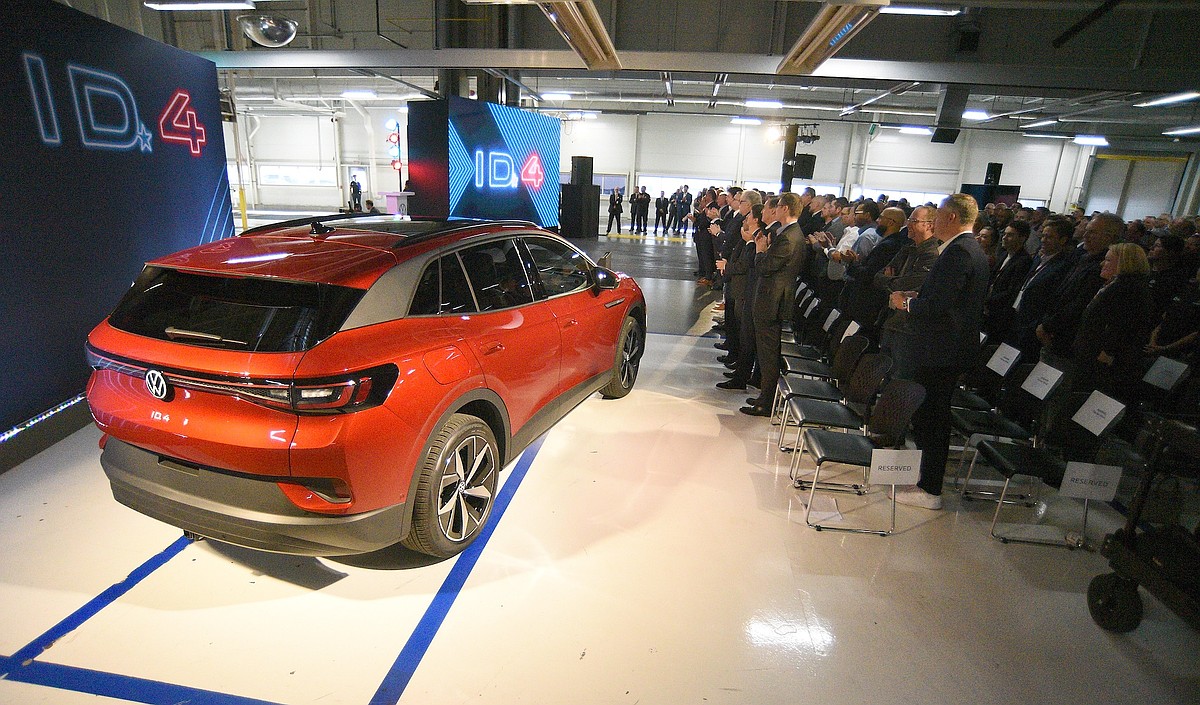
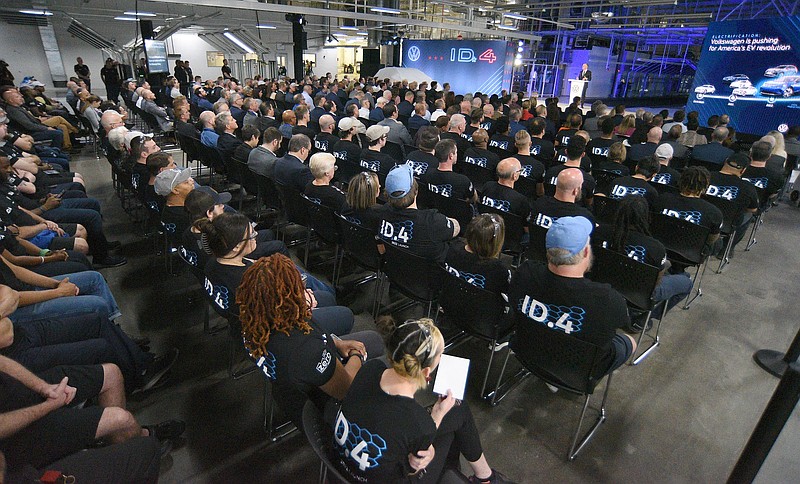 Staff file photo by Matt Hamilton / In 2022, employees look on during the launch celebration for the Volkswagen ID.4 electric SUV at the Chattanooga Volkswagen Assembly Plant.
BEETLE
Karl Brauer, executive analyst at iSeeCars.com, said Volkswagen’s decision is an undeniable indication that the company can’t sell enough ID.4s in the U.S. The electric SUV was supposed to be the automaker’s new, high-volume seller akin to the Volkswagen Beetle, which was the foundation of its success in the U.S., Brauer said.
After Ford’s Model T, which was produced from 1908 to 1927, there was no other car as dominant in U.S. and globally than the Volkswagen Beetle, he said.
“They essentially presented the ID.4 as their next Beetle — their next high-volume, foundational anchor for their entire model line and their sales in the U.S.,” Brauer said by phone. “And, obviously, that hasn’t worked out.”
The Beetle was less expensive than the average car, which contributed to its success, Brauer said. The ID.4, meanwhile, was a $40,000 vehicle — well above the new car price at the time, Brauer said. As an electric car, it also had a series of restrictions, he said, including its performance in cold weather and range.
“It’s really just a complete capitulation to the fact that the ID.4 could not remotely deliver the number of sales and consumer interest that VW initially planned,” he said.
VW’s plans to unveil a future version of the ID.4 echos assurances other automakers have made about their electric vehicle strategies, he said.
“No one wants to say they’re walking away from EVs, but no one wants to commit like they were two years ago,” he said.
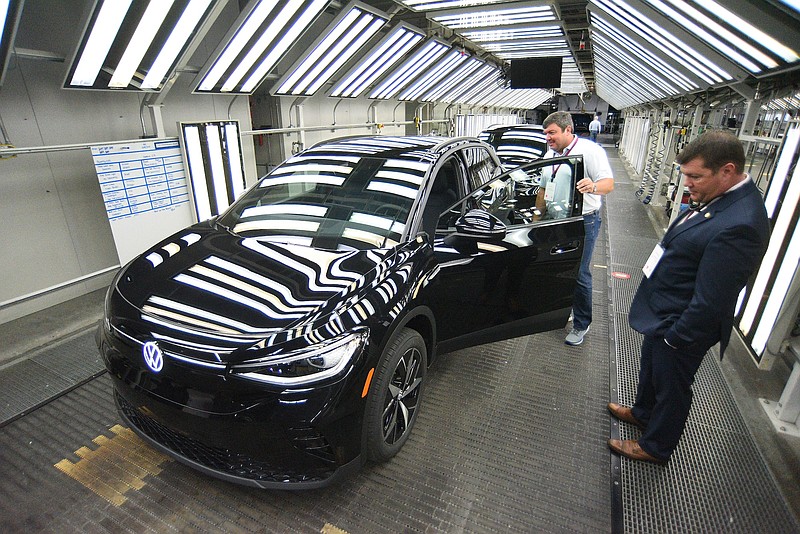 Staff file photo by Matt Hamilton / In 2022, visitors get a chance to look over the new vehicles during the launch celebration for the Volkswagen ID.4 electric SUV at the Chattanooga Volkswagen Assembly Plant.
TAX CREDIT
Federal legislation passed under President Donald Trump ended the tax credit for electric vehicles. The credits were worth $7,500 for new purchases and $4,000 for used automobiles. However, Brauer said the disappearance of the incentive had little impact on EV demand, although it may have pulled forward purchases that people otherwise would have made in early 2026.
(READ MORE: Chattanooga-produced Volkswagen ID.4 makes top 10 list)
“That’s the narrative that a lot of people want to say — ‘If we were supporting EVs, they would still be selling great,’” he said. “No, no and — once again — no.”
In cities and states across the U.S., Brauer said, the market share for EVs has persistently hit a plateau of around 7% to 8%, at which point sales dramatically slowed. Nationally, market share hit that 8% level in September 2024 — before the presidential election. Car companies started getting nervous about the rate of EV sales in October or November of that year, he said.
The expiring tax credit did lead to a rush on electric vehicles before it expired, Brauer said, but it was not responsible for ending growth in the market. That had already ended a year earlier.
“Incentive or no incentive, 90% plus of the U.S. consumers don’t want an electric vehicle,” Brauer said. “That’s all there is to it.”
Contact business reporter David Floyd at dfloyd@timesfreepress.com or 423-757-6249.

David Floyd is a business reporter for the Chattanooga Times Free Press. He graduated from East Tennessee State University in 2017 and previously worked for the Johnson City Press. He is the second youngest of six siblings. Contact him at 423-757-6249 or dfloyd@timesfreepress.com.