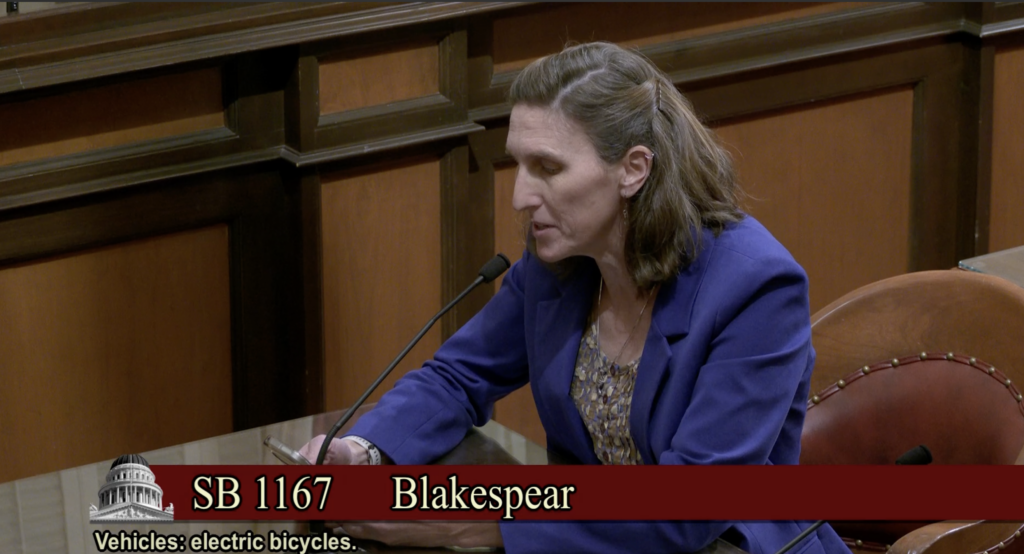
Yesterday, the California Senate Transportation Committee unanimously moved Senate Bill 1167, legislation by Catherine Blakespear (D-Encinitas) that would create statewide definitions for e-bikes and regulate how faster, and more dangerous, e-motorcycles (e-motos) could be sold and marketed. You can watch yesterday’s hearing at CalMatters’ Digital Democracy page for the legislation.
“SB 1167 will address the lack of clarity in the e-bike marketplace by better regulating motor vehicles that look like e-bikes so purchasers are aware of safety risks, and manufacturers and sellers are held responsible for misleading advertisements,” testified Blakespear while introducing the legislation.
There are many bills seeking to regulate e-bikes moving in the legislature, but SB 1167 is nearly universally supported. Organizations that are backing the legislation include bicyclists advocacy groups, other traffic safety groups, police organizations, and cities.
Speaking on behalf of People for Bikes, Jeanie Ward-Waller explained the major safety issues created by the current confusion between e-bikes and e-motos.
“Some e-motos have motors with thousands of watts of power and can reach highway speeds of 65 miles per hour,” she informed the committee. “Particularly terrifying are the growing safety risks to children and teens as e-motos are marketed to younger riders on social media. Recent research tallied devices in bike racks at San Mateo and Marin County Schools, and found that 90% were actually e-motos.”
Key Provisions of SB 1167
As amended, SB 1167 would do the following.
Definitions and classifications
Refines the legal definition of an “electric bicycle”
Must have operable pedals and a motor ≤ 750 watts.
Excludes higher-powered or faster devices from being classified as e-bikes, even if marketed that way.
Updates definitions of related vehicles, including:
Motor-driven cycles (electric motorcycles up to certain power levels)
Mopeds (low-speed motor vehicles, including electric versions)
Consumer protection and advertising rules
Makes it illegal to market or sell non–e-bikes as “electric bicycles”
Targets deceptive labeling of high-speed devices.
Treats violations as false advertising under state law, creating enforcement mechanisms.
Requires clear disclosures in advertising for electric mopeds and similar vehicles:
Must inform buyers they are motor vehicles subject to licensing, registration, and insurance laws.
Safety and regulatory framework
Separates low-speed e-bikes from higher-speed electric vehicles in law and regulation.
Ensures more powerful devices are treated as motor vehicles, subject to stricter safety and operational rules.
Addresses growing concerns about youth use and safety risks tied to mislabeled high-speed devices.
Additional provisions
Clarifies rules for off-highway electric motorcycles, including identification and certification requirements.
Expands enforcement, meaning violations (e.g., mislabeling) could carry legal penalties.