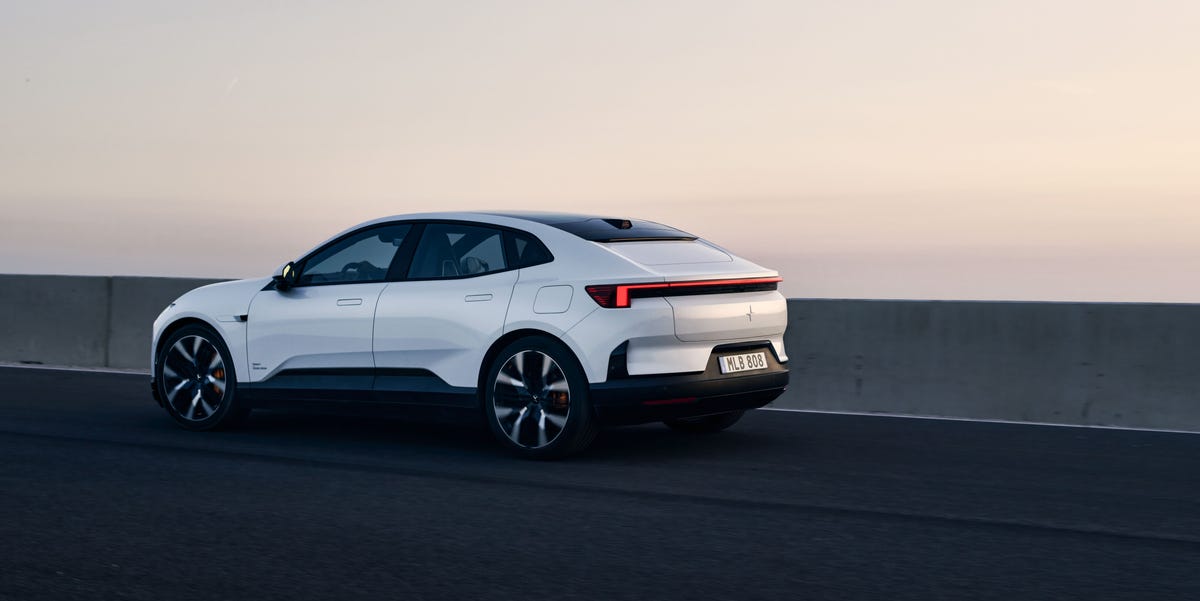
The 2026 Polestar 4 electric crossover will not be mistaken for anything else out there. Way out there. That’s hard to do in today’s market, where if you took the badges off all the crossover utility vehicles, we could all drive each other’s cars and no one would know the difference.
So kudos to Polestar.
Related Story
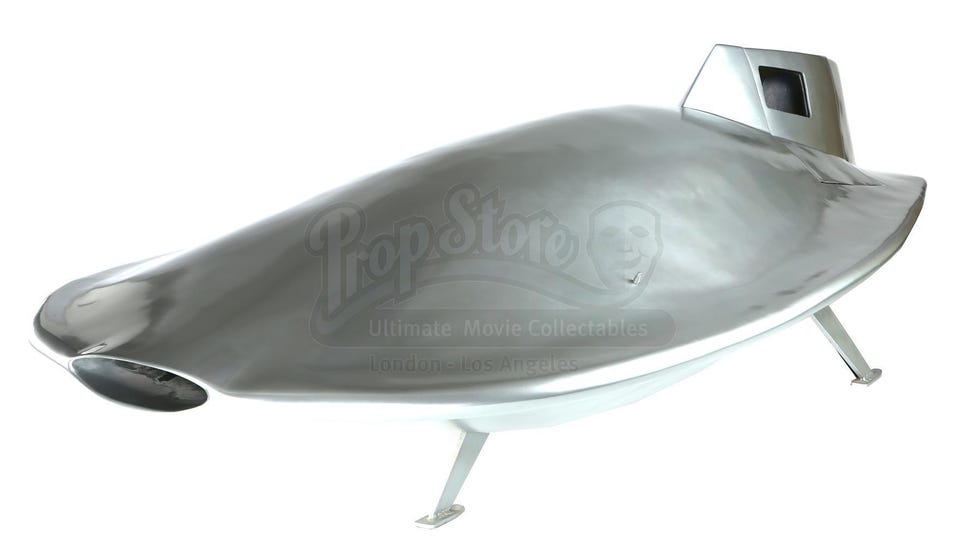
But getting to that uniqueness took some sacrifices. For instance, the car bears a striking resemblance to Uncle Martin’s spaceship from the TV show My Favorite Martian, which ran on CBS from 1963 to 1966. Of course, the inspiration for the spaceship was supposed to have been the Jaguar E-Type. Maybe the fairing came from the D-Type. So the Polestar 4’s look is not necessarily a bad thing.
But the funky look includes no rear window! You have to look at the inside rearview mirror to see what’s behind you. Will you get used to it? I’ve had the car a week and I haven’t. The C8 Corvette really needs its rearview mirror and it has rear glass. It’s hard not to whine about this feature.
Another thing: the car has those pop-out door handles, but they seem to take forever to pop out. Hold the key fob right on the door, hold it on the little symbol on the B-pillar, hold it anywhere you like, even leave it in your pocket, and the door handles take their own sweet time about popping out.
All this for $80,800, as tested. The starting MSRP is $64,300 including destination. But my borrowed press car was the fancy dual-motor model, with one permanent magnet synchronous motor at each axle. Together they make 536 hp and 506 lb-ft of torque, enough to swat the Polestar 4 from 0-60 in 3.7 seconds with no one-foot rollout. With it, the time would be even quicker, maybe 3.5, or so.
Related Story
That’s not bad for a commodious crossover utility vehicle that weighs 5192 pounds, much of which is the 100-kWh nickel-manganese-cobalt lithium ion battery (94 kWh useable). That’s good for 272 miles EPA range, or 367 miles on the downright delusional European WLTP cycle. I wound up getting closer to the EPA range figure when driven at freeway speeds around 70 mph.
The combination of 22-inch wheels and 265/40R22 Pirelli P-Zeros meant a harsher-than-preferred ride. It does do a better-than-expected job of controlling roll in corners, but I’d spec mine out with smaller wheels and taller sidewalls.
 VIEW GALLERYMark Vaughn
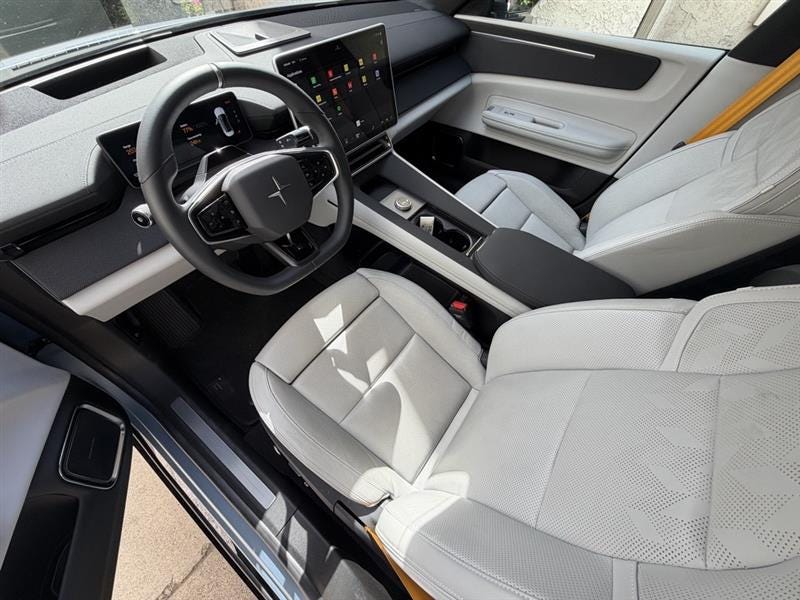
Clean, comfortable cabin with a big touchscreen.
Inside is where the 4 shines. Polestar calls the interior “like business class.” If you’ve ever driven a Tesla you’ll think Polestar was trying a little too hard to copy Elon, or at least Elon’s Tesla designer Franz von Holzhausen. Most of the controls are adjusted through the center touchscreen, another thing I didn’t get completely used to in the week I had the car.
I never completely figured out the radio, for instance. Sometimes it would work, other times it refused to. I’m sure I just had to read more of the owner’s manual, but most carmakers have figured out that most buyers want two knobs for audio. The Polestar 4 does get one knob but only for volume and mute, everything else is handled via the touchscreen.
Related Story
The solid metal hatch is supposed to be for better headroom, which is the worst excuse ever thought up. Headroom is not a function of rear glass.
Okay, enough whining about the rear hatch. The car overall was mostly pleasant to drive. The rear seats had lots of room in every dimension, and the front seats were likewise comfortable.
If the 63k dual-motor is too steep a price to pay for the 4’s individuality, the single-motor 4 starts at about eight grand less, which isn’t that much less so you might as well get the quicker car.
Funkiness has its price, both monetarily and in very mildly irritating personality traits.
 Propstore/CBS
Uncle Martin’s full-sized metal and fiberglass spaceship from the sci-fi sitcom My Favorite Martian sold on Propstore.com for $100,000.

Mark Vaughn grew up in a Ford family and spent many hours holding a trouble light over a straight-six miraculously fed by a single-barrel carburetor while his father cursed the Blue Oval, all its products and everyone who ever worked there. This was his introduction to objective automotive criticism. He started writing for City News Service in Los Angeles, then moved to Europe and became editor of a car magazine called, creatively, Auto. He decided Auto should cover Formula 1, sports prototypes and touring cars—no one stopped him! From there he interviewed with Autoweek at the 1989 Frankfurt motor show and has been with us ever since.