 Market Overview
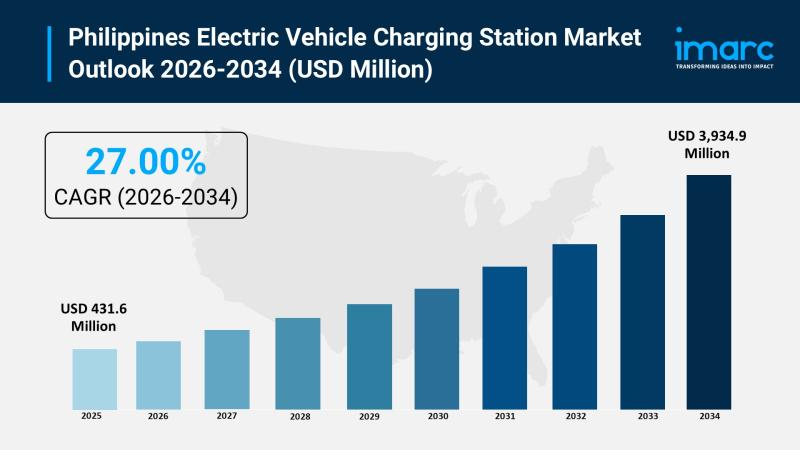
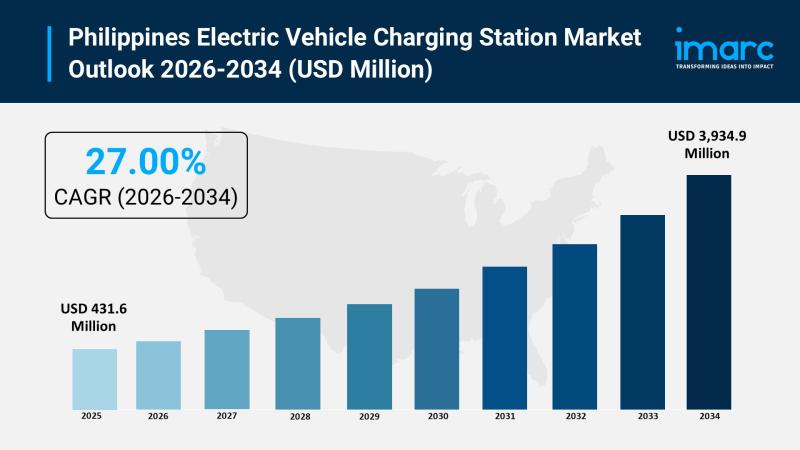
The Philippines electric vehicle charging station market size reached USD 431.6 Million in 2025. Looking forward, the market is expected to reach USD 3,934.9 Million by 2034, exhibiting a growth rate (CAGR) of 27.00% during 2026-2034. The market encompasses diverse charging station types, vehicle compatibility categories, installation formats, charging levels, and connector standards tailored to the Philippines’ rapidly expanding EV ecosystem, covering AC charging, DC charging, and inductive charging across portable and fixed installation types, serving battery electric vehicles (BEV), plug-in hybrid electric vehicles (PHEV), and hybrid electric vehicles (HEV) through Level 1, Level 2, and Level 3 charging infrastructure across residential and commercial applications spanning the regions of Luzon, Visayas, and Mindanao. Environmental imperatives, growing EV ownership, public-private infrastructure investments, renewable energy integration, mobile app platforms, regional deployment plans, and government incentive schemes are some of the key factors driving market growth throughout the forecast period.
Request for a sample report PDF: https://www.imarcgroup.com/philippines-electric-vehicle-charging-station-market/requestsample
Philippines Electric Vehicle Charging Station Market Summary
• The Department of Energy’s EV infrastructure roadmap targeting the deployment of over 7,000 public EV charging stations by 2028 – up from approximately 300 in 2023 – supported by partnerships with distribution utilities for the integration of solar-hybrid chargers in provincial hubs.
• Municipal governments in Cebu and Davao approving rooftop charger installations in transport terminals and public parking facilities, expanding the geographic footprint of public charging infrastructure beyond Metro Manila into key secondary cities.
• Reduced import tariffs on EV charging equipment lowering capital expenditure for infrastructure operators and accelerating the deployment of both public and private charging networks across urban and provincial areas.
• Real-time station locator applications and reservation platforms improving charging accessibility and consumer confidence, with blockchain-based payment systems and interoperable RFID tags enabling seamless billing across multiple charging network providers.
• VinFast’s charging arm V-GREEN signing an MOU with Taiwan’s eTreego in March 2025 to deploy 100,000 EV charging stations across Southeast Asia – including the Philippines – supporting rising regional EV demand and accelerating infrastructure development.
• V-Green, Green GSM Philippines, and MERALCO signing an MoU in July 2025 to accelerate EV adoption and charging infrastructure deployment, targeting public charging stations and electric taxi hubs in Metro Manila while exploring solar-powered charging and workforce training initiatives.
• VinFast launching a free EV charging program at V-Green-operated stations in April 2025 – available until May 2027 – alongside green financing partnerships with EastWest Bank and BDO, supporting broader EV ecosystem development and consumer adoption.
• Smart charging networks leveraging load-balancing algorithms and dynamic tariff systems to manage grid stress, with pilot microgrid-linked stations in typhoon-prone regions like Bicol offering backup power resilience during outage events.
Key Trends Shaping the Philippines Electric Vehicle Charging Station Market
• Government incentives and deployment targets: The Department of Energy’s EV infrastructure roadmap – backed by reduced import tariffs on charging equipment and an ambitious target of over 7,000 public stations by 2028 – is providing a structured policy and funding framework that catalyzes station deployment and strengthens consumer confidence in EV adoption across all regions.
• Technology partnerships and energy resilience: Energy and technology providers are collaborating to build resilient, smart charging networks using load-balancing algorithms, solar-battery pairing, microgrid integration, and remote diagnostics – addressing grid stress and power reliability challenges in a country regularly affected by typhoons and intermittent grid outages.
• Renewable energy integration: Solar-hybrid charger deployments in partnership with distribution utilities and the integration of battery storage at charging sites are reducing peak demand costs, lowering operating expenditures, and aligning the charging infrastructure sector with the Philippines’ broader renewable energy and decarbonization objectives.
• Digital platform and payment ecosystem development: The expansion of mobile app-based station locators, reservation platforms, blockchain-enabled billing systems, and interoperable RFID payment tags is improving the user experience, reducing friction in multi-network charging, and building the digital infrastructure layer required to support mass EV adoption.
• Strategic multinational and public-private partnerships: High-profile collaborations between global EV manufacturers, domestic energy utilities, financial institutions, and government agencies – including MoUs between V-GREEN, MERALCO, eTreego, EastWest Bank, and BDO – are establishing integrated EV mobility ecosystems that combine charging infrastructure, clean energy, green financing, and after-sales services under coordinated frameworks.
Browse the full report with TOC and list of figures: https://www.imarcgroup.com/philippines-electric-vehicle-charging-station-market
Market Growth Drivers
Government Policy, Infrastructure Targets, and Incentive Frameworks
The Philippine government’s proactive deployment agenda – anchored by the Department of Energy’s target of over 7,000 public charging stations by 2028, reduced import tariffs on charging equipment, and coordinated partnerships with distribution utilities – is creating a strong and enabling policy environment for rapid infrastructure scale-up. Municipal-level approvals in Cebu and Davao are extending deployment beyond Metro Manila, ensuring geographic diversification of the charging network. The alignment of national infrastructure targets with local government implementation, digital platform development, and consumer incentive programs – including VinFast’s free charging initiative and bank-backed green financing schemes – is simultaneously lowering barriers to EV ownership and charging access, reinforcing a virtuous cycle of adoption and infrastructure investment that underpins the market’s exceptional 27.00% CAGR trajectory through 2034.
Energy Resilience, Technology Integration, and Private Sector Investment
The Philippines’ unique geographic and climatic challenges – including typhoon vulnerability, archipelagic dispersal, and intermittent grid reliability – are driving demand for resilient, smart, and solar-integrated charging solutions that go beyond standard grid-tied infrastructure. Private sector investments in microgrid-linked stations, solar-battery paired chargers, load-balancing smart networks, and OTA-updatable equipment are addressing these localized infrastructure challenges while simultaneously reducing operating costs and improving service reliability. The entry of major multinational players including VinFast’s V-GREEN, eTreego, and MERALCO into large-scale MoU-based deployment frameworks is injecting significant private capital, technical expertise, and cross-border partnership structures into the market – creating the investment momentum and ecosystem depth required to sustain the Philippines electric vehicle charging station market’s rapid expansion across Luzon, Visayas, and Mindanao throughout the 2026-2034 forecast period.
Market Segmentation
IMARC Group provides an analysis of the key trends in each segment of the Philippines electric vehicle charging station market, along with forecasts at the country and regional levels from 2026-2034. The market has been categorized based on charging station type, vehicle type, installation type, charging level, connector type, application, and region.
By Charging Station Type:
• AC Charging
• DC Charging
• Inductive Charging
By Vehicle Type:
• Battery Electric Vehicle (BEV)
• Plug-in Hybrid Electric Vehicle (PHEV)
• Hybrid Electric Vehicle (HEV)
By Installation Type:
• Portable Charger
• Fixed Charger
By Charging Level:
• Level 1
• Level 2
• Level 3
By Connector Type:
• Combined Charging Station (CCS)
• CHAdeMO
• Normal Charging
• Tesla Supercharger
• Type-2 (IEC 621196)
• Others
By Application:
• Residential
• Commercial
By Region:
• Luzon
• Visayas
• Mindanao
Key Players
The Philippines electric vehicle charging station market features competition among global EV charging equipment manufacturers, domestic energy utilities, multinational EV brands with integrated charging arms, technology platform providers, and public-private infrastructure consortiums. The market research report provides a comprehensive analysis of the competitive landscape including key player positioning, market structure, top winning strategies, competitive dashboards, and detailed company profiles.
Key Aspects Required for the Philippines Electric Vehicle Charging Station Market
• Demand structure spans individual EV owners, residential condominium developments, commercial real estate operators, retail malls, transport terminals, government fleet operators, logistics companies, and public utility vehicle operators across all Philippine regions.
• Balanced growth between public fast-charging infrastructure deployment in Metro Manila and key secondary cities, and growing residential and workplace slow-charging installation demand as EV ownership accelerates across middle-class and fleet user segments.
• Increasing demand for smart, IoT-connected charging systems with remote monitoring, load balancing, dynamic tariff management, and predictive maintenance capabilities – particularly critical for commercial operators and fleet managers seeking to optimize energy costs and minimize downtime.
• Buyers and operators prioritize charging speed, grid compatibility, software platform interoperability, renewable energy integration capability, total cost of ownership, connector standard coverage, and availability of after-sales technical support in equipment and network selection decisions.
• Growing demand for solar-integrated and microgrid-linked charging solutions addressing the Philippines’ grid reliability challenges and supporting off-grid or backup-powered deployment in typhoon-prone and geographically remote provincial areas.
• Competitive landscape includes VinFast’s V-GREEN, MERALCO, eTreego, and other global and regional charging infrastructure providers competing alongside domestic energy utilities, telecommunications companies, and property developers entering the EV charging space.
• Distribution and deployment channels include direct utility partnerships, property developer integration agreements, government infrastructure tender programs, multinational MoU-based deployment frameworks, and EV manufacturer-bundled charging ecosystem offers combining vehicle sales, financing, and charging access.
• Rising consumer awareness and green financing availability – through bank partnerships offering EV-linked loan products and manufacturer-sponsored free charging programs – reducing the total cost of EV ownership and reinforcing the demand pull for expanded charging infrastructure across all segments.
Recent News and Developments
February 2026: The Philippine government and private sector accelerated efforts to expand EV charging infrastructure, targeting around 7,300 charging stations nationwide by 2028, up from roughly 1,100 stations currently, with partnerships focusing on malls and commercial hubs to improve accessibility.
February 2026: Industry players highlighted infrastructure challenges due to the country’s geography of over 7,000 islands, prompting increased collaboration with local technology providers and property developers to scale charging networks efficiently.
July 2025: V-Green, Green GSM Philippines, and MERALCO signed an MoU to accelerate EV adoption and charging infrastructure deployment in the Philippines, targeting public charging stations and electric taxi hubs in Metro Manila, while also exploring solar-powered charging, workforce training, and technical collaboration to support a full EV mobility ecosystem combining clean transport, energy, and digital services.
April 2025: VinFast launched a free EV charging program at its V-Green-operated stations in the Philippines, available until May 2027, alongside the debut of the VF 6 electric SUV at the 2025 Manila Auto Show. The initiative was complemented by green financing partnerships with EastWest Bank and BDO to support broader EV adoption and accelerate the country’s transition to sustainable transportation.
March 2025: VinFast expanded its EV ecosystem in the Philippines through a partnership with Motech to enhance after-sales services across 63 centers, while V-GREEN signed an MOU with Taiwan’s eTreego to deploy 100,000 EV charging stations across Southeast Asia – including the Philippines – supporting rising regional EV demand and infrastructure scale-up.
Note: If you require any specific information that is not covered currently within the scope of the report, we will provide the same as a part of the customization.
Speak to an analyst for a customized sample report: https://www.imarcgroup.com/request?type=report&id=42008&flag=C
Contact Us
IMARC Group
134 N 4th St., Brooklyn, NY 11249, USA
Email: sales@imarcgroup.com
Tel. No.: (D) +91 120 433 0800
United States: +1-201-971-6302
About Us
IMARC Group is a global management consulting firm that helps the world’s most ambitious changemakers to create a lasting impact. The company provides a comprehensive suite of market entry and expansion services. IMARC offerings include thorough market assessment, feasibility studies, company incorporation assistance, factory setup support, regulatory approvals and licensing navigation, branding, marketing and sales strategies, competitive landscape and benchmarking analyses, pricing and cost research, and procurement research.
This release was published on openPR.