Polestar registered 4,151 units in the UK and 1,284 in Germany during the first quarter — with both key European markets posting year-over-year gains.
The Geely-backed brand registered 2,406 vehicles in the UK in March, according to data published on Tuesday by the Society of Motor Manufacturers & Traders (SMMT).
Sales edged lower by 28 units year over year, but more than tripled compared to February.
First-quarter registrations rose 12.3% compared to the same period a year ago.
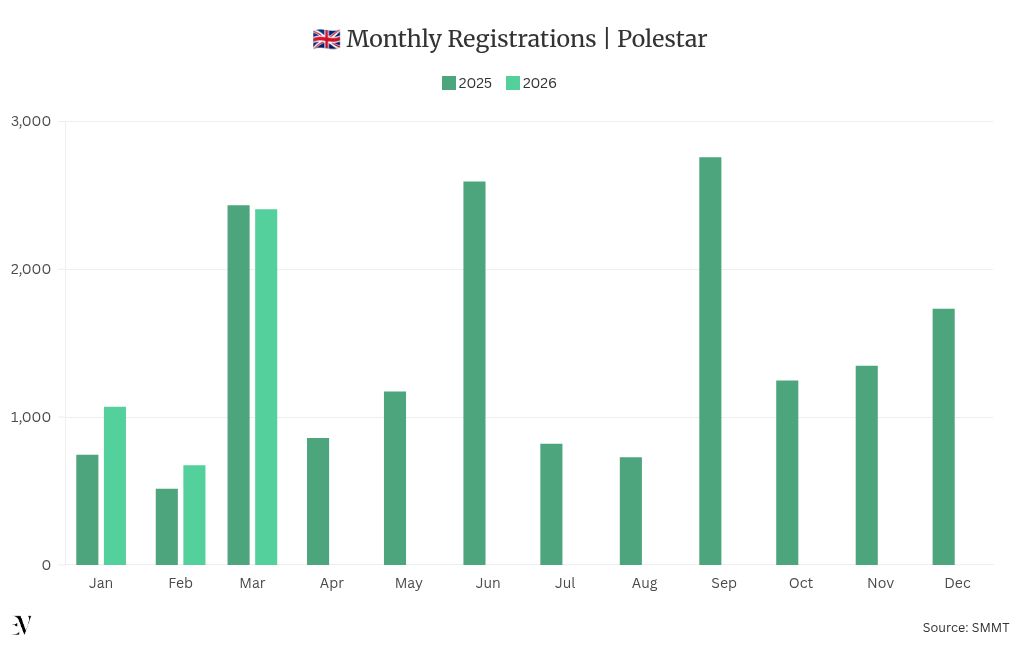
Polestar‘s monthly registrations in the UK depend heavily on shipping logistics from its overseas plants.
All its models are produced in either China or the US (Polestar 3).
Production of the Polestar 4 SUV recently began in South Korea; however, management said the output is set to supply the North American market.
In 2025, the brand registered 16,959 EVs in the country, doubling the number sold the year before.
The company recently delivered its 50,000th vehicle in the UK, according to country chief Matt Galvin.
Speaking on Keyloop’s Drivetime podcast earlier this year, Galvin said the brand is a “common sight on public roads.”
Lineup
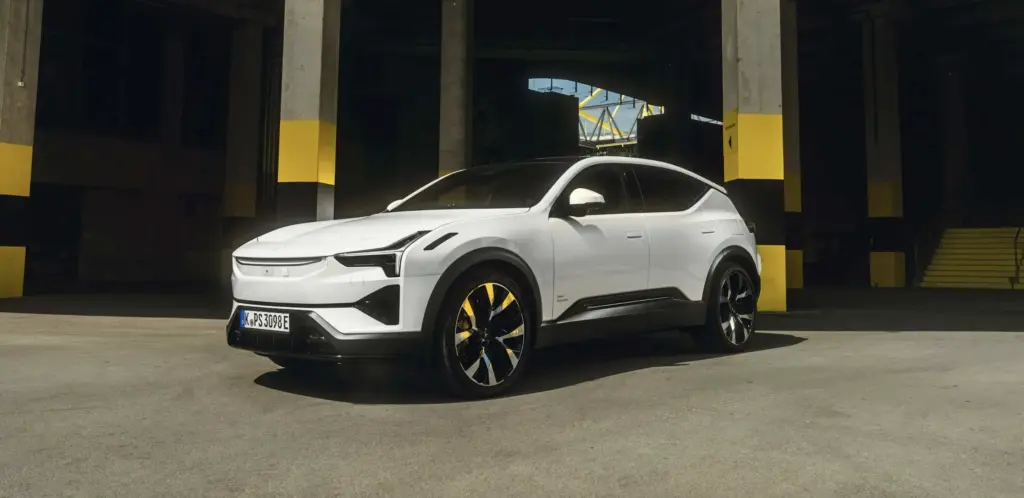
The company’s UK portfolio includes the Polestar 2 sedan, the Polestar 3 and 4 SUVs, and the recently launched Polestar 5 GT.
The Polestar 5 debuted last September at Germany’s IAA Auto Show.
The grand tourer is priced from £89,500 ($121,800), with deliveries originally expected in spring 2026.
The timeline has since slipped to Summer, according to its website. It includes both the Dual Motor and the Performance launch editions.
The UK was the first market to receive the upgraded Polestar 3, released late last year, “due to high demand and the previous model year being sold out in that market.”
The British website lists the new version from £71,540 ($94,700), with a seasonal offer of £5,000 applied across all variants.
In January, the estimated delivery of the model was scheduled for “early March.”
As of Tuesday, the timeline has shifted to “September-October 2026.”
Last week, Volvo and Polestar announced that the SUV is going to be exclusively produced in Volvo’s South Carolina plant in the US.
The Polestar 3 was previously manufactured both there and in China.
Newly configured Polestar 2s have an estimated delivery window of “August-September,” while customized Polestar 4 SUVs are expected to be delivered “late in April.”
Although the SMMT does not break down registrations by model, EV tracking platform EU-EVs reports that the Polestar 4 accounted for 1,305 units in March, making it the brand’s best-selling model in the country.
The SUV represented 2,328 of Polestar‘s total UK registrations in the first quarter.
UK EV Adoption
New vehicle registrations in the UK rose 6.6% in March — typically the country’s busiest month — to 380,627 units.
It was also the strongest month on record for new energy vehicle (NEV) volumes, which reached 196,059 registrations.
Plug-in hybrid (PHEV) registrations climbed 46.9% to a 13.0% market share, while battery electric vehicles (BEV) hit a new record at 86,120 registrations.
Tesla — the EV market leader — registered 8,599 vehicles in the UK in March, bringing its first-quarter total to 11,739 units.
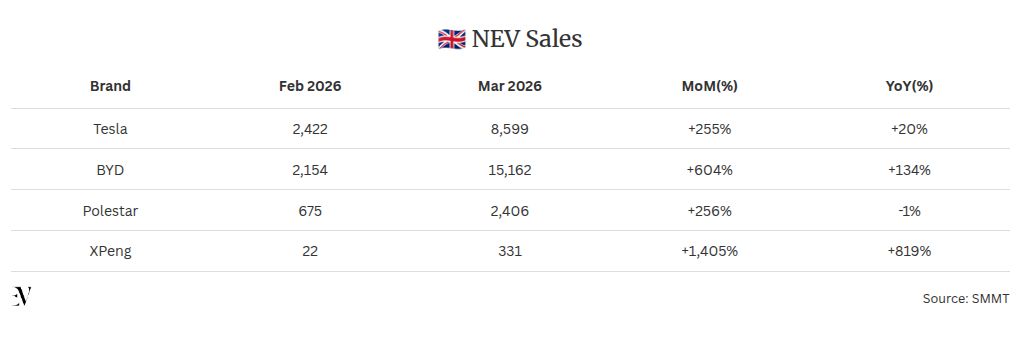
Chinese automaker XPeng, which entered the UK a year ago with the right-hand drive G6, sold 331 vehicles in March.
Policy Shifts
BEVs accounted for just 22.6% of the UK market in March and 22.4% year to date — well below the 33% target set for 2026 under the Zero Emission Vehicle (ZEV) Mandate.
The SMMT noted that conditions have shifted sharply since the mandate was set, including higher battery costs, industrial energy prices, and public charging costs.
The UK has set a target for all new vehicles sold from 2030 to be electric or plug-in hybrid, and plans to ban sales of new petrol and diesel cars entirely.
Starting in April 2028, electric vehicles will be subject to a pay-per-mile road charge similar to the duty currently applied to combustion vehicles.
The government said that the measure will create a fairer system for all drivers.
The change follows the introduction of Vehicle Excise Duty (VED) for EVs in April 2025, which starts at £10 in the first year and rises to £195 from the second year onward.
Germany
Polestar sold 456 vehicles in Germany in March, a 28% increase year over year.
Sequentially, sales jumped 54%.
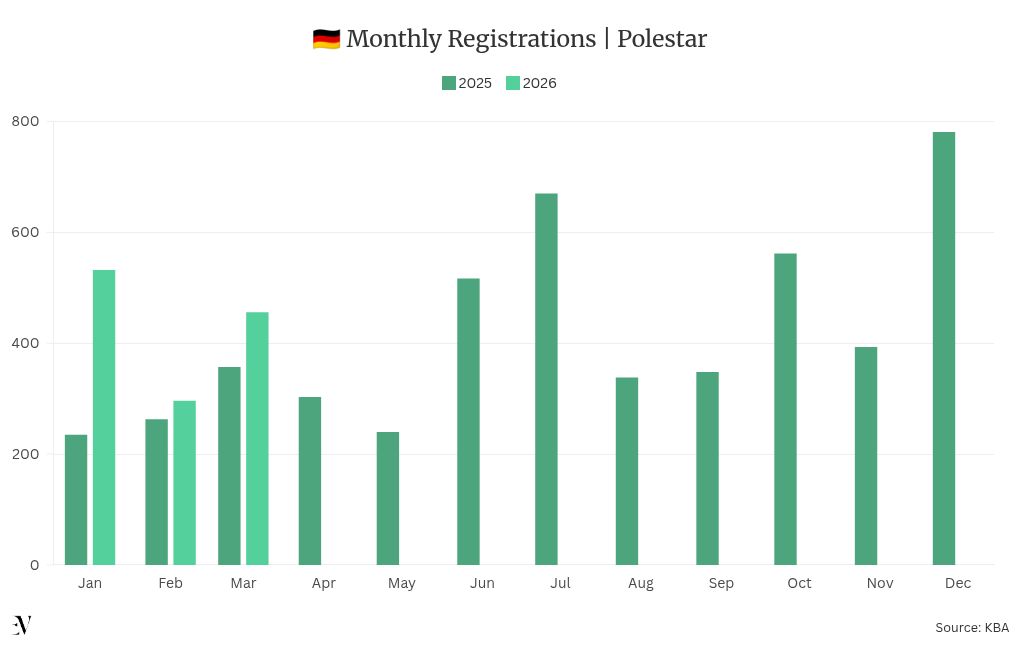
The brand’s first-quarter registrations in Germany reached 1,284 units, a 50.2% jump when compared to the first three months of 2025.
Polestar‘s German lineup includes the Polestar 2 sedan, starting at €48,990 ($57,210); the Polestar 3, from €79,090 ($92,360); and the Polestar 4, from €61,900 ($72,285).
The company is currently offering a €2,000 direct discount on the Polestar 4, applied automatically at checkout on both inventory units and custom orders through June 30.
Buyers can alternatively opt for 0% financing on the same model over a 24-month term with no down payment.
The most recently unveiled Polestar 5 can be configured on the company’s German website, with a starting price of €118,600 ($137,000).
Deliveries in Germany are also scheduled to begin in the Summer.
As the company upgrades its Polestar 3 SUV, the new version is still not available for purchase in Germany.
As of Tuesday, customers were directed to the inventory page, with the configurator for the model stating that “this configuration is not available.”
German EV Adoption
A total of 294,161 new passenger cars were registered in Germany in March, up 16.0% year over year. First-quarter registrations rose 5.2% overall.
Battery electric vehicles accounted for 70,663 of the month’s registrations, up 66.2%, taking a 24.0% market share.
Hybrids accounted for 117,846 units, or 40.1% of the market, including 29,996 plug-in hybrids.
Tesla led the EV segment, with 9,252 vehicles registered — its best monthly results since December 2022.
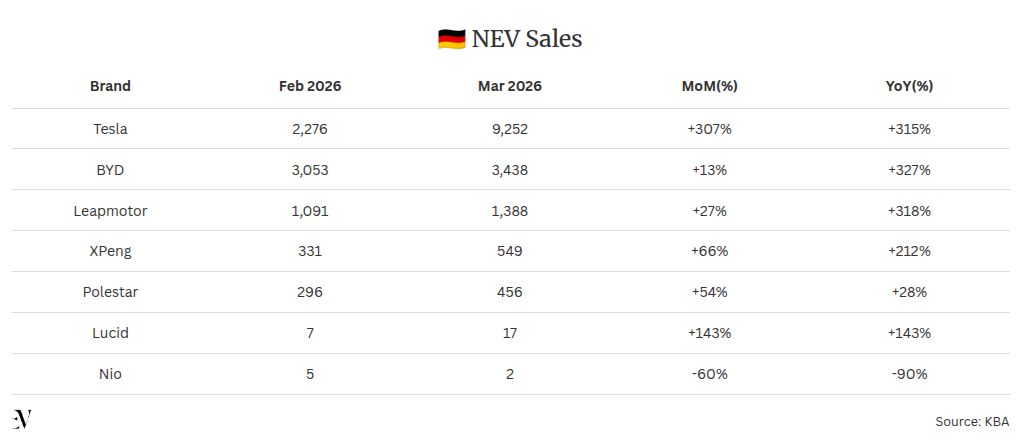
Leapmotor, which entered Germany through its partnership with Stellantis, posted a 318.1% year-over-year surge to reach 0.5% market share.
XPeng rose 211.9%, reaching 0.2% market share as it prepares to begin deliveries of its P7+ sedan in the country.
Nio registered two vehicles in Germany in March, bringing its first-quarter total to eight units in Europe’s largest automotive market.
Germany’s EV market growth is being driven by the new purchase incentive confirmed in January.
The €3 billion scheme, running through 2029, applies retroactively to all eligible EVs registered since January 1, 2026.
The online application portal is expected to go live in May.
Private buyers can receive between €3,000 and €6,000 depending on household income and family size, capped at €80,000 in taxable annual income — or €90,000 for households with two or more children.
The program replaces the previous “Umweltbonus,” which was abruptly scrapped in late 2023 and triggered a sharp slump in German EV demand throughout 2024 and early 2025.
Polestar’s 2026 Outlook
Polestar quietly cut its 2026 sales growth target last month, alongside the announcement of what it described as the “largest model offensive in its history.”
The company is now guiding for “low double-digit volume growth” in 2026 — implying growth of roughly 10–15%.
It is about 20 percentage points below the 30–35% compound annual retail sales growth target for 2025–2027 that it had set a year earlier.
Polestar met its 2025 guidance by delivering approximately 60,119 vehicles, a 34% year-over-year increase, with over 46,000 of those registered in Europe, according to data compiled by EV.
Under the previous 30–35% target, Polestar had been on a path toward 78,000 to 81,000 deliveries in 2026.
The revised outlook implies roughly 66,000 to 69,000 units instead.
Detailed financial guidance is expected alongside the company’s full-year 2025 results — usually reported in April.