“That’s one seriously big lump of chrome-covered Chinesium,” said the text message.
My neighbour. A fellow car enthusiast – not short on an opinion or three – literally gives me the man-on-the-street opinion on the car I’m testing each week, as he daily walks his yappy little dog past my house.
He’s not really wrong. The GWM Tank 500 plug-in hybrid is massive, has been lathered in plasticky chrome, and indeed hails from China.
And as we expect from electrified offerings from the capitalist communist country, value next to legacy brands appears standout.
The 500 PHEV recently joined its hybrid stablemate in the Tank line-up, GWM clearly keen to minimise its new vehicle emissions (NVES) fines with this potential planet-saver: all 2775kg of it.
READ MORE: GWM Tank 500 Ultra review: Is this the electrified 4×4 wagon that signals the end for Toyota’s dirty diesels?
READ MORE: Massive 4500kg braked towing from a PHEV for close to $100K! Tank 700 SUV could deliver that to Australia as soon as 2026
READ MORE: GWM Tank 300 plug-in: Full spec and technical details confirmed, including 115km EV range
Deals are already offered. Initially priced at $79,990 drive-away, the single-grade Ultra model now sits at $76,990 on the road.
That’s a couple of grand under an entry-level diesel-powered Toyota Prado; a trad rival for this new player that’s loaded with kit, luxury and a more cutting-edge powertrain.
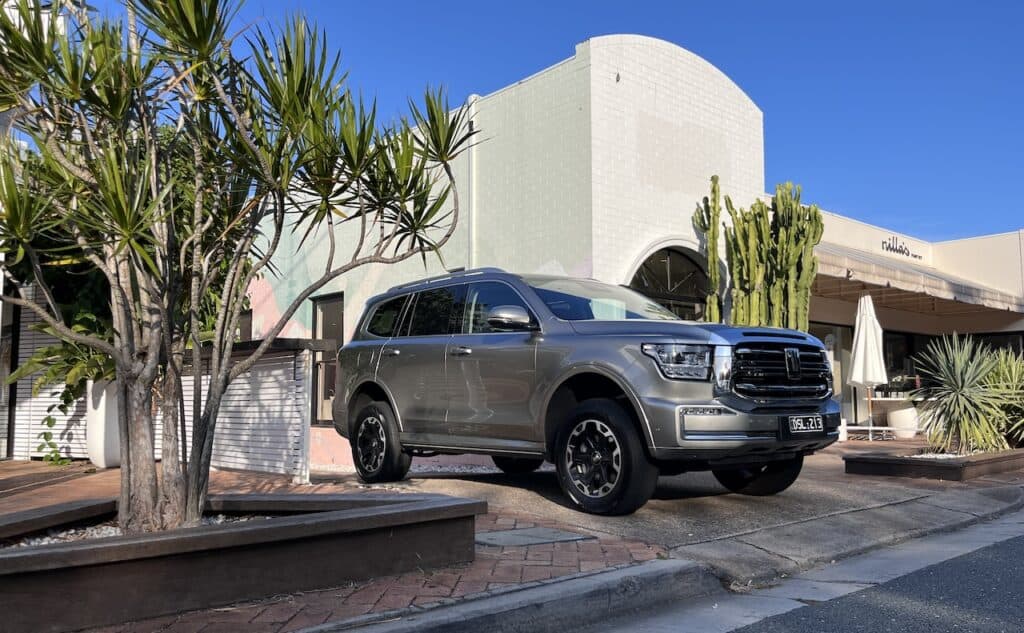 2026 Tank 500 Ultra PHEV.
The 500 PHEV has twice the power (300kW vs 150kW) and substantially more torque (750Nm vs 500Nm) over an oil-burning Prado, while it’ll travel roughly 100km on electric power alone.
It’ll tow only 3000kg – 500kg less than a Prado – which matches its Chinese plug-in rival, the new Denza B5, also closely matched in size. The BYD-backed Denza costs from around $79,500 drive-away.
While use cases and buyers-types will typically be different between large PHEV SUVs and the likes of a Toyota Prado, the impact of the plug-in BYD Shark into established one-tonne ute sales shows tens of thousands of Aussies will ditch what’s gone before for the thrill of the new – and something that can use a lot less fuel.
Can our Tank 500 PHEV do likewise?
2026 GWM Tank 500 Ultra price and equipment
At time of writing, GWM’s ditched cheaper grades of the Tank 500 hybrid (no plugging in required), leaving only a high-spec Vanta at $74,990 – almost price parity with our 500 Ultra plug-in hybrid.
The PHEV features GWM’s heavy-duty Hi4-T setup, bringing mechanical 4WD, dual-range transfer case and electric-locking front and rear diffs. There’s 800mm wading depth, ground clearance is 213mm, while approach/break over/departure angles are 30°/22.5°/24° respectively.
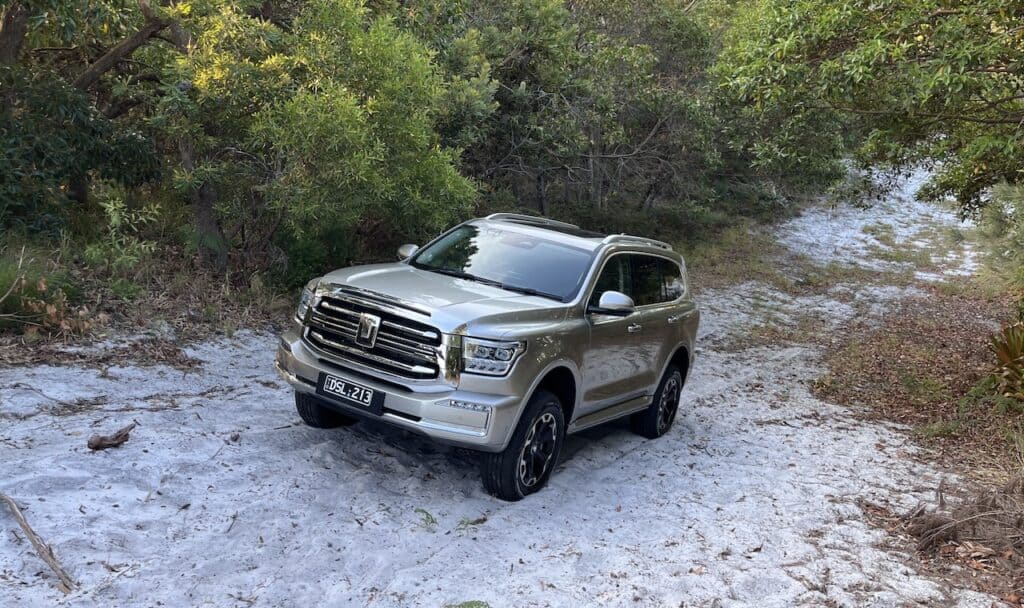 2026 Tank 500 Ultra PHEV: a true mechanical 4×4 with electric front and rear diff locks.
Powering this big unit is a 2.0-litre turbo petrol four-cylinder offering 180kW and 380Nm, complemented by a 120kW/400Nm electric motor mounted between the combustion engine and a nine-speed transmission.
Combined, they offer a rapid-enough 0-100km/h in 6.9 seconds. You’ll accelerate quicker than in a Prado, but a Denza B5 with its 1.5L turbo petrol and twin electric motors does the job in a claimed 4.8 seconds (although our test found this optimistic) with its 425kW and 760Nm outputs.
Battery is a 37.1kWh nickel-manganese-cobalt unit, and GWM claims an all-electric range of 120km under the NEDC rating, which converts to roughly 100km with the more realistic WLTP testing.
It can be charged using public DC charging at up to 50kW, giving 30-80 per cent in 24 minutes. AC charging from 15-100 per cent takes 6.5 hours, while there’s V2L functionality to charge or run appliances up to 6kW.
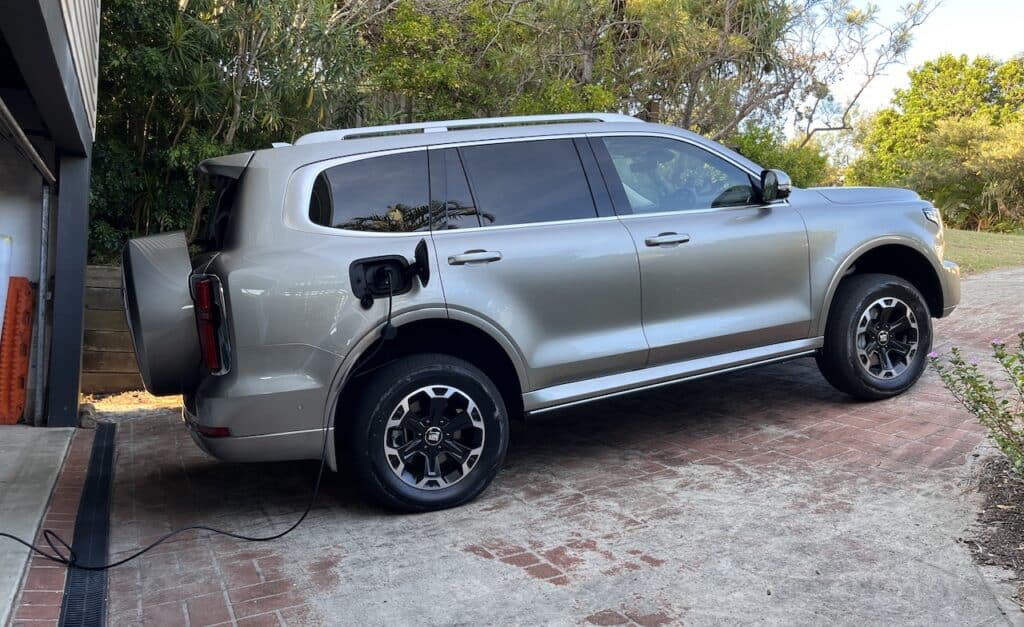 Home charging the 2026 Tank 500 Ultra PHEV: 15-100 per cent takes 6.5 hours with a wallbox.
There’s only a 70L fuel tank (the Tank 500 hybrid’s is 80L), so combined range of this PHEV is around 930km.
The big battery means this Tank 500 PHEV is limited to five seats. The Tank 500 hybrid, however, can be bought with a third row of chairs.
Specification is mighty. There’s 18-inch alloys, electric retractable side steps, electric panoramic sunroof, a trailer power outlet, black Nappa leather interior with power, heated, ventilated, massage and memory front seats, heated steering wheel, ambient lighting, tri-zone climate control, head-up display and 12-speaker Infinity audio.
You ain’t getting that for $76k drive-away in a Prado.
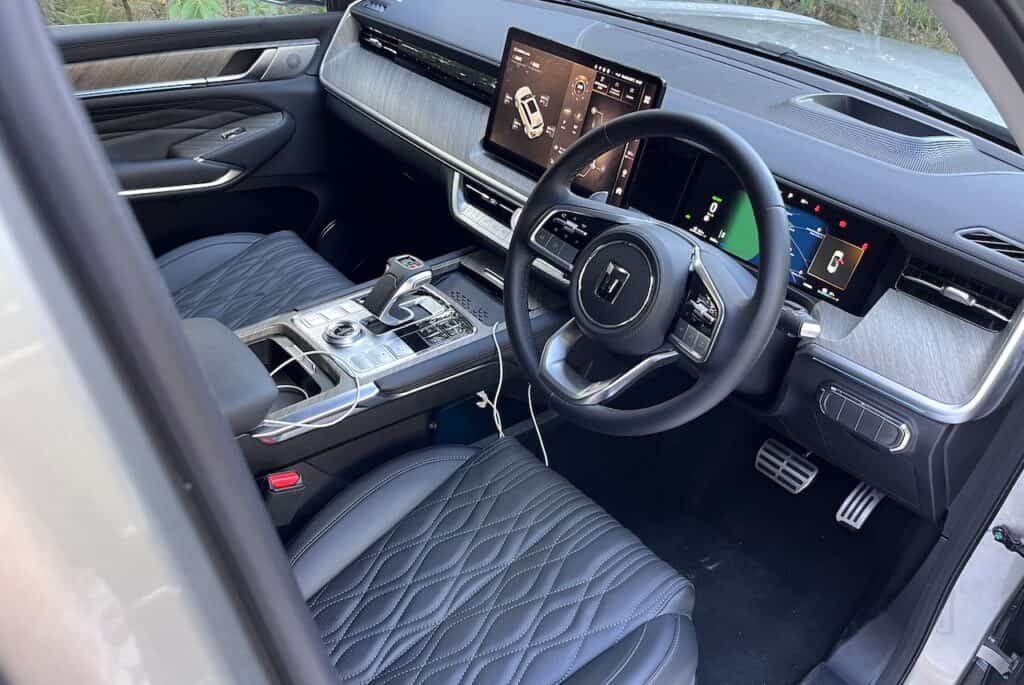 Nappa leather and high-spec interior in the 2026 Tank 500 Ultra PHEV.
Infotainment is through a huge 14-6 inch touchscreen, there’s a 360-degree camera, wireless phone charging, USB-A and USB-C ports, wired Apple CarPlay/Android Auto, 12.3-inch digital driver display and a full suite of driver assist gear. Second row outer seats are heated and ventilated; the back row has independent air con control, and there are window shades.
Cargo volume with all seats up is 640L (the Tank 500 Hybrid has a better 795L), while two seats only up is 1400L (vs 1459L). These easily trump a Denza B5’s, but looks pretty skinny next to a Toyota Prado 5-seater’s 954L/1895L.
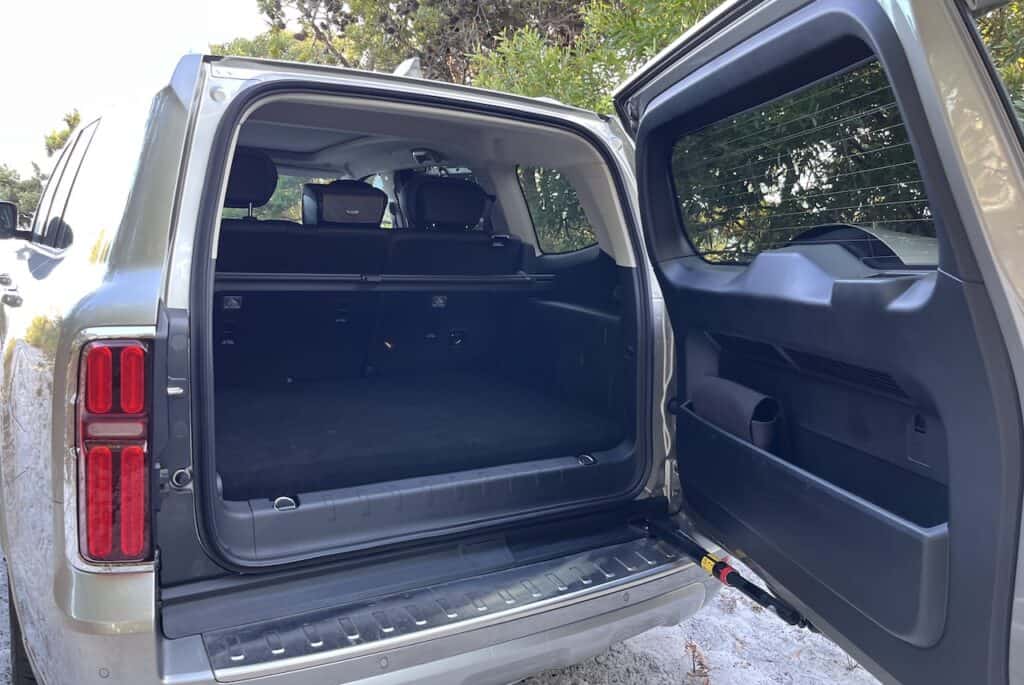 High floor and not that big a boot in the 2026 Tank 500 Ultra PHEV.
It comes with a seven-year/unlimited km warranty, while a separate eight-year/unlimited km warranty applies to the hybrid battery.
2026 GWM Tank 500 Ultra: What we think
Let’s talk who’d buy this behemoth.
For starters, as it has a comprehensive 4WD system, leave it well alone if you’re not planning on doing a fair bit of off-roading. If it’s strictly a town car, your $75k will be much better spent on a more car-like large SUV with lovely on-road manners, like a Hyundai Santa Fe.
This PHEV also only makes sense next to the hybrid version if you’ll be doing slow speed, urban journeys. Here, it excels. You’ll smoothly cruise cities, suburbs and motorway traffic without troubling the petrol engine. And roughly 100km of pure EV range covers a few days of general commuting for most folk, before you need plug it in.
If this is your lap of Australia car, long-distance tourer or tow vehicle, the Tank 500 hybrid’s probably the better option.
If you’ve got home solar and can regularly tap into it to charge the car, that tips things massively in the PHEV’s favour.
When running in ‘Smart’ driving mode, in town and with a bit of off-roading, over 100km with 50 per cent battery I returned 9.3L/100km plus 9.7kWh/100km, which the car reckons combines for 12.3L/100km. Not bad for such a brute in such conditions. But also not saving the planet, you could say.
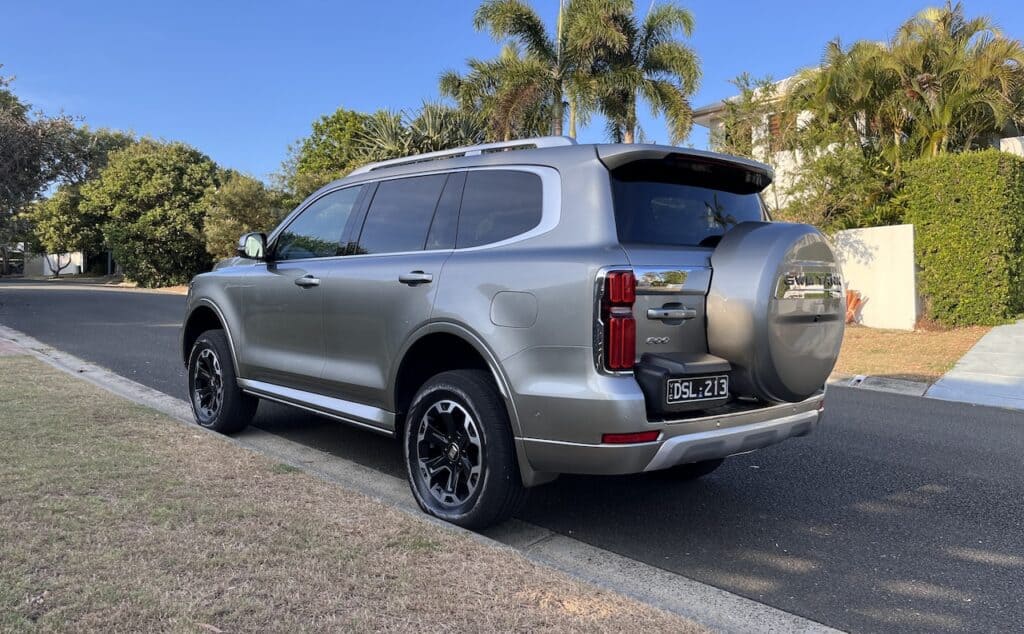 2026 Tank 500 Ultra PHEV – very under-wheeled and on highway rubber.
Prioritising battery power and with some highway thrown in, over 100km it returned 5.6L/100km in petrol and 16kWh/100km battery to combine for 10.6L/100km.
Sling it in EV-only mode and it’ll rapidly consume electrons. With 37.1kWh battery and true range around 100km, you’re staring down efficiency of 37kWh/100km. That’s the trade off lugging around such mass.
In electric-only it’s superbly quiet, while in HEV mode it’ll start recharging the battery using the petrol engine as a generator. This ensures it’s able to tow without losing the combined shove of petrol and electric. The lowest it let me take the battery to was 14 per cent before it began the charging.
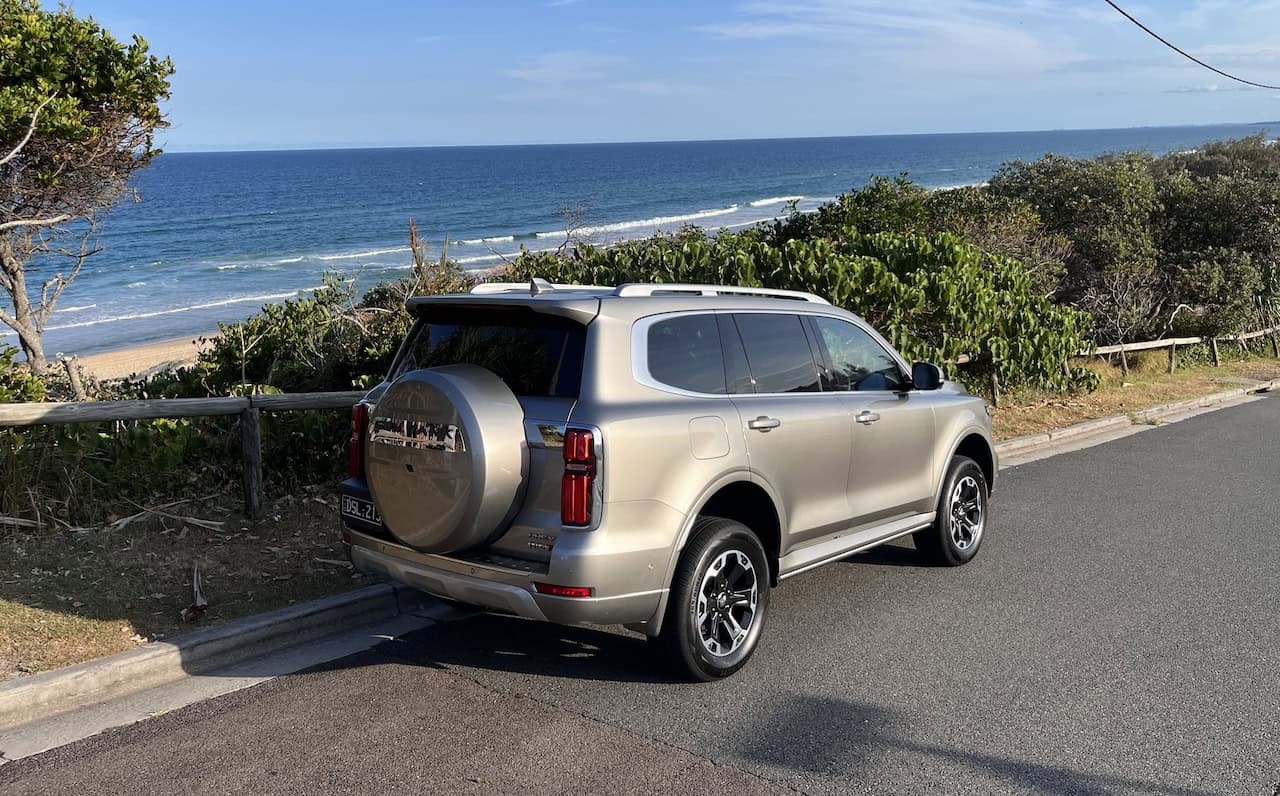
I’m not convinced about the exterior blinginess, overload of front-end lighting, bulbous tailgate-mounted spare and the 500’s quite flabby design, not helped by it looking under-wheeled on 18s with highway tyres. Some chunky knobbly rubber would help the style no end.
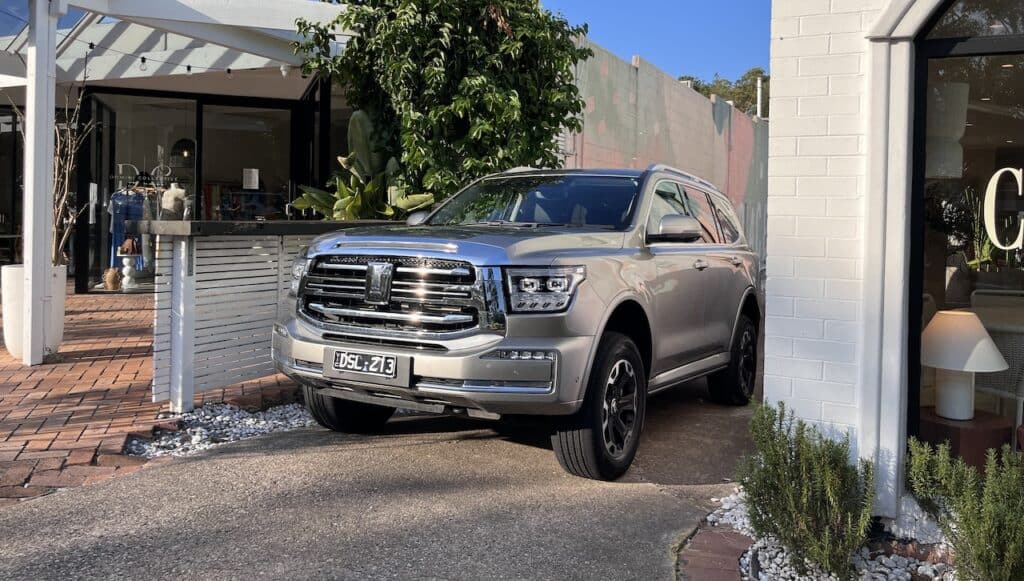 2026 Tank 500 Ultra PHEV in the urban jungle.
The interior – where you spend your time – is another matter.
It presents very well with its patterned-stitched Nappa chairs, giant screens and aviation-like gear selector. There are proper buttons for ventilation, layout’s easy to navigate and there’s heaps of storage.
The digital driver’s display font is daftly too small, while the infotainment screen is, if anything, simply too big and in-the-way. When running CarPlay or Android Auto (like everyone does) there’s no way of dimming the screen enough. At night, it’s ludicrously bright. And as expected, there’s way too much reliance on putting every other control and function through countless menus.
Other negatives include an unnecessary back-lit twinkling stars panel in front of the passenger; radar cruise control panics when it loses the car in front, and it simply makes too many errors with its traffic sign recognition. It’s so bad I was always forced to turn it off.
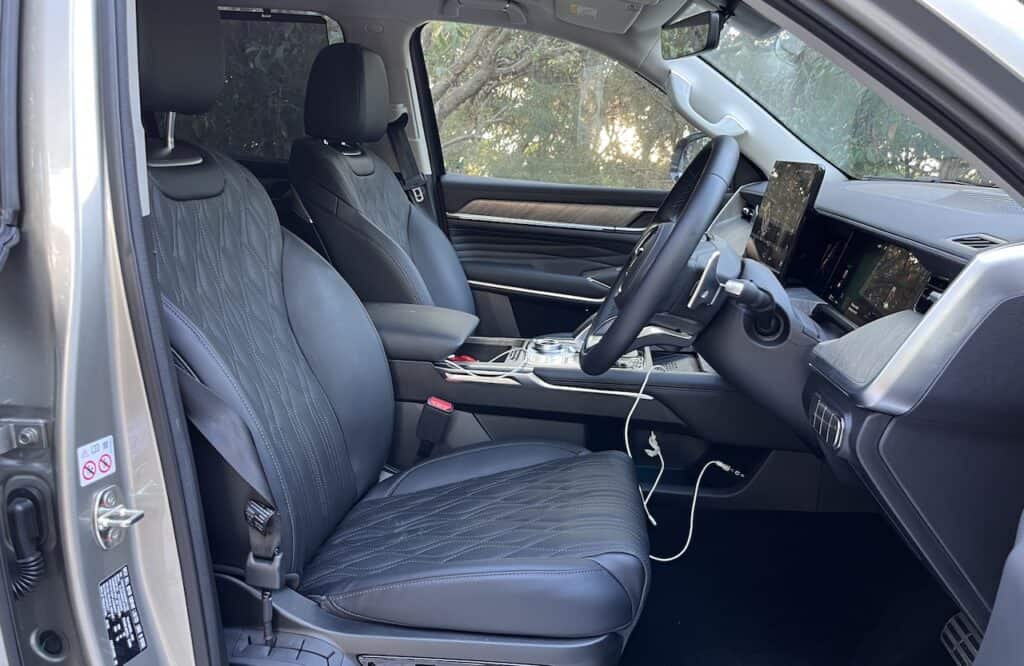 2026 Tank 500 Ultra PHEV – plush cabin.
Throttle response is annoyingly lazy unless you take charge with paddle shifts, but it feels seriously swift when petrol and electric combine their shove.
To its credit, it’s not a wobbling horror in corners, but our Tank works best without quick direction changes.
It’s a peach on the highway, especially in EV mode. It cruises with spongy class, and with massage seat on (I recommend cat walk), giant head-up display in view and impressive sound system, you could while away many hours road tripping in spoil-yourself loveliness.
In town the ride’s firmer and sharper – you simply can’t hide that three-tonne weight when the family’s on board.
2026 Tank 500 Ultra PHEV was limited by its tyres on our sandy climb.
Cameras are superb, especially a clear chassis view when off-roading. Diff locks engage at the touch of a button and clunk-free, but my sandy trail test showed up the limitations of the Tank’s highway tyres. It’ll handle an off-road track really well, and there are a neat selection of drive terrain modes, but my soft sand steep climb proved too much. Different tyres and it’d walk it I reckon.
Rear seat space is mega and ultra-luxurious. Three adults are well accommodated, and if you’ve kids, they’ll have acres of room. They just can’t bring their friends with that lack of third row.
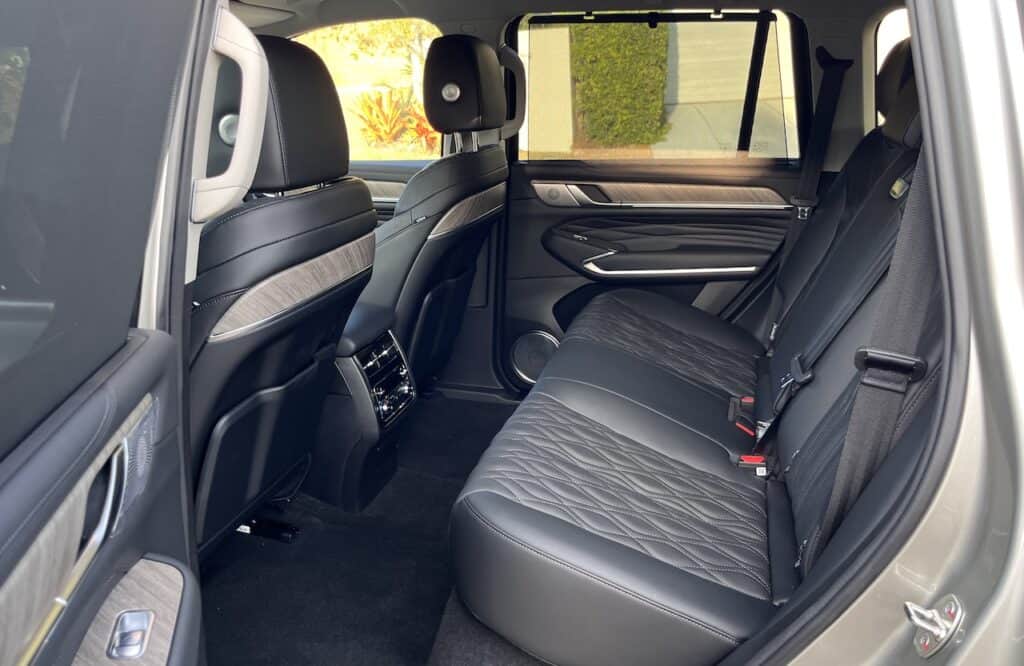 2026 Tank 500 Ultra PHEV: superb rear space and with heated/ventilated chairs.
The side-hinged tailgate will be the preference of some, but the boot shows up its limitations. It’s a really high floor so heavy loading is not easy, and there’s no extra storage beneath.
2026 GWM Tank 500 Ultra: Verdict
A hell of a lot of vehicle and off-road capability for the dollars.
The cabin’s a lovely place to be and supremely spacious, while the PHEV drive is smart, relatively seamless and the 100km EV-only range is potentially hugely cash saving in these spiking petrol price times.
Not great are the towing limited to 3000kg, you must be careful of your payload, the lack of a third row of seats and the poor boot setup. Some fine-tuning of the low-speed ride, throttle maps and driver assist would make this a far easier brute to live with.
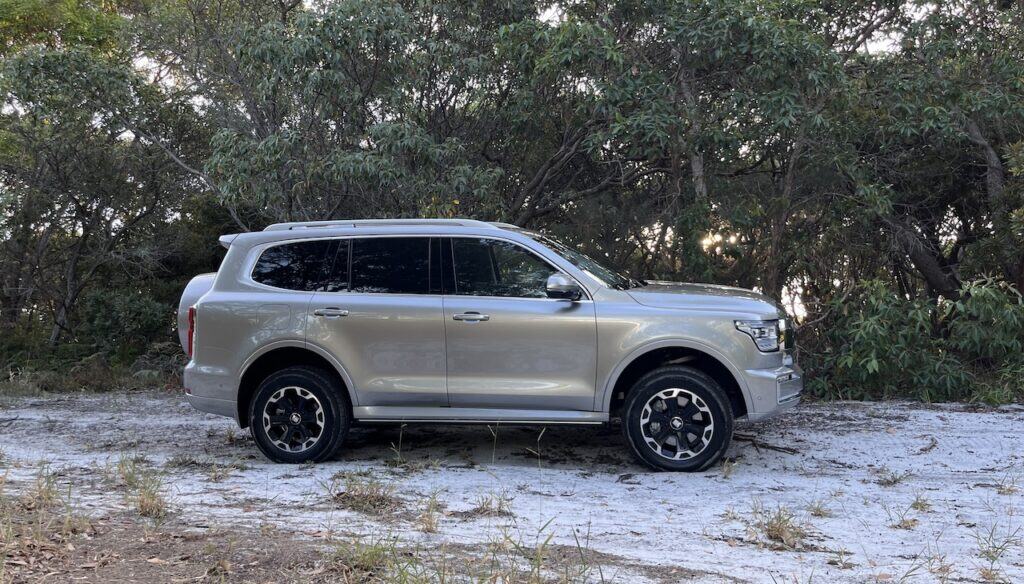 2026 Tank 500 Ultra PHEV.
It’s a large SUV absolutely worth considering if you are a regular off-roader. It’s got the 4WD chops, but like its Denza B5 rival, not the years building trust in the field as Toyota has.
SCORE: 3.5/5
2026 GWM Tank 500 Ultra price and specifications
Price: $76,990 drive-away
Basics: PHEV, 5 seats, 5 doors, SUV, 4WD
Electric Range: 120km (NEDC)
Battery capacity: 37.1kWh
Battery warranty: 8 years/160,000km
Energy consumption: 17.3kWh per 100km
Powertrain: 2.0-litre turbo petrol four-cylinder 180kW/380Nm, with single electric motor 120kW/400Nm – combined 300kW/750Nm
AC charging: 6.6kW, Type 2 plug
DC charging: 50kW, CCS combo plug
0-100km/h: 6.9 seconds