Jakarta deepens partnership with Korea to build full EV, battery supply chain beyond nickel
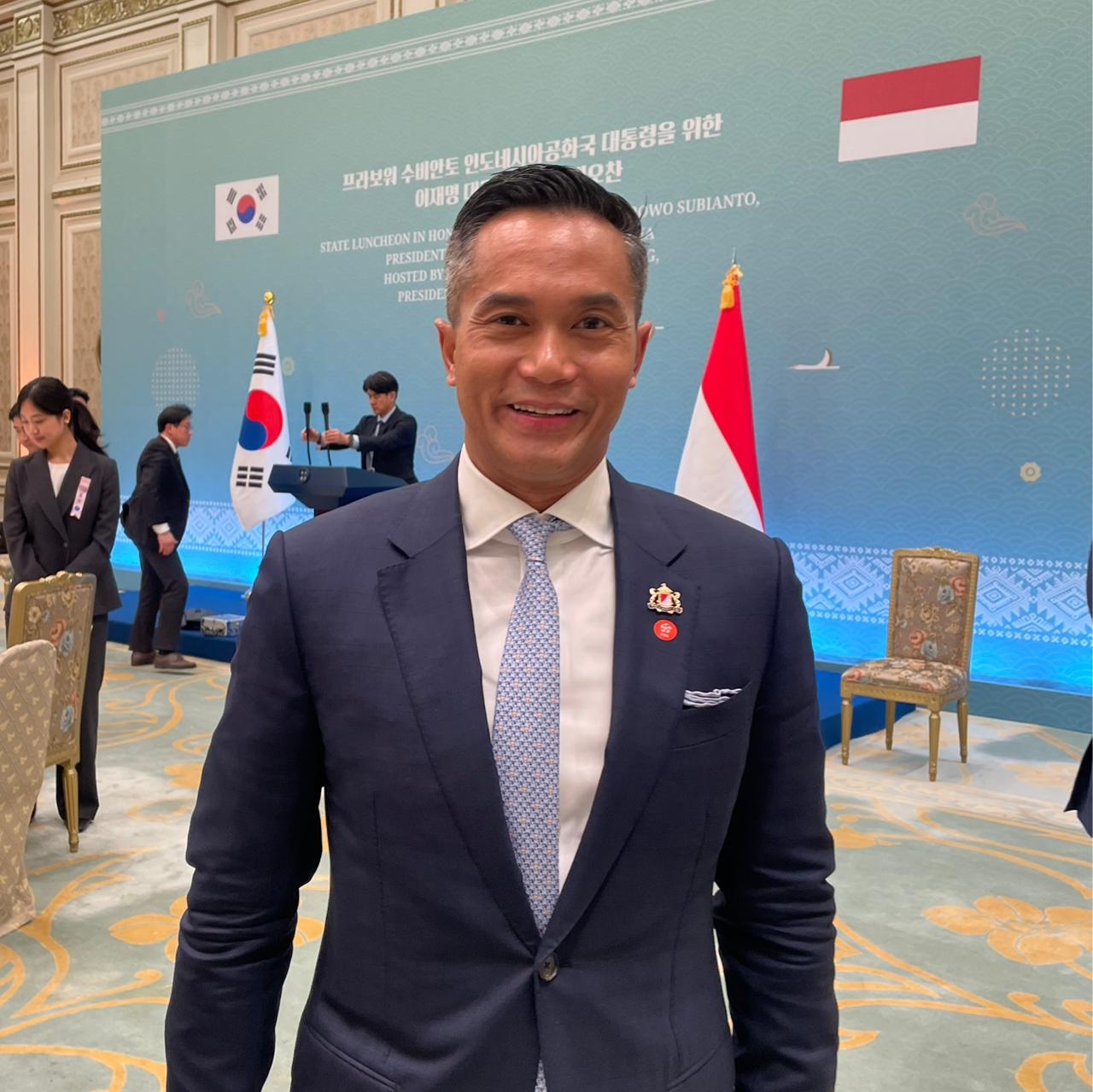 Anindya Novyan Bakrie, CEO of Bakrie & Brothers and chair of the Indonesian Chamber of Commerce and Industry, poses for a photo during a state luncheon hosted by President Lee Jae Myung in honor of Indonesian President Prabowo Subianto at Cheong Wa Dae on Wednesday. (Kadin)
Long known as the world’s largest nickel producer, Indonesia has set its sights on cultivating a full electric vehicle and battery supply chain at home.
South Korea is emerging as one of its most important partners in driving that vision forward, according to Anindya Novyan Bakrie, chair of the Indonesian Chamber of Commerce and Industry, or Kadin.
“Korea will be one of Indonesia’s most important partners in this strategy,” Bakrie said in a written interview with The Korea Herald last week. Bakrie, who also heads Bakrie & Brothers — part of one of Indonesia’s oldest conglomerates, the Bakrie Group — was in Seoul as part of the business delegation accompanying Indonesian President Prabowo Subianto’s state visit.
“For Indonesia, Korea’s role is highly strategic over the next decade because Indonesia is not just trying to sell nickel, we are trying to build a complete domestic EV and battery industry.”
He said Korean companies are critical partners in this effort because they bring technology, process discipline and end-market access as the mineral-rich country seeks to establish a full value-chain ecosystem, from refining and cathodes to battery cells, packs and recycling.
A prime illustration of this partnership is HLI Green Power. The 50:50 joint venture between Hyundai Motor Group and LG Energy Solution launched the country’s first battery cell plant in 2024, boasting an annual production capacity of 10 gigawatt-hours.
Bakrie described it as “the most transformative” investment by Korean companies, because it changed Indonesia from being “mainly a raw-materials story into actual battery cell manufacturing.”
This push was reiterated during the latest summit between the leaders of the two countries. During President Lee Jae Myung’s meeting with Indonesian President Prabowo Subianto in Seoul on Wednesday, the two leaders reaffirmed their commitment to close cooperation in building an EV ecosystem in Indonesia and expanding production of batteries made in Indonesia.
While Korean companies have made substantial investments in Indonesia’s battery and electric vehicle sector in recent years, some have begun to reassess their exposure to the country amid a slowdown in global EV demand and persistent concerns over regulatory uncertainty.
Bakrie argued that investors should take a long-term view: “Do not read Indonesia through one difficult cycle,” he said.
Sales of battery-electric vehicles in Indonesia totaled approximately 55,200 units during the first nine months of 2025, accounting for around 10 percent of the country’s overall car market. Despite a slowdown in growth, Bakrie said the market is still in a nascent phase, leaving ample opportunity for companies to expand investment and capture a larger share.
Indonesia is also moving to end incentives for imported EVs in 2026, a move Bakrie said makes clear that the “future belongs to companies that localize production and build a real base here.”
At the same time, he said Indonesia still has significant work to remain competitive.
“We need faster permitting, more consistent policy implementation, better charging and recycling infrastructure, stronger local supplier capacity, and smoother logistics,” he said.
Beyond batteries and EVs, Bakrie noted that the partnership between the two countries has room to expand into other industries.
He identified advanced manufacturing supply chains, energy and minerals, petrochemicals, biotechnology, and consumer industries as the next major areas of growth, arguing that the two countries are well-positioned to complement each other.
“These are sectors where Korea brings advanced technology, industrial capability and manufacturing strength, while Indonesia brings scale, resources and a strategic position in the heart of Southeast Asia.”
Bakrie also pointed to digital infrastructure and AI as another promising area for cooperation. “I would also like to see Korean investment in data centers, AI infrastructure, industrial software and digital finance,” he said.
He stressed that Korea’s role has become increasingly central to Prabowo’s vision to lift Indonesia’s economic growth to 8 percent by 2029, from around 5 percent currently.
“I see Korea as not only our partner, but certainly one of Indonesia’s most strategic and trusted partners in achieving our 8 percent growth ambition.”
sahn@heraldcorp.com