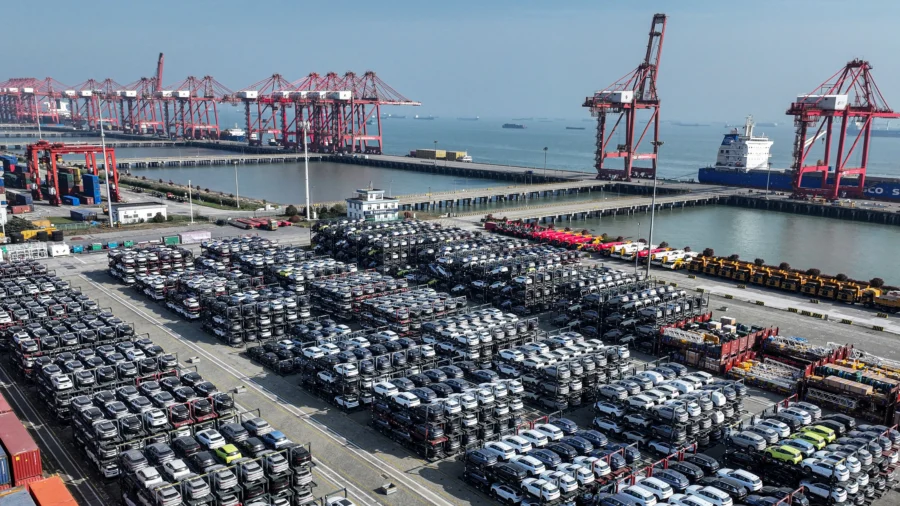
Three U.S. senators are asking President Donald Trump to prohibit Chinese automakers from opening plants in the United States, ahead of the president’s trip to Beijing for a bilateral meeting next month.
“Allowing automakers headquartered in China, which operate with backing from the Chinese Communist Party (CCP), to build and sell vehicles in the United States would have far-reaching consequences for our economic and national security,” the lawmakers wrote in an April 3 letter to the president.
Sens. Tammy Baldwin (D-Wis.), Chuck Schumer (D-N.Y.), and Elissa Slotkin (D-Mich.) urged Trump to reconsider comments he made in January about welcoming Chinese automakers if they create jobs in the United States.
“If they want to come in and build a plant and hire you and hire your friends and your neighbors, that’s great, I love that,” Trump had told the Detroit Economic Club.
The senators raised economic and national security concerns, saying that allowing Chinese automakers into the country would undercut the domestic industry and aid in the Chinese regime’s global dominance agenda. They also asked the president to close transshipment loopholes preemptively, preventing Chinese automakers from bringing cars into America through Canada and Mexico.
“We urge you to stay the course and make it clear that Chinese auto manufacturers and their products present unprecedented dangers to our economic and national security, and their manufacture, sale, or operation on U.S. soil is non-negotiable,” the letter reads.
The letter follows Sen. Bernie Moreno’s (R-Ohio) announcement that he will introduce legislation to codify and expand bans against Chinese cars and parts in the American market—which are currently in effect by executive order from the Biden administration.‘Insurmountable Economic Advantage’The senators say that allowing Chinese automakers to build in the United States would give Beijing an “insurmountable economic advantage” that the domestic industry would not be able to overcome.
Chinese car manufacturers receive subsidies from the CCP and use exploitative labor practices in a “strategy designed to win at any cost,” the lawmakers said, allowing them to undercut competitors without “any possibility of a level playing field.”
The lawmakers said allowing Chinese automakers to sell in the United States in exchange for building plants in the United States would result in temporary or a small number of jobs created in exchange for long-term loss of jobs. They raised concerns that Chinese manufacturers would import China-made vehicle parts and materials, and undermine the tariffs Trump has already imposed on critical industries such as steel and aluminum.
The American auto industry accounts for around 10.95 million jobs and 3 to 5 percent of GDP, the senators said, and plays a critical role in the manufacturing ecosystem in the United States.
“For every job on a vehicle assembly line, there are roughly two jobs in the auto parts and supplier network. Thus, if Chinese auto plants develop a presence in the United States, it will alter supply chains drastically,” the letter reads.
The lawmakers also noted the increase in Chinese autos in Canada and Mexico, and worries about transshipment. Canada recently signed a deal cutting the 100 percent tariffs it previously imposed on Chinese cars at the urging of the United States, allowing imports of up to 70,000 Chinese cars annually by 2030 under a tariff rate of 6.1 percent.
Chinese automakers are also growing their presence in Mexico, the lawmakers said, with 84 percent of Mexico’s electric vehicle imports coming from China-based BYD in 2025.
Autos account for the biggest industry in U.S.-Mexico trade, and make up more than a fifth of trade between the United States, Mexico, and Canada.Security RiskThe senators also said Chinese cars in America could represent an “unprecedented” and “existential” national security risk.
The United States also has rules to ban Chinese software in connected vehicles, based on concerns that these vehicles can collect and send vast amounts of data about military sites, government buildings, and other sensitive or critical infrastructure information. Parts of these rules don’t go into effect until 2027, and the lawmakers urged the Trump administration to consider accelerating this timeline.
They noted that Beijing banned Teslas from driving near government buildings in China until they passed a security test, and a case where a public transit operator in Norway found Chinese-made buses could be shut down remotely.
The lawmakers also raised concerns over Beijing’s “military-civil fusion” strategy, where there is no separation between civilian products and industries and military research and development, and how the Chinese regime could seek to leverage any access the Chinese automakers are given.
“Facilitating further Chinese incorporation into our supply chains, and those of our allies, creates vulnerabilities and choke points that could cripple domestic industries,” the letter reads.
“The United States must reaffirm our clear position – that Chinese vehicles of all types and automakers are not welcome to operate here in any capacity,” the letter reads. “In addition to banning Chinese connected vehicles, we must work with our allies to counter the global threat posed by Chinese vehicles, and we must spur a new generation of automotive innovation to ensure that U.S. auto industry remains the world’s best.”
Trump is set to meet with CCP leader Xi Jinping next month during his trip to Beijing May 14–15.