The automotive industry is currently navigating a period of profound “cognitive dissonance.” On one hand, the long-term future is undeniably electric; on the other, the immediate financial reality is starting to look a lot like a deep, fiscal frost. Financial analysts are currently buzzing over a move that has sent shockwaves through boardrooms from Detroit to Tokyo: Honda’s staggering $15.7 billion write-off related to its shifting electric vehicle (EV) strategy.
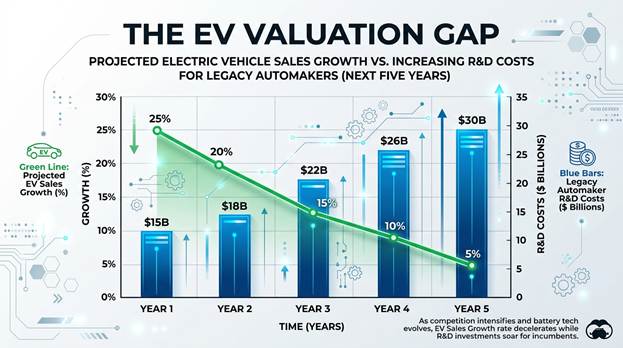
This isn’t just a rounding error or a minor course correction. It is a fundamental admission that the initial “gold rush” phase of EV investment—characterized by aggressive targets and “all-in” rhetoric—has met the cold wall of market reality. As we enter what many are calling the “EV Winter,” the question isn’t just about Honda’s survival, but whether Ford, GM, and the rest of the legacy guard are about to catch a very expensive cold.
The Anatomy of a $15.7 Billion Write-Off
To understand why Honda essentially “erased” nearly $16 billion from its projections, we have to look at what a write-off actually represents in the automotive sector. This isn’t necessarily cash disappearing from a bank account today; rather, it is an impairment of assets. Honda had invested heavily in specific EV platforms, battery supply chains, and manufacturing tooling based on the assumption of a linear, rapid transition to battery electric vehicles (BEVs).
As documented in the April 26 Market Pulse, the global EV market is experiencing a significant cooling period. When the projected revenue from these investments no longer justifies their carrying value on the balance sheet, accounting rules mandate a write-off.
The cause is multifaceted: high interest rates making $60,000 EVs unattractive to the middle class, a lack of robust charging infrastructure in non-urban areas, and a surprising resurgence in consumer preference for hybrids. Honda’s write-off is an acknowledgment that the specific technology and production paths they previously bet on are no longer the most efficient route to profitability.
The Domino Effect: Will Ford and GM Follow Suit?
The fear permeating Wall Street is that Honda is merely the first domino to fall. Ford and General Motors are arguably more exposed to the “EV Winter” than their Japanese counterparts. Ford’s Model e division has been losing billions of dollars annually, essentially subsidized by the profits from its “Blue” (internal combustion) and “Pro” (commercial) divisions.
Ford and GM have already begun delaying factory openings and scaling back ambitious EV production targets. However, delaying a project isn’t the same as writing it off. If Ford or GM determines that their dedicated EV architectures (like GM’s Ultium platform) cannot achieve the scale required to be profitable within the original timeframe, they will be forced to take similar multi-billion-dollar impairments. The likelihood is high; as the gap between “EV ambition” and “EV registration” widens, the auditors will eventually demand a reality check.
Smart Move or Premature Panic? The Gas Price Paradox
Critics argue that Honda’s retreat is premature, especially as global volatility keeps gas prices stubbornly high. Traditionally, high pump prices act as the best marketing tool for EVs. However, the current market is defying tradition. While high gas prices make EVs attractive, the total cost of ownership—exacerbated by high insurance premiums and rapid depreciation of used EVs—is neutralizing the “fuel savings” argument for many buyers.
Honda’s move is likely “smart” from a capital preservation standpoint. By taking the hit now, they clear the deck for a more flexible strategy that includes “multi-pathway” solutions (hybrids and hydrogen). It is better to admit a mistake early than to continue pouring “good money after bad” into platforms that the consumer is currently rejecting.

Japan vs. China: The Battle for the Electric Soul
The backdrop to Honda’s financial maneuvers is the “rising tide” of Chinese EV manufacturers like BYD, Xiaomi, and Li Auto. While Japanese automakers were famously slow to embrace pure BEVs—preferring the hybrid route pioneered by Toyota—Chinese firms were building vertically integrated supply chains.
Currently, Japanese carmakers are on the defensive. In Southeast Asia, a traditional stronghold for Honda and Toyota, Chinese EVs are rapidly gaining market share through aggressive pricing and superior software integration. The “EV Winter” affecting Western and Japanese firms doesn’t seem to be cooling the Chinese export machine quite as much, largely due to state subsidies and lower production costs. Honda’s write-off is, in part, a strategic retreat to regroup and find a way to compete on cost—a battle they are currently losing.
How Honda Can Dig Out of the Hole
To improve EV sales and recover from this fiscal blow, Honda needs to stop trying to be Tesla and start being Honda again. This means focusing on:
Affordability over Specs: The market doesn’t need more $50,000 electric SUVs. It needs a $25,000 electric Civic equivalent that offers “just enough” range with Honda’s signature reliability.
Hybrid as a Bridge: Honda has some of the best hybrid powertrains in the world. They should lean into these to generate the cash flow necessary to fund the next generation of EVs.
Software-Defined Vehicles: One of the biggest complaints about Japanese EVs is the infotainment and software. Honda’s partnership with Sony (Afeela) is a step in the right direction, but it needs to trickle down to their mass-market cars.

The Ace in the Hole: Is the Write-Off Premature?
Interestingly, Honda has several projects in the pipeline that could make this massive write-off look like a temporary stumble. The upcoming Honda 0 Series, set to debut in 2026, represents a “thin, light, and wise” approach to EV design that moves away from the heavy, battery-bloated SUVs of the current era.
If the 0 Series hits the market with the promised efficiency and a breakthrough in solid-state battery technology (which Honda is aggressively researching), the $15.7 billion write-off may be seen as a necessary “sloughing off” of old skin to make room for a more competitive future. However, if these new models fail to capture the public’s imagination, the write-off will be remembered as the beginning of a long decline.
Assessing the Strategy: A Necessary Evil
Was the write-off a good idea? Financially, yes. It aligns the company’s book value with the reality of the 2024-2025 market. It provides transparency to shareholders and reduces future depreciation expenses, which will help Honda’s “on-paper” profitability in the coming years. Strategically, it is a “reset” button. It allows Honda to pivot away from the partnership-heavy (GM-reliant) strategy of the past toward their own proprietary platforms.
Wrapping Up
The “EV Winter” is proving to be a Darwinian event for the automotive industry. Honda’s $15.7 billion write-off is a stark reminder that the transition to sustainable mobility is not a straight line, but a jagged path filled with financial potholes. While the move suggests a cooling of the initial EV fever, it also positions Honda to be more agile.
The success of Japanese automakers now hinges on their ability to bridge the gap between their legendary hybrid reliability and the high-tech, low-cost pressure coming from China. If Honda can leverage its upcoming 0 Series and maintain its reputation for engineering excellence, this write-off will be a footnote in a successful transformation. If not, it may be the first of many cold winters to come.
Disclosure: Images rendered by Artlist.io
Rob Enderle is a technology analyst at Torque News who covers automotive technology and battery developments. You can learn more about Rob on Wikipedia and follow his articles on TechNewsWord, TGDaily, and TechSpective.
Follow us today…