Overview
Subaru’s hybrid SUV workhorse is the Forester Hybrid, a boxy and sensible all-wheel drive crossover. It lacks the refinement of the Honda CR-V Hybrid and the fun-loving personality of the Mazda CX-50 Hybrid, but it’s nonetheless a trusty steed with a rugged look. A 2.5-liter flat four-cylinder engine is paired with an electric motor for 194 horsepower. Acceleration is languid, but the setup is quieter than the nonhybrid Forester, not to mention more fuel efficient.
Standard equipment is plentiful and includes niceties such as driver-assistance features, heated front seats, and a panoramic sunroof. The cabin sports a straightforward design and is focused on practicality, with a generously sized cargo bay that held 12 carry-on suitcases in our testing. The Forester Hybrid may not be excitement on wheels, but you’ll likely be thankful for how little gas this steady-Eddie SUV uses getting you where you need to go.
Expert Tip: Subaru also offers the smaller Crosstrek SUV with a hybrid powertrain, so if you don’t need the space of the Forester, the Crosstrek Hybrid could save you some cash.
What’s New for 2027?
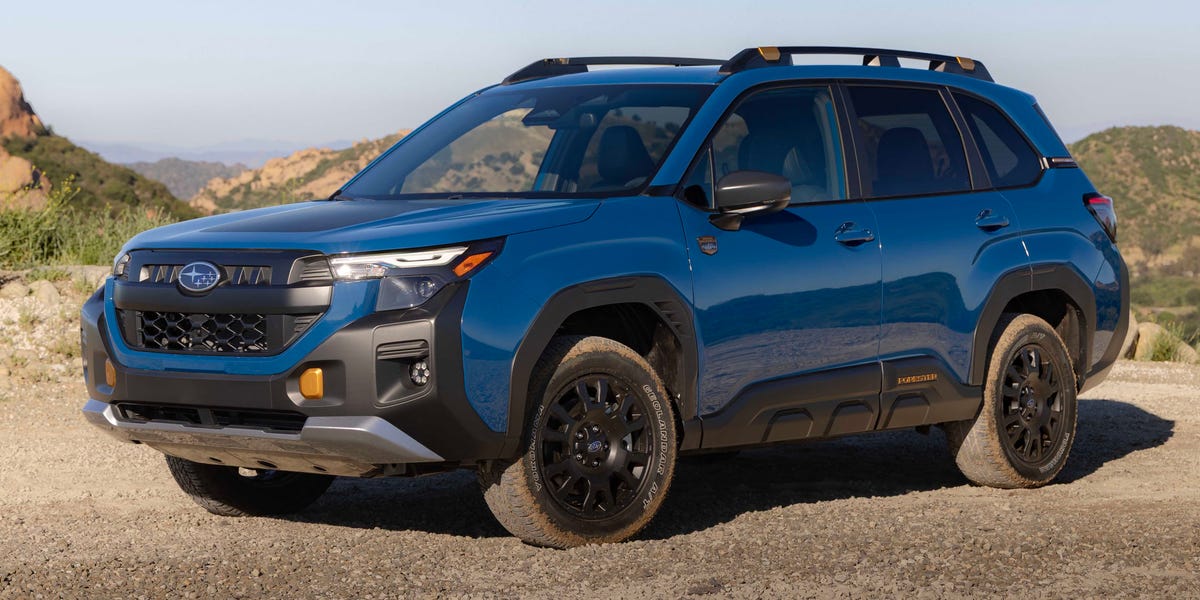
A Wilderness trim joins the Forester Hybrid lineup this year. Like the nonhybrid Forester Wilderness, the hybrid version boasts 9.3 inches of ground clearance, all-terrain tires, underbody protection panels, and specialized snow and mud driving modes. It comes loaded with goodies, including Harman/Kardon audio, in-dash navigation, a power liftgate, and in-dash navigation.
 What’s Your Car Worth?
Car and Driver calculates your car’s value in three free and easy steps – using the same Black Book® data dealers use to appraise vehicles.
Get your trade-in valuePricing and Which One to Buy
The lineup opens with the Premium trim, which, true to its name, boasts heated front seats, dual-zone automatic climate control, an 11.6-inch infotainment screen with navigation and smartphone-mirroring tech, a panoramic sunroof, a kick-under-to-open liftgate, and most driver-assistance features. It’s what we’d pick.
Engine, Transmission, and Performance Hybrid Powertrain: 2.5-liter four-cylinder and one motor, 194 hp Transmission: continuously variable automatic (CVT) Drivetrain: all-wheel drive
The Subaru Forester Hybrid uses a series-parallel hybrid system, wherein the vehicle can switch between the 2.5-liter flat-four engine and the traction electric motor to drive the wheels as the situation demands. Together, these components produce 194 horsepower—an increase of 14 ponies over the nonhybrid Forester. (A second motor acts as a generator for the 1.1-kWh lithium-ion battery but doesn’t help with propulsion.) All-wheel drive is standard, as is a CVT.
Compared with the gas-only Forester, the hybrid model is quieter and more responsive. It displayed amiable body control during our test drive, but the steering is not very precise. Although the brake pedal was a bit touchy, we hardly noticed the transition from regenerative to friction braking.
0–60-MPH Times C/D 60-mph Test: 8.6 seconds
In Comparison: Everything from the Honda CR-V Hybrid to the Toyota RAV4 Hybrid to the Hyundai Tucson Hybrid can hit this speed in under eight seconds. The nonhybrid Forester Sport we tested did the 60-mph dash in 8.3 seconds.
Additional ResearchTowing and Payload Capacity
Buyers can spec a Class I trailer hitch good for 1500 pounds. It’s available as an accessory.
Fuel Economy and Real-World MPG EPA City Rating: 35 mpg EPA Highway Rating: 34 mpg
The EPA estimates the Forester Hybrid’s fuel economy at 35 mpg city, 34 mpg highway, and 35 mpg combined. When we get a chance, we’ll take the Forester Hybrid on our 75-mph highway fuel-economy route and update this story with real-world results.
In Comparison: While the hybrid Forester is far more efficient than the nonhybrid model in the city, its electrified rivals do better. Some have city ratings in the 40s, and the front-drive Kia Sportage Hybrid boasts a 44-mpg highway estimate. For more information about the Forester Hybrid’s fuel economy, visit the EPA’s website.
Interior, Comfort, and Cargo
First Row: The driver’s seat is all-day comfortable, thanks to good bolstering and standard heating. (Seat ventilation is available on certain trims, too.) You have a great view of the road through the windshield and out the back, and the controls are well placed. The dash, though, looks like something Subaru pieced together after diving through various parts bins.
Second Row: The second row offers a generous amount of legroom and plenty of seat space for two adult-sized butts.
Cargo Capacity: With the seats up, the Forester Hybrid offers 28 cubic feet of cargo volume, the same as the nonhybrid (base trim excluded). Other models in this segment, however, have larger holds. We fit 12 carry-on suitcases in the cargo bay during our testing; with the rear seats folded, we fit a total of 28.
Infotainment and Connectivity Infotainment: 11.6-inch touchscreen) Connectivity: Bluetooth, wireless Apple CarPlay and Android Auto compatibility Audio Systems: 6-speaker stereo (standard), 11-speaker Harman/Kardon stereo (optional)
A 11.6-inch vertically oriented touchscreen displays infotainment and HVAC settings and supports wireless Android Auto and Apple CarPlay connections, but the screen can be slow to respond. We appreciate the large icons and the physical knobs for volume adjustment and station tuning. There’s also a wireless phone charging pad directly below this screen and a 12.3-inch digital instrument cluster in front of the driver.
Safety and Driver-Assistance Features
All models come standard with Subaru’s EyeSight suite of camera-based driver-assistance features.
Standard Safety Features: blind-spot monitoring, lane-keeping assist, adaptive cruise control Optional Safety Features: rear automated emergency braking, 360-degree camera system
For information about the Forester Hybrid’s crash-test results, visit the National Highway Traffic Safety Administration (NHTSA) and Insurance Institute for Highway Safety (IIHS) websites.
Warranty and Maintenance Coverage
The Forester Hybrid offers merely average warranty coverage. For better policies, check out the Toyota RAV4 Hybrid or Hyundai Tucson Hybrid.
Limited Warranty: three years or 36,000 miles Powertrain Warranty: five years or 60,000 miles Battery-Component Warranty: eight years or 100,000 miles Complimentary Maintenance: noneC/D Test Results and Specs
Each year, we put hundreds of vehicles through our rigorous instrumented testing regimen. If the data in the chart below is for a different model year, that’s because this vehicle hasn’t changed from when we last tested it, and the test results remain accurate.
 Specifications
Specifications
2025 Subaru Forester Touring Hybrid
Vehicle Type: front-engine, front-motor, all-wheel-drive, 5-passenger, 4-door wagon
PRICE
Base/As Tested: $44,715/$45,605
POWERTRAIN
DOHC 16-valve 2.5-liter Atkinson-cycle flat-4, 162 hp, 154 lb-ft + AC motor, 118 hp, 199 lb-ft (combined output: 194 hp; lithium-ion hydride battery pack)
Transmission: continuously variable automatic
CHASSIS
Suspension, F/R: struts/multilink
Brakes, F/R: 12.6-in vented disc/11.8-in vented disc
Tires: Bridgestone Alenza EL450
Size: 235/50R-19 99V M+S
DIMENSIONS
Wheelbase: 105.1 in
Length: 183.3 in
Width: 72.0 in
Height: 68.1 in
Passenger Volume, F/R: 58/49 ft3
Cargo Volume, Behind F/R: 69/28 ft3
Curb Weight: 3937 lb
C/D TEST RESULTS
60 mph: 8.6 sec
1/4-Mile: 16.6 sec @ 84 mph
100 mph: 25.8 sec
Results above omit 1-ft rollout of 0.4 sec.
Rolling Start, 5–60 mph: 9.5 sec
Top Gear, 30–50 mph: 4.5 sec
Top Gear, 50–70 mph: 5.7 sec
Top Speed (gov ltd): 113 mph
Braking, 70–0 mph: 181 ft
Roadholding, 300-ft Skidpad: 0.80 g
Interior Sound
Idle: 45 dBA/4 sone
Full Throttle: 73 dBA
70-mph Cruising: 68 dBA/24 sone
C/D FUEL ECONOMY
Observed: 31 mpg
EPA FUEL ECONOMY
Combined/City/Highway: 35/35/34 mpg