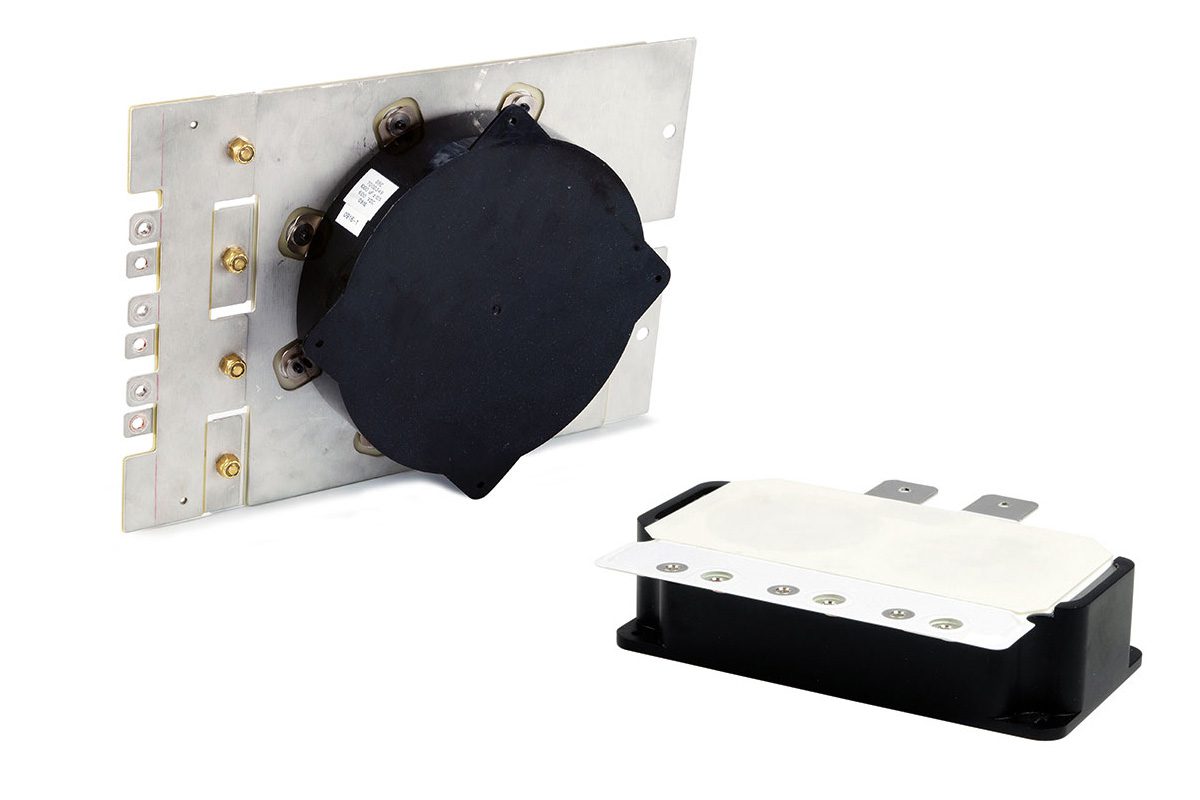
Peak Nano and Advanced Conversion have announced a partnership to co-develop DC-link capacitor solutions engineered specifically for 800 V+ SiC inverter systems in electric vehicles and e-mobility platforms. Advanced Conversion is a wholly owned subsidiary of ETI, based in Clearwater, Florida.
The collaboration pairs Peak Nano’s NanoPlex LDF (Low Dissipation Factor) capacitor film with Advanced Conversion’s Power Ring capacitor platform. NanoPlex LDF maintains a dissipation factor below 0.0004 up to 150 °C—headroom that conventional biaxially oriented polypropylene (BOPP) film can’t match, as BOPP-based designs require significant derating at the temperatures typical in high-power SiC inverters. The Power Ring platform tackles the other key constraint: commutation loop inductance. Its ultra-low inductance architecture reduces voltage overshoot at SiC switching events, letting inverter designers avoid the derating and oversizing that higher-inductance capacitor packages typically force.
DC-link capacitors sit between the battery bus and the inverter in an EV powertrain, smoothing voltage ripple and absorbing switching transients. SiC MOSFETs switch far faster than the silicon IGBTs they replace, which drives both higher dV/dt and more heat into the capacitor—well beyond what BOPP-based designs were built to handle.
“Engineers designing 800 V+ inverter systems shouldn’t have to derate, oversize, or add cooling just so their capacitors can keep up,” said Edward Sawyer, CEO of Advanced Conversion. Peak Nano CEO Jim Welsh said the partnership “puts the right film and the right manufacturing platform together for the first time,” targeting “a new benchmark for DC-link performance in e-mobility on land, sea and air.”
Target applications include Formula E and high-performance automotive, electric buses and heavy trucks, off-highway vehicles and electrified aviation. Advanced Conversion’s US-based manufacturing positions the combined solution as a domestic supply chain option. Initial product releases are planned for late 2026.
Source: Peak Nano