Here is something you do not hear every single day from a major automaker CEO. Ford’s Jim Farley sat down recently on the Spike’s Car Radio podcast, and right around the one hour mark of the interview, he dropped a statement so direct, so specific, that it immediately went viral. He did not hint at it. He did not dance around it. He looked straight into the camera and essentially told the world that Ford is coming for Tesla’s two best selling cars, the Model 3 and the Model Y. If you want to understand what is really going on inside the Ford Motor Company right now, and what it means for you as a buyer sitting on the fence about going electric, you need to read every word of this article. This story matters. And if you are one of those people wondering whether to buy a Tesla now or wait for something better and more affordable from Detroit, we have a very important answer for you below. You might also want to check out our analysis on why people choose the Tesla Model Y when the Model 3 has longer range, handles better, and costs less, because that decision just got a lot more complicated. And while you are thinking about it, there is a solution to the “affordable EV” problem hiding in plain sight today, which we discuss further down, and it connects directly to our coverage of the most affordable EVs available and how much they can save on fuel costs.
Sawyer Merritt, one of the most followed EV news voices on X with over 530,000 followers, clipped the key moment and posted it to his account today, April 1, 2026, and it racked up over 210,000 views in just hours.
Here is exactly what Farley said, word for word: “We’ll have an all-electric, affordable vehicle to compete with Model Y and Model 3. I think there’s nothing else like it on the market. We started a skunkworks team 4 years ago. They were basically Formula 1 and Tesla people. That vehicle is radically different. I’m really excited to show everyone maybe late this year or next year. It will be coming out next year.” (via Spike’s Car Radio)
That is a statement worth sitting with. The CEO of Ford Motor Company, one of the oldest and most storied automakers on the planet, just publicly named Tesla’s most popular vehicles as the target. Not Chevrolet. Not Toyota. Tesla. That tells you something very important about where the industry stands in 2026.
Jim Farley Names Tesla’s Best Sellers as the Target: What This Really Means for Ford
Let me be clear about why this is significant. When a legacy CEO walks onto a podcast and says the words “Model Y and Model 3” out loud, as the benchmark they are chasing, it is a form of public surrender on the old way of doing things. It means Ford has accepted, fully and without reservation, that Tesla now owns the category. It is not just a compliment to Tesla. It is an admission that for years, Ford and every other traditional automaker underestimated what Elon Musk was building. We covered Ford’s massive $19.5 billion course correction last year when the company abandoned large EVs for a hybrid and truck centered future, and that backstory is critical context here. Ford did not get here by accident. That $19.5 billion write down was painful. The cancellation of the F-150 Lightning hurt. And yet, something interesting was quietly happening in California while all of that chaos unfolded in Detroit.
The pressing problem that every buyer faces right now is this: you want an affordable, practical, well built electric vehicle that does not require a $50,000 check. And right now, that vehicle barely exists. The average new vehicle transaction price in America is hovering near $48,000. The Model 3 and Model Y are genuinely competitive at their price points, but they are not cheap for a family on a tight budget. Ford is saying there is something coming that solves this problem. But can they actually deliver? That is the question this article will answer as honestly as possible.
Inside Ford’s Secret California Skunkworks Team: Tesla and F1 Engineers, and a CEO Who Could Not Get In
Here is the part of the story that nobody is really telling in full. Four years ago, while the world watched Ford struggle with Mach-E software glitches and Lightning price cuts, Farley quietly authorized a completely separate team to be built. Not in Dearborn, Michigan. Not inside Ford’s traditional corporate structure. In Irvine, California. And it was so secret that Farley himself joked his own CEO badge did not work in the building.
That is not just a funny line. That is a management philosophy. Farley knew that if this team was inside the Ford machine, they would be crushed by committee meetings, legacy engineering constraints, and the same thinking that gave us the Mach-E’s software problems. So he quarantined them. He built a startup inside a corporation, staffed it with people who came from Tesla and Formula 1 teams, and basically said: go build something radically different and do not let me slow you down.
According to reporting confirmed by TechCrunch and InsideEVs, the team is led by Alan Clarke, a former Tesla engineering director. His co-collaborator, Anil Paryani, founded Auto Motive Power, a company Ford acquired in 2023, and Paryani himself worked alongside Clarke at Tesla for roughly five years. These are not marketing people writing press releases about the future. These are engineers who actually built parts of the car you are probably already driving if you own a Tesla. Our earlier deep dive into how Ford is using Formula 1 race car design principles to streamline its new $30,000 midsize EV truck explained how the F1 aerodynamics philosophy translated into a 15% efficiency gain over any current pickup, shaving the mirror housing alone by 20% and recovering meaningful range that traditional engineering would have left on the table.
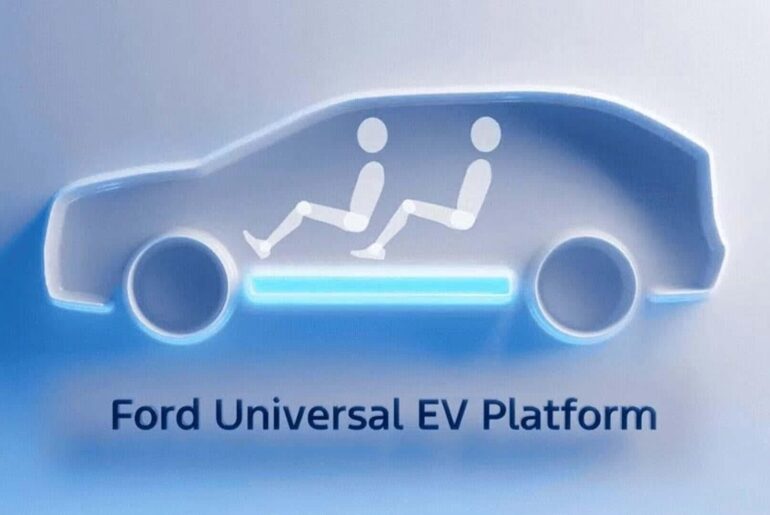
The first fruit of this team’s work is the Universal EV Platform, which we covered in detail back in February in our report on Ford’s new EV platform promising a $30,000 pickup with 4.5 second zero to sixty performance and 15% better efficiency. The platform uses a structural LFP battery made in Michigan, gigacastings that replace 146 separate parts with just two massive aluminum components, and zonal electronics that cut thousands of feet of wiring from the vehicle. The result is a car architecture that is lighter, cheaper to build, and far more scalable than anything Ford has done before.
Ford’s Affordable EV Timeline: When Can You Actually Buy One?
Let us be straight with you here, because this is where reality meets enthusiasm and it gets a little complicated. Here is the timeline as we understand it today.
Between 2022 and 2026, this California skunkworks team has been in deep development. They have been building prototypes, testing the vehicle with Ford’s own zonal software, and running megacasting machines at the retooled Louisville, Kentucky plant. Farley confirmed to InsideEVs in January that the vehicle is already in prototype phase, that supply chain parts are quoted and designed, and that Ford software is actively controlling the prototype vehicles in turning and stopping tests.
Late 2026 or early 2027 is when Farley says he is “really excited to show everyone.” That means a public reveal event, not a delivery to your driveway.
2027 is when customer deliveries are supposed to begin. The first vehicle will be a midsize electric pickup targeting around $30,000, built in Louisville. After that, the platform is designed to scale into sedans, SUVs, and vans, which is where the Model 3 and Model Y competitor conversation gets very real.
Now here is the hard truth that the EV community on X was very quick to point out after the Sawyer Merritt tweet went viral. The most upvoted reply said it plainly: “Starting ramp in 2027 to try and compete with products launched in 2018 and 2020 isn’t a great thing as Tesla will be knee deep in Cybercab and full autonomy.” And that is not a small point. By the time Ford is delivering its first UEV platform vehicle to real customers, Tesla will have been running Cybercab production at Giga Texas for over a year. FSD V14 will likely be on its next iteration. The autonomous future that Tesla has been building toward will be considerably closer to reality.
We also reported recently on whether buyers who are waiting on affordable EVs should skip the wait and look at what is already available now, and there are legitimate options today that solve the affordability problem without waiting until 2027.
Ford Affordable EV vs. Tesla Model Y and Model 3: An Honest Comparison
So let us say Ford delivers on every promise. Here is what the comparison looks like.
On price, Ford is targeting around $30,000 for its first UEV vehicle. The current Tesla Model 3 rear wheel drive starts in the upper $30,000 range, and the Model Y sits similarly. A meaningful price advantage for Ford is real, on paper.
On range, Ford is targeting approximately 300 miles for its midsize pickup. The Model Y long range today offers over 320 miles. A comparable Ford sedan or crossover on the same platform could match this, but we do not know yet.
On software and autonomy, this is where the comparison gets uncomfortable for Ford. Tesla has a decades head start in software defined vehicles, over the air updates, and driver assistance systems. Ford has no answer for FSD. They have BlueCruise, which is a good highway assist system, but it is not in the same category as what Tesla is building toward. One reply in Sawyer Merritt’s thread cut right to it: Ford is “silent on software.”
On manufacturing, Ford will build this vehicle in the United States with American workers, which matters for federal incentives and for buyers who prefer domestic production. This is a real advantage, and it is one that Ford should lean into hard.
On charging, Ford has access to the BlueOval network and also NACS compatibility, meaning Tesla Superchargers are accessible. That gap has largely closed. As we covered when looking at the Ford Power Promise and how it steps up the EV ownership experience, Ford actually handles the home charger installation as part of the purchase, which is a genuine customer service advantage Tesla has historically not matched.
Ford’s Three Powertrain Strategy and the Skunkworks EV as the Make or Break Bet
Something important in Farley’s podcast conversation that got lost in the Tesla headline is that Ford is not going all in on pure EVs. He mentioned hybrids and EREVs (extended range electric vehicles) for towing in the same breath as the affordable pure EV. That is a strategic hedge. Ford is covering multiple bases: hybrid for fuel efficiency and mainstream adoption, EREV for truck owners who need range and towing confidence, and pure EV for the urban commuter and direct Tesla competitor segment.
In our analysis of the $30,000 moonshot and how Ford’s Universal EV Platform is the Blue Oval’s last best hope to compete against GM and outrun China, we noted that Chinese manufacturers like BYD have rewritten the rules of EV production through vertical integration and radical cost discipline. Ford’s unicasting approach is a direct response to that competitive reality. By replacing 146 parts with two aluminum castings and cutting thousands of feet of copper wiring from the vehicle, Ford is attempting to match the cost structure of manufacturers who have been building EVs at scale for a decade.
There is also a warning worth heeding here. The F-150 Lightning was America’s best selling electric pickup in 2025, and Ford still canceled it. So the bar for this new platform is not just building a good car. It is building a good car that makes money. Farley himself admitted to InsideEVs that the project involves so many new unproven technologies that there is no guarantee of success. That kind of candor from a CEO is rare and it is worth respecting, but it also means buyers should maintain realistic expectations. For those considering the F-150 Lightning experience as a reference, we have detailed owner stories including someone who decided not to buy a Cybertruck and chose a Lightning instead, calling it the best vehicle he had ever driven. That context matters when evaluating how real buyers respond to Ford’s EV execution.
What the EV Community Is Saying Right Now and What It Tells Us
The reaction in Sawyer Merritt’s replies is a real time focus group, and the dominant mood is skepticism tempered by a small amount of genuine curiosity. The skeptics are not wrong. Competing with cars launched in 2017 and 2020 by launching in 2027 is a real challenge. Several people pointed to the April 1st date and called it a joke. It is not a joke. The Spike’s Car Radio interview is real, and the timestamp is verifiable. But the timing gives you a sense of how much credibility the EV community currently extends to legacy automaker EV promises.
The constructive minority in those replies made a point worth amplifying. Hiring actual Tesla and F1 engineers, building the team outside the corporate mothership, and showing real prototypes with Ford software actually running the vehicle turning and stopping, these are not vaporware signals. These are engineering signals. The question is whether Ford’s execution speed and cost discipline can match the ambition. As we noted in our deep dive on whether the Xiaomi YU7 is more than just a Tesla Model Y rival and represents a massive value proposition, the global competitive landscape is moving faster than most American buyers realize. Ford is not just racing Tesla. It is racing BYD, Xiaomi, and an entire Chinese manufacturing ecosystem that is extremely good at building affordable EVs quickly.
There is a moral embedded in this story that goes beyond cars. The lesson here is one about humility and long term thinking. Jim Farley admitted in a separate interview with La Nacion that working on this EV platform was “very humbling” for his entire team when they realized how far behind they were. That kind of honest acknowledgment, rather than defensiveness or arrogance, is actually the first step toward genuine improvement. For any reader who faces a big gap between where you are today and where you want to be, whether in business, in personal finance, or in any competitive endeavor, the Ford story is a reminder that starting late is better than never starting, but you have to work with twice the urgency and half the ego. Build your team outside the comfortable structure that got you into trouble in the first place. Learn from the people who already solved the problem. And then execute faster than anyone expects you to.
The solution to the pressing “affordable EV” problem for buyers today is actually simpler than waiting until 2027. If you need an electric or electrified vehicle right now at a reasonable price, the Ford Maverick Hybrid is still one of the most compelling practical choices you can make, delivering 47 MPG in mixed driving at a starting price around $30,000 while driving mostly in EV mode. We covered exactly this argument in our piece on why you should not wait for a low cost electric pickup to arrive in 2027 when you can buy a Ford Maverick Hybrid Electric Pickup now and get 47 MPG while covering more than half your miles in EV mode. If you want to go fully electric right now and can budget for it, the Model 3 and Model Y remain the benchmark for a reason.
For more context on what Ford is up against competitively, the team at InsideEVs reported today that the Spike’s Car Radio quote is very likely referring to a sedan or crossover body style built on the same UEV architecture as the midsize truck, which would be the direct head to head Tesla competitor.
The reveal is coming, possibly before the end of 2026. And when it arrives, it will be one of the most watched automotive events in years. Torque News will be there with full coverage the moment it happens, so make sure you are following us.
Here are two questions we would love for you to answer in the comments below, because your real world perspective is far more valuable than any analyst prediction:
If Ford’s 2027 affordable EV starts at around $30,000 with 300 miles of range and is built in the United States, would that be enough to make you choose it over a current or updated Tesla Model 3 or Model Y, and what single factor would drive your decision? Also, given Ford’s track record with the F-150 Lightning cancellation and past EV growing pains, how much trust do you have right now in Ford’s ability to actually deliver this vehicle on time and at the promised price, and has anything you have seen recently changed your confidence level up or down? Please share your experience and thoughts in the comments section below.
About The Author
Armen Hareyan is the founder and Editor-in-Chief of Torque News and an automotive journalist with over 15 years of experience writing car reviews and industry news. Now based in the Charlotte region (Indian Land, SC, he founded Torque News in 2010, which since then has been publishing expert news and analysis about the automotive industry. He can be reached at Torque News on X, Linkedin, Facebook, and Youtube. Armen holds three Masters Degrees, including an MBA, and has become one of the known voices in the industry, specializing in the landscape of electric vehicles and real-world stories of actual car owners. Armen focuses on providing readers with transparent, data-backed analysis bridging the gap of complex engineering and car buyer practicality. Armen frequently participates in automotive events throughout the United States, national and local car reveals and personally test-drives new vehicles every week. Armen has also been published as an automotive expert in publications like the Transit Tomorrow, discussing how will autonomous vehicles reshape the supply chain, and emerging technologies in vehicle maintenance.
Follow us today…