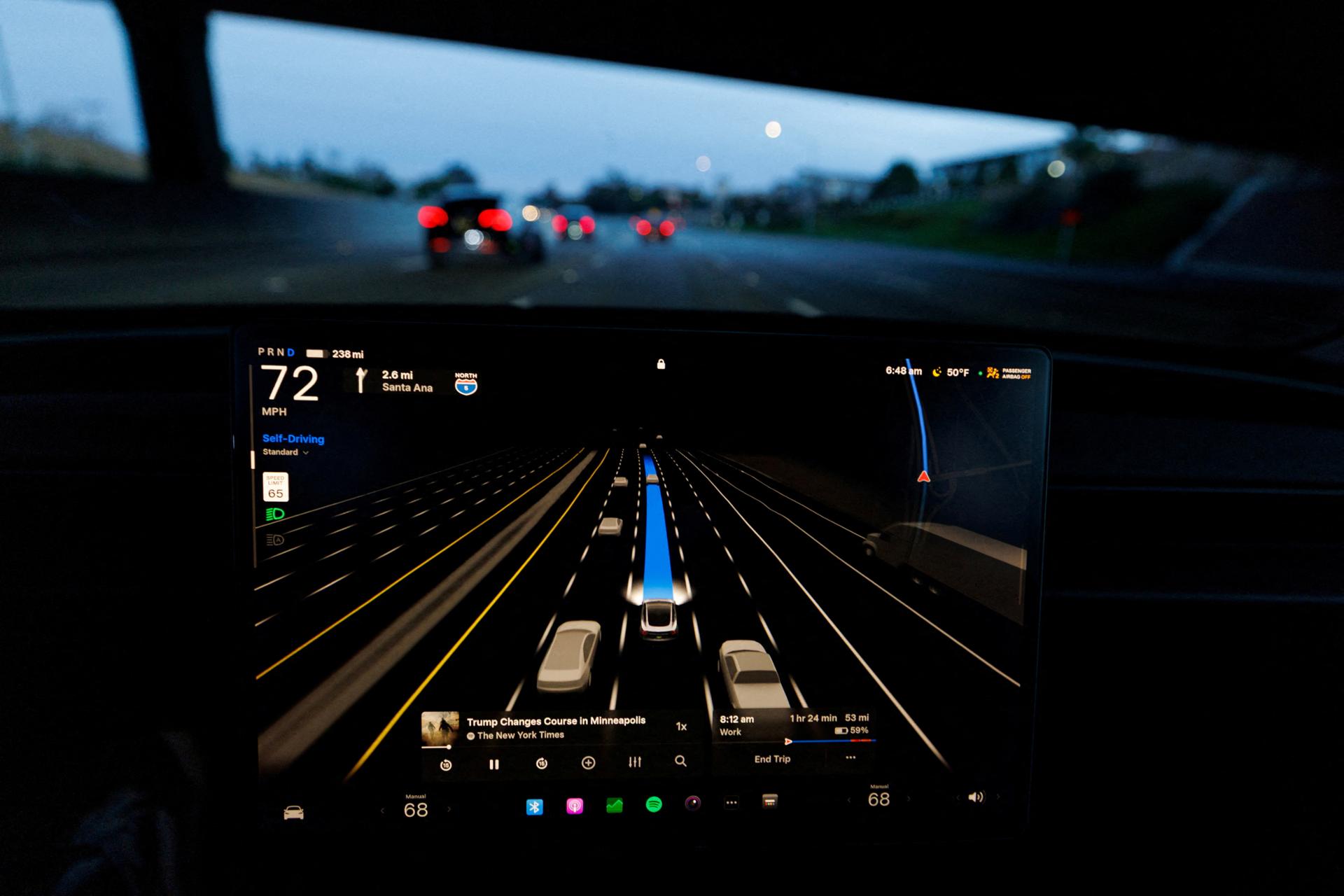
A Tesla Model 3 is shown driving on the highway using the company’s FSD self-driving software in Irvine, California, Jan. 28. Reuters-Yonhap
The Ministry of Land, Infrastructure and Transport warned Tuesday that activating Tesla’s Full Self-Driving (FSD) feature without authorization is illegal, after Tesla Korea reported a software vulnerability that could be used to unlock the system on vehicles where it is not permitted.
The ministry said cases have been reported overseas in which unofficial external devices — typically costing about 500 euros and plugged into a vehicle’s controller area network — are used to bypass software restrictions and enable FSD on vehicles where it is not permitted. It warned that similar attempts could spread to Korean owners, including through publicly available source code.
Under Korea’s Motor Vehicle Management Act, vehicles with unauthorized FSD activation are deemed noncompliant with safety standards and cannot be legally operated. The ministry said such use constitutes an unauthorized modification of safety-critical software under Article 35 of the law, punishable by up to two years in prison or a fine of up to 20 million won ($14,500).
The warning, however, highlights a regulatory inconsistency that critics say the ministry has yet to address.
The FSD is currently permitted only on U.S.-manufactured Tesla models — the refreshed Model S, Model X and the Cybertruck — because under the Korea-U.S. Free Trade Agreement, American-made vehicles that meet U.S. Federal Motor Vehicle Safety Standards are exempt from local certification requirements and may receive new features through over-the-air software updates without prior regulatory review.
Korea, which broadly follows United Nations Economic Commission for Europe (UNECE) vehicle safety standards, has not yet adopted a framework that would allow FSD certification for vehicles built to those specifications, including the China-made Model Y that accounts for 99.7 percent of Tesla’s Korean sales in 2024.
A small number of U.S.-built Teslas are already using FSD in Korea under a trade agreement exemption, even as most owners are blocked from accessing a feature they may have purchased.
The ministry’s statement focused entirely on the legal risks facing individual owners attempting to circumvent those restrictions, without addressing the underlying regulatory asymmetry that has left most of the country’s Tesla fleet in a gray zone.
Tesla is reportedly working toward broader regulatory approval in multiple markets. Korean authorities are preparing to adopt the UNECE Driver Control Assist Systems framework, a move that industry analysts say could open the door for China-built Teslas to use supervised FSD as early as 2027.
This article was published with the assistance of generative AI and edited by The Korea Times.