Check out the interior of theself-driving car in Spielberg’s Minority Report that whisks Tom Cruise’s character toward jail: There are only two seats.
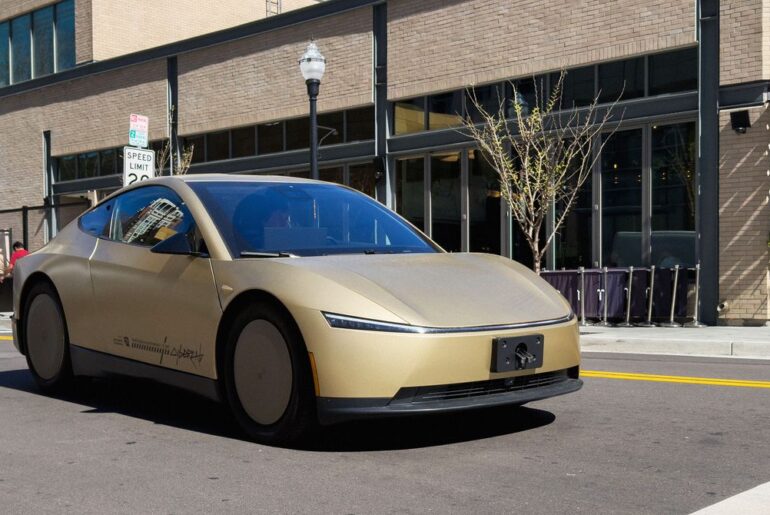
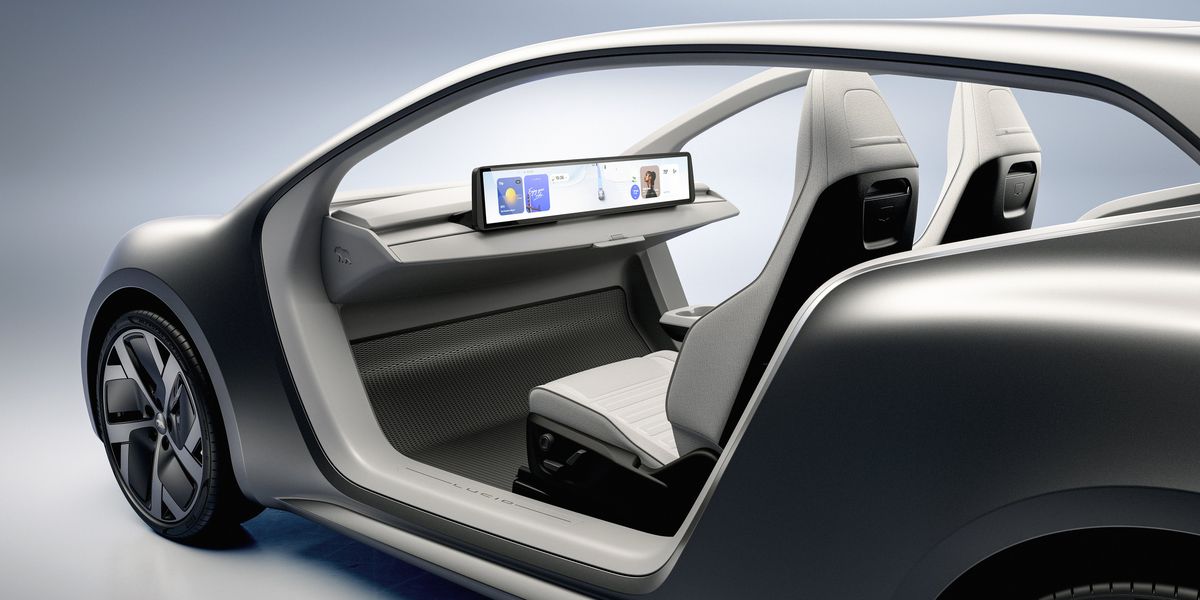
Perhaps taking a page from that sleekly designed sci-fi, Lucid Motors revealed the Lunar, a hyperefficient robotaxi concept, at its recent Investor Day in New York City. With its two side-by-side seats, compact size, and a cabin freed from a steering wheel, pedals, and garrulous cabbie, the Lunar defies more than a century of taxi tradition.
Lucid, which has partnered with Uber to deploy up to 20,000 of its seven-passenger Gravity SUVs as robotaxis, says that as many as 90 percent of taxi trips involve one or two passengers. Since passengers almost never sit up front in a human-driven taxi, having two rows of seats in this energy-saving model makes little sense, says Zach Walker, Lucid’s chief of advanced product creation. “People already view the front seat of a taxi as a no-go land,” he declares.
The Lunar is a scaled-down version of Lucid’s forthcoming midsize Cosmos and Earth SUV’s. Walker explains that for the project his team was freed for a “technical moonshot” that could make this car among the world’s most energy-efficient production EVs. That kind of efficiency could be critical for a fledgling robotaxi business that seeks to squeeze every kilowatt and penny from cars that could might be cruising up to 20 hours a day, seven days a week.
The Cosmos, a Tesla Model Y competitor, is no slouch, at up to 7.24 kilometers (4.5 miles) of driving range for every kilowatt-hour of battery energy, thanks to its new Atlas power train and a class-best 0.22 coefficient of drag. The Lunar advances the company’s goal of “radical efficiency” by further shrinking its battery size, to about 55 kilowatt-hours, down from 69 kWh in the Cosmos. Walker says the Lunar could deliver up to 9.7 kilometers (6 miles) of driving range for every kilowatt-hour of battery—nearly double the efficiency of a typical four-seat electric SUV. A quick calculation suggests that would be enough to travel more than 500 kilometers (310 miles) on a charge, despite the Lunar’s relatively pint-size battery.
Downsizing Can Be a Virtuous Circle
Downsizing batteries is a design tactic expounded by Lucid founder and former CEO Peter Rawlinson. He believed it sets off a virtuous circle or “convergent series” of efficiency gains, allowing less nonactive battery-pack material, supporting structures, and downsized brakes and suspension components. In other words, each weight reduction means that slightly less battery can deliver the same driving range. Up to a point, anyway.
Sam Abuelsamid, an engineer and vice-president of market research for Telemetry, agrees the weight of a power train or battery can lead to a virtuous—or vicious—circle in engineering. “A Hummer EV is the worst example on the electric side, carrying almost 3,000 pounds of battery, but also all the structure (and associated components) to support it,” he notes.
Taxis have traditionally been big, lumbering, and fuel-thirsty. Consider the iconic yellow cabs that Checker Motors built in Michigan from 1922 to 1982, or London’s tall-roofed hackney cabs, originally designed to provide head room for men’s top hats and bowlers. But today, Abuelsamid says, two-passenger robotaxis make obvious sense for urban areas where they are most likely to proliferate.
“They have a smaller footprint, use less energy, and reduce congestion in cities,” Abuelsamid says. “You just wouldn’t want them for your entire fleet.”
Efficiency gains can pay special dividends in robotaxis, which some industry leaders envision logging up to 100,000 miles a year. For every 1 kWh reduction in battery size, Walker calculates, that robotaxi workhorse would save up to $1,000 a year in operating costs. Lucid says the Lunar could reduce operating costs by 40 percent versus larger robotaxis retrofitted from passenger cars, such as Waymo’s Jaguar iPace models.
Regarding charging, the larger Cosmos can already add 200 miles of range in 14 minutes on a DC fast charger. With its superior per-kilometer efficiency, the Lunar could likely add 200 miles in closer to 10 minutes, reducing service downtime that’s another critical calculation for taxi operators.
At Investor Day in New York City, Lucid’s interim CEO March Winterhoff and Uber President Andrew Macdonald sat inside a Lunar concept car, which was shown with no doors—the better to flaunt its 36-inch display screen and spacious cabin. The Lunar integrates a large array of sensors to create a bird’s-eye view of its environment, including lidar, cameras, and radar. It’s powered by Nvidia’s new Drive Thor system-on-a-chip, designed to support Level-4 or Level-5 autonomy with 1,000 teraflops of compute performance for critical inference processing.
Dispensing With the Giggle Factor
Where Lucid’s Air and Gravity models are known for blistering acceleration and sporty handling, a utilitarian robotaxi has no need for “the giggle factor,” as Walker dubs it. That creates more opportunities for savings, and passenger comfort. A chassis can be optimized for a comfy ride and low NVH (noise, vibration, and harshness). Meanwhile, driver pedals, a steering wheel and complex linkages, and electrified assists are all eliminated. Dynamic steering, beefed-up body control or massive wheels and tires to boost cornering? No need. After all, there’s no human driver to experience those sensations. And a taxi passenger’s worst nightmare is a driver who thinks he’s Max Verstappen.
Of course, robotaxis bring their own set of tech challenges. According to Walker, a current robotaxi might use up to 24 kWh of energy over 20 hours to sense its environment and operate safely. Most of that goes to processors and onboard sensors, with lidar an especial energy hog.
Though the Lunar remains a concept for now, it’s no sci-fi fantasy. The Lunar was designed to use the same components front and rear as other midsize Lucids, differing only in its downsized battery and center passenger section. No complex, costly reengineering is required, and the Lunar could share a production line with those showroom SUVs. For all those reasons, Walker says the Lunar is fundamentally sound and ready to scale. All Lucid needs are customers.
“We still have our day jobs, but this was like our midnight project that we were all obsessed with making,” Walker says. “We think the [robotaxi] industry is primed for a really cool takeoff.”
From Your Site Articles
Related Articles Around the Web