Read James Foord article on Seeking Alpha!
Follow James Foord on Seeking Alpha!
Join The Pragmatic Investor Today!
This video’s transcript was generated by a third party. It is not curated or reviewed and is provided for convenience and information purposes only. The accuracy and completeness of the transcript are not guaranteed.
Past performance is no guarantee of future results. Content is offered for information purposes only. Unless stated otherwise, any and all individuals participating in the video are third parties that include both professional investors and individual investors who may not be licensed or certified by any institute or regulatory body. Unless stated otherwise, the views or opinions expressed may not reflect those of Seeking Alpha as a whole.
The accuracy and completeness of content shared cannot be guaranteed. Seeking Alpha does not take account of your objectives or financial situation and does not offer any personalized investment advice. Seeking Alpha is not a licensed securities dealer, broker, US investment adviser, or investment bank.
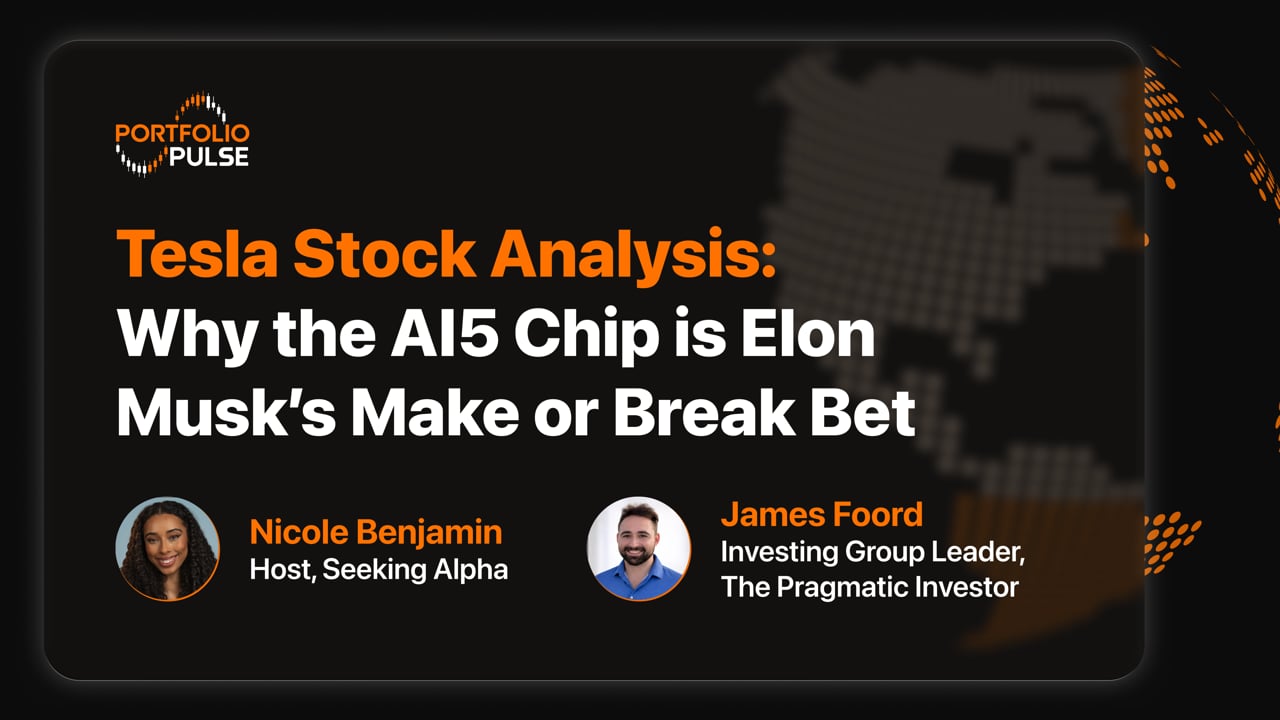
Nicole Benjamin: Hey, everybody. It’s Nicole Benjamin, your host here at Seeking Alpha to bring to you another episode of our new series Portfolio Pulse, where, as the name suggests, we’re going to be keeping close to all the big financial moves happening in the market. Now, for today’s episode, we’re joined by none other than James Foord, and he’s going to be talking with us about all things Tesla. So, without further ado, thank you so much, James, for joining us today.
James Foord: Yeah. Thank you so much for having me, Nicole.
NB: Yes. Absolutely. So, James, I see you’ve been on Seeking Alpha since about 2020. So, tell us a little bit about how you joined Seeking Alpha, what your investment philosophy is, and just how you got started?
JF: Yeah. Absolutely. Like you said, been writing on Seeking Alpha for a little over five years now. And something that just really spoke to me, melded my two passions, which were economics and writing. I studied economics in university and that’s when I started falling in love with macroeconomics and investing. And I was also a pretty prolific writer back there, wrote for my university newspaper. Back then, a bit more focused on social issues and politics. That was my idealist side. Now, I bring out the pragmatic side when it comes to investing, so always trying to keep emotions out of it, which of course, is very important when it comes to investing.
NB: Love that. Well, I want to jump right in. You wrote an article, the Only One Thing Saves Tesla (But It’s Expensive). Now, in your article, you wrote about how there’s been a shift for you personally as an investor. You were originally a bull, but now you’ve shifted to a bear for Tesla. So, was there a specific trend that’s happened in their Q4 results that convinced you that the fundamentals are finally breaking?
JF: Yeah. Like you said, I’ve been a long-term bull. Tesla, obviously, we all see the cars. Great company. They make great cars. But a great company doesn’t necessarily mean it’s a great business to invest in, right? And something that we’ve seen not just over the last quarter, but maybe over the last year almost is a bit of a loss in the appeal that the Teslas used to have, right? And that’s reflected in the numbers. So, the revenues, which is the money that the company is taking in has actually declined for the first time last year.
We’re seeing the margins becoming a bit compressed. We’ve seen Tesla try and put out cheaper models or trying to lower prices, but it’s not sticking and we can see that Tesla’s starting to lose market share both in the U.S., Europe, China especially. It’s struggling a lot over there. This is all powered up and together with what I talk about in the article, which is these very bold initiatives that Tesla has right now, I just feel like the company’s trying to do too much and it’s just not going to be able to do everything it wants to do, unfortunately.
NB: Now, I see here that you talked about how Elon Musk has called the AI5 chip the most critical project at Tesla. Now, why is that so vital for them to bring this chip’s manufacturing in-house now rather than just continuing to rely on the strategic partners like NVIDIA or Samsung?
JF: Right. Of course, this is something that Tesla is doing, arguably a very smart move. Obviously, in the world of AI now, basically, what’s becoming a real bottleneck now for a lot of these companies is compute, right? So, what you really need are those chips and we’re seeing it. Obviously, we saw it with NVIDIA when their stock price went up and everyone was looking at their chips. We’ve seen other bottlenecks now appear.
And Musk, obviously, as he’s trying to rebrand Tesla into this more AI company focused on autonomy, they’re going to need a lot of these chips, right? So, he’s trying to secure this by obviously getting the AI5, which would be like their in-house chip, right? Kind of akin in a way to Google’s TPUs, which obviously gained quite a lot of traction last year. So, to that extent, like I said, because Tesla’s undergoing this AI transformation, being able to have their own chip is really important to this transformation, which is why I think Musk is right in saying that this is probably the most important thing they’re doing right now.
NB: Now, you also mentioned that the risk of Tesla being spread too thin. There’s plan of building a Terafab, which for anybody listening in, a massive chip plant. What makes that the necessary move for their long-term growth? Is it a money pit, or I don’t know, do you think this is going to be distracting from their core EV business model?
JF: Right. Again, it’s hard to say. When it comes to Tesla and Musk, they often has all these big plans, and then it’s hard to pinpoint exactly what he means with some of these things. But basically, the idea is, yeah, to create this Terafab, this big factory for these chips. Obviously, I think that basically starting from now, I mean, that’s going to obviously be a bit of a money pit really because this is something very capital intensive, right?
It requires a lot of upfront investment. And even if it did have some ability to generate cash, it wouldn’t be until much, much later, right? And like we said, I think Tesla already is at a moment where it’s struggling with its margins. Obviously they’re having to lower prices. They’re struggling with their growth. Again, it’s going to be difficult to bring out this project.
NB: Tesla is aiming to spend about $20 billion in CapEx for 2026. And in comparison to 2025’s free cash flow that just over $6 billion, how does the company’s fund in massive spending – just that gap? How is it hurting the stock price potentially?
JF: Right. Again, that’s a pivotal issue, right? I think, Tesla’s shifted down to a company that’s obviously isn’t growing, and it also has these big plans who spend all this money. So, where’s this money going to come from? Well, obviously there are a few avenues now. I believe the company does have about $44 billion in cash in their balance sheet, so they do have some runway to spend money, but of course, you can’t just spend all your money while you’re not bringing it in. So, the real problem is that big difference, right? The $6 billion in free cash flow versus all that spending.
So, generally there’s a few ways you can fund this. You can either take more debt, you could issue equity, or again, you can draw down on your cash reserves. Usually this isn’t something that investors take well, right? Taking more debt means having more interest expense, so that’s an issue in the future. Issuing equity means you release more shares, so the shares that are already in circulation are worth less. So, to that extent, that puts the company and the stock in a position of vulnerability.
NB: Currently, Tesla is trading at a Forward P/E ratio of 200. Given the downward revisions from Wall Street and just its current valuations, is it sustainable for the company’s margins if it continues to face such pressure from this AI investment cycle?
JF: Right. That’s the question, and that’s probably one of the hardest things to answer. I mean, already, starting from the basics, people would look at a Forward – at an earnings P/E of 200 and think, well, that’s outrageous, right? How can that be sustainable? But it has been valued that way. That’s a little bit where my pragmatism comes in here because we’ve got to look at Tesla obviously through a different lens than maybe a regular EV company.
So, to that extent, yes, Tesla obviously does deserve somewhat of a premium valuation, but in my view, at this point in time, I think that’s going to have to compress, right? A few years ago, Tesla was worth this premium because it was growing fast. There was a lot of expectations around EV. Now, maybe you could justify it, especially in the last year. You could talk about the autonomy and how, maybe there’s some room there for Tesla to rebrand as an AI company.
NB: Now, between the AI5 chip, the Optimus robot, and I also see here the Robotaxi, Tesla is launching several new verticals all simultaneously. That sounds like a lot. So, what do you think is the most important milestone as an investor’s looking at Tesla for their portfolio? Like, what should they be looking at in 2026 to prove that this AI pivot is really worth it?
JF: Right. That’s what it is, right? So, is this all going to pay off one day? So, here we have a few things going on. Now, the AI5, like we’ve mentioned before, is the chip that Tesla’s tried to build in-house. Now, the future of the AI5 really, the way I see it is not so much maybe about actually selling it, it’s more about it will underpin all these other initiatives. So, to that extent, we could say that the AI5 is the most important thing going forward because it’s going to underpin all of these developments in Tesla.
However, in terms of actual, we could say maybe consumer facing, what are investors looking at and what’s going to make Tesla successful at this point, it’s going to be, in my opinion, winning what you might call the autonomy race.
NB: Now, I have one more question for you. Just something to just throw out there. As you look at Tesla for 2026 and the future ahead, every stock holds some risk. So, in this regard, what under the most ideal circumstances would you like to see Tesla do just so, you would be considering them for the long haul?
JF: Right. Well, we’d need to see a couple of things, I think. Basically, we could break it down in terms of the fundamental business and maybe their future prospects. So, in terms of the fundamental business, I would like to see a bit of an improvement in what we’ve seen in the last year basically. Maybe hopefully an improvement, a return to growth, of course, in revenues and potentially a slight increase in the margins because we’ve seen those getting squeezed and that’s a bit of an issue.
Hold Tesla accountable. It keeps putting out milestones and it’s about hitting those milestones and hopefully, eventually seeing some real revenues come in with all these AI initiatives, not just spending. So, that’s what I think we would really need to start to see to actually – for me to consider Tesla a good investment again.
NB: All right. Well, let’s wrap things up there for today. Thank you, James so much, for joining us. It has been a pleasure. And for everybody that’s listening in, go ahead, take a look at The Pragmatic Investor, see if that’s the right investing group for you and check out Tesla. See if that’s going to be right for your portfolio. And we’ll see you again here on Portfolio Pulse.
Read James Foord article on Seeking Alpha!
Follow James Foord on Seeking Alpha!
Join The Pragmatic Investor Today!