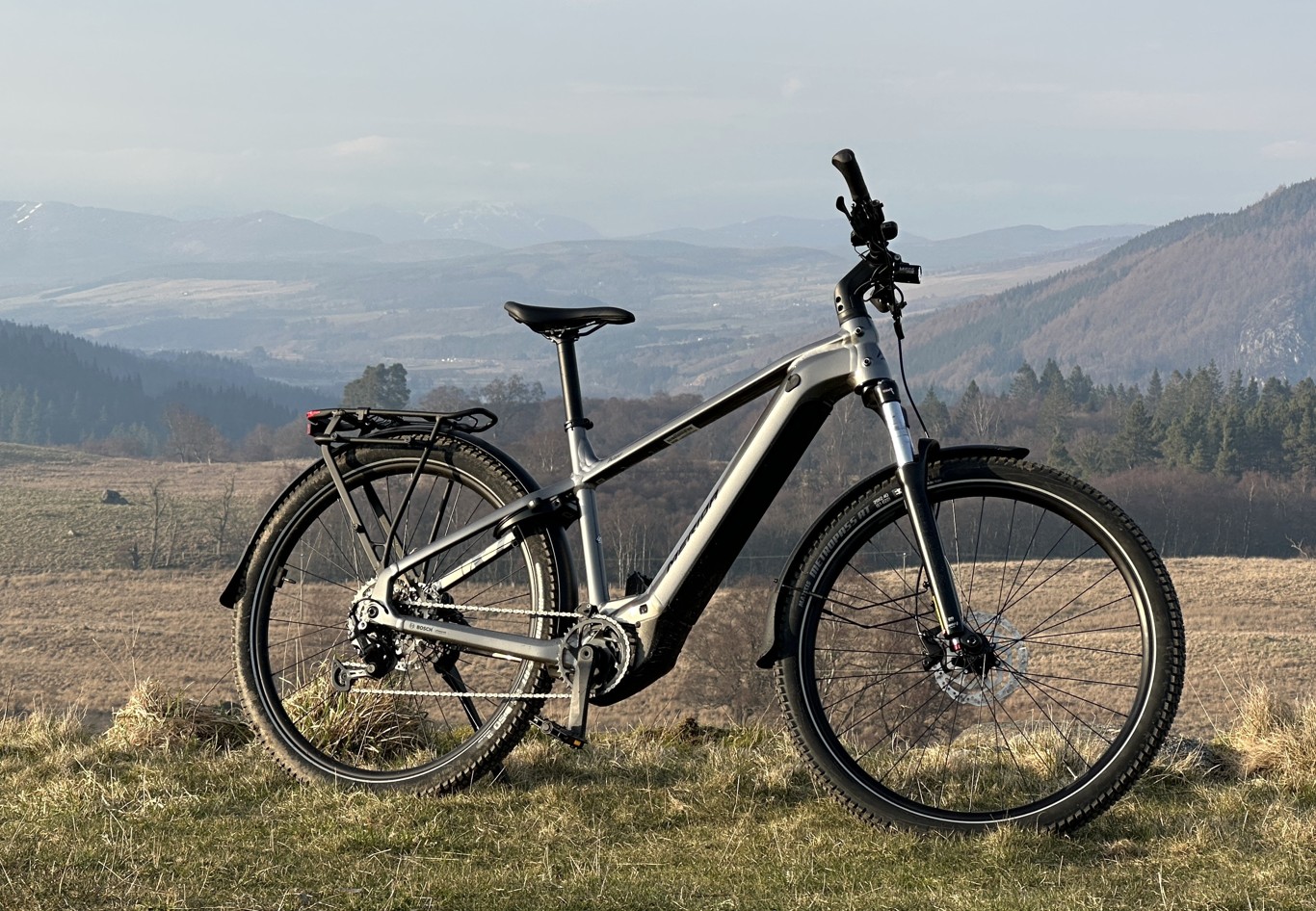
The snappily-named Merida eFloat CC 400 EQ is a Bosch CX-powered mid-drive hardtail that comes with pretty much every accessory you could want for urban or countryside adventuring and, in this review, it gets high praise for going the distance and having enough hill-climbing grunt for the Scottish Highlands.
With oodles of torque and power on tap delivered through a bulletproof e-bike-ready Shimano CUES drivetrain, the eFloat CC 400 EQ is a far more capable bike than most people will need off-road – it will gobble up bridleways, canal paths and forest roads with ease.
The full accessory pack of built-in lights, mudguards, wheel lock and rack means most people will be able to hop on and get on with whatever they need to do. If you can only have one bike and want to get around town as well as explore the countryside, the Merida eFloat CC 400 EQ ticks pretty much every box going. If you need a step-through frame for ease of access, Merida has closely specified bikes with that option too.
As befitting one of the world’s largest manufacturers, quality and finish is excellent – this is a premium bike. There are only two misses that I’d expect to see at this price point – a chainguard, and some sort of suspension or dropper post to make getting on/off easier and to improve comfort. That said, it’s a cracking bike as-is, and I really enjoyed taking the bike on adventurous as well as local rides.
Before you read our Merida eFloat cc 400 EQ review, Cycling Electric has already spent a large part of 2026 compiling electric mountain bike reviews and updating our guides to both the best hardtail electric mountain bikes and the similar, but more practical, best SUV-style electric bike guides. If you’d like to compare and contrast, reading these guides is a must, and if you’d like to try e-bikes like these for yourself, why not attend our in-person Demo Day test events around the country?
£3,250 | VIEW OFFER
Pros
Hugely powerful motor
Very low gearing for climbing steep hills
Full suite of integrated accessories including a strong lock
Very capable off-road
Cons
No dropper or suspension post
No chainguard
Features
Powerful 100Nm-capable Bosch CX motor and 600Whr removable battery
Shimano CUES 4000 wide-range gears
Fat, grippy 2.4” tyres
Integrated lights and lock
Full mudguards and kickstand
Specifications
Frame: eFLOAT CC LITE II
Frame sizes: S, M, L, XL
Fork: SR Suntour XCM34-Boost
Motor: Bosch Performance Line CX
Battery: Bosch PowerTube 600
Charger: Bosch 2A Charger (220-240V)
Display: Bosch Purion 200
Speed sensor: Bosch Rim Magnet, EB11.200.015 + EB11.200.02S
Rims: MERIDA COMP TR II
Hubs Shimano TC500
Tyres: Maxxis Metropass AT
Hubs: MERIDA EXPERT TR
Chainwheel: FSA Direct Mount Steel Chainring
Crank: FSA CK-220 wide E-Bike Forged Crankset
Cassette: Shimano LG400-9
Chain: Shimano LG500
Shifters: Shimano Cues U4000-9
Rear derailleur: Shimano Cues U4000
Brakes: Shimano MT-200
Brake rotors: Shimano RT10
Headset Acros ICR MERIDA INTEGRATED neck w/ Blocklock
Stem MERIDA EXPERT TK III
Stem: S/M/W-S/W-M :70mm, L/XL/W-L/W-XL :90mm
Handlebar MERIDA EXPERT CC
Grips: MERIDA COMP TK
Seatpost: MERIDA EXPERT CC
Saddle: MERIDA EXPERT TK II
Seat clamp MERIDA EXPERT
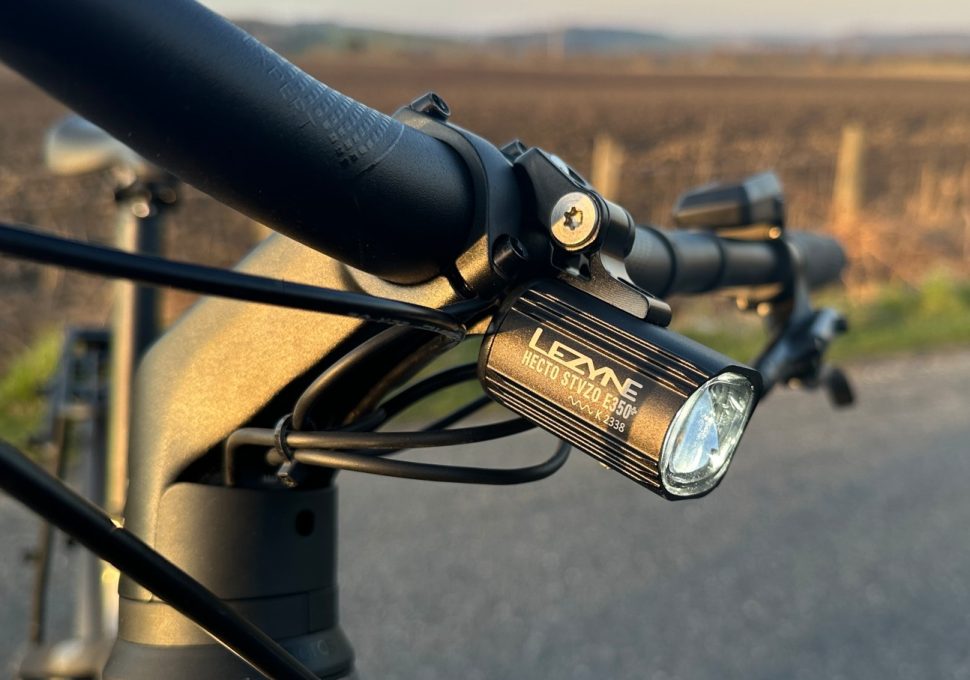
Lights: Lezyne Hekto StVZO E350+ Reverse / Spanninga Commuter Glow XE integrated in MERIDA MIK HD carrier
Carrier: Merida MIK HD Carrier with Spring clip & Spanninga rear light
Mudguards: Sunnywheel SW-FA311-70A/ SW-FA311-70E1
Kickstand: Atranvelo ED-100-PC
Frame lock: Abus 4650 XL
Pedal: VP VPE-891
The Merida eFloat CC 40 EQ was tested for ride quality, experience and endurance, for multi-hour rides across varied terrain. The bike was ridden through the Scottish Highlands, up and down significant climbs and along different forest tracks and muddier MTB trails.
Our tester, Michael Vincent, is a long-time road, gravel and MTB rider, with decades of experience running cycle clubs and events, reviewing and repairing bikes. He’s a Bosch, Shimano and Fazua-certified engineer with his own cycle service business.
Merida eFloat cc 400 EQ review: The build
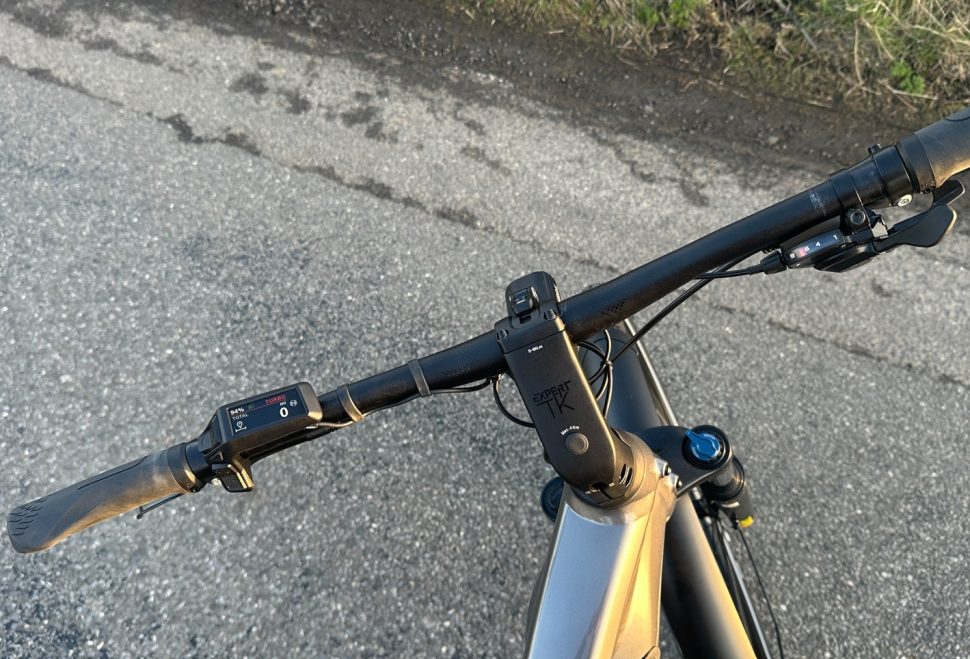
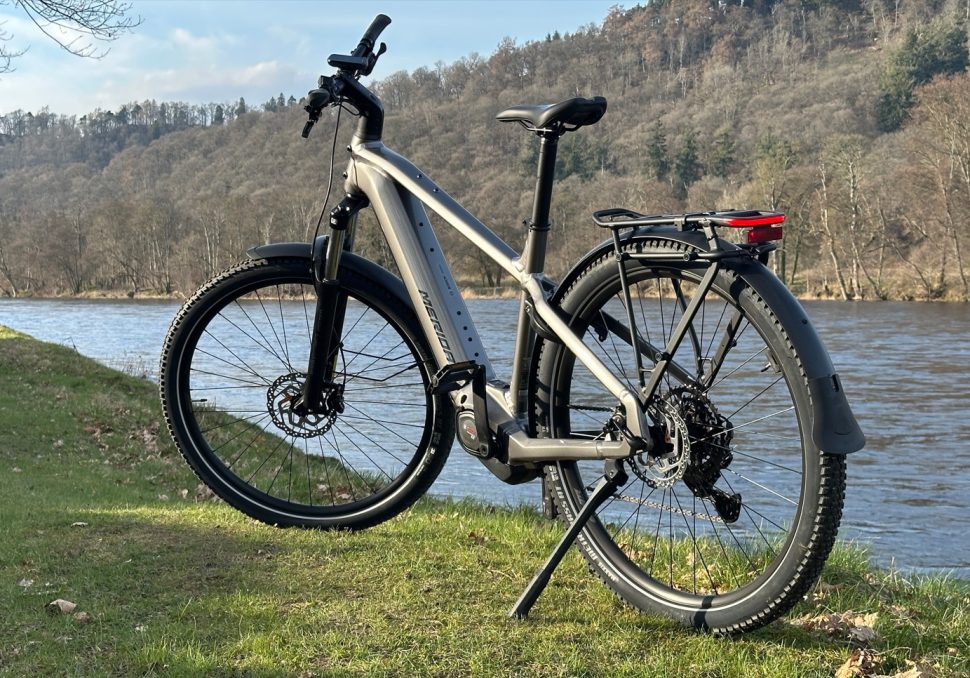
The alloy frame is well finished as befits Merida’s reputation, the low-sloping top tube giving plenty of standover height. The geometry lends itself to playful riding, and with the power on offer I had a blast on twisty singletracks – but the bike is also predictable on the flat and doesn’t feel skitterish at all. The riding position is relatively upright, the non-adjustable stem bringing the bars up. The handlebars are 770mm wide on the size Large model, highlighting the off-road-ability of the design.
If you’re only going to use the bike for urban rides, you may want to consider cutting them narrower for a more upright riding position and ease of riding around cars or navigating the bike in and out of buildings or sheds. You get three (count ‘em) waterbottle mount locations, including on the top tube where you can mount a wee bag if needed.
The 29” rims are shod with quality 2.4” Maxxis tyres, and are tubeless-ready if you want more puncture protection for off-road riding – but you’ll need to add your own tape and tubeless valves. Personally, I’d just go for Slime-filled inner tubes. Noting the tyres are not tubeless ready, so don’t set them up as such. A 29” wheel with a 2.4” tyre is a lot of air underneath you – so you can run low pressure to optimise both comfort and grip. I ran about 25PSI in each and the ride was excellent.
The 120mm SR Suntour XCM fork is a coil spring with a lockout function. Don’t expect amazing plushness, but it does take the edge off larger hits whilst being quiet in operation. Brakes are two-piston Shimano, perfectly good – especially here paired with 180mm rotors for extra stopping power. Riders with smaller or weaker hands will be able to stop with confidence.
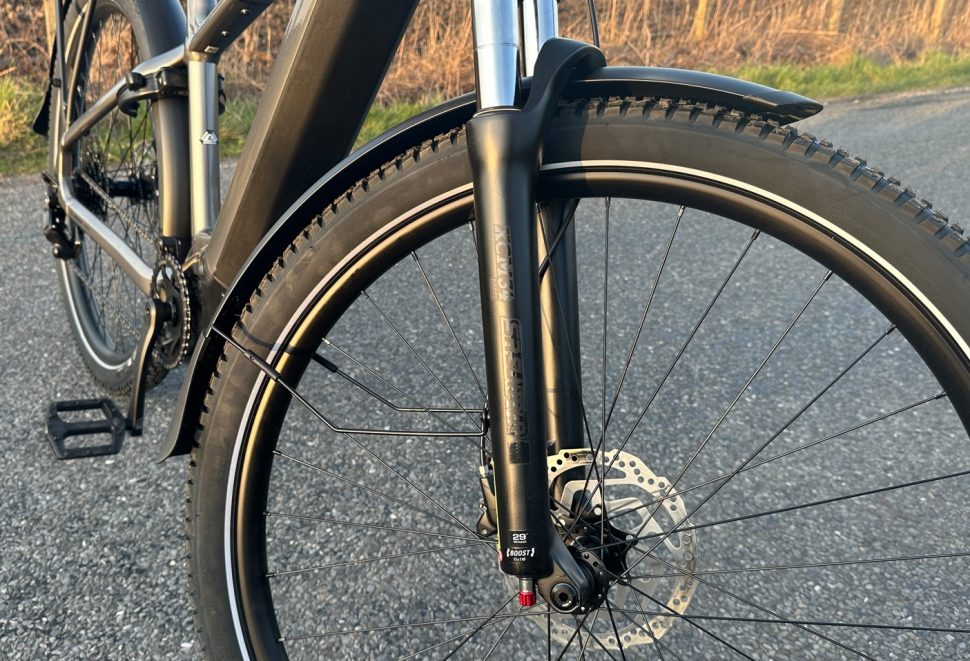
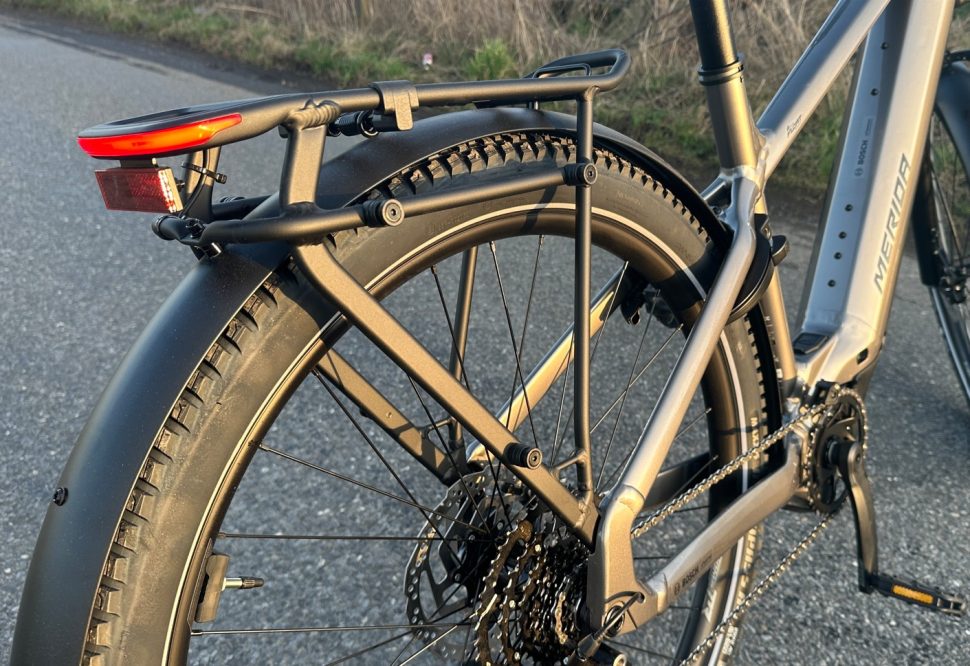
The ‘EQ’ in the name refers to this bike coming with a full accessory pack, including mudguards, a high-quality Lezyne front light built to the German StVZO standard so as not to dazzle oncoming traffic, a 25kg-ready rear rack with a built-in light, plus a kickstand and integrated wheel lock. In other words, pretty much everything that turns the bike into a practical tool for getting about town or country.
Some may not see the bike as a ‘real’ mountain bike due to being loaded with these features, and for sure, they add weight. They also add practicality even when used off-road – not getting plastered in muck, and not having to lay the bike down or find a convenient tree to lean it up against, for example.
Emerging from the woods to park at a cafe, the integrated lock with the option to add a £30-ish plug-in chain to loop around a rack or another bike makes stopping for food or drink easy. The lock key is the same as for removing the battery – handy. Never having to charge lights or remove them for fear of theft, is a huge win in the pre- or post-ride faff department. For me, these features greatly broaden the appeal of the bike to a much wider audience.
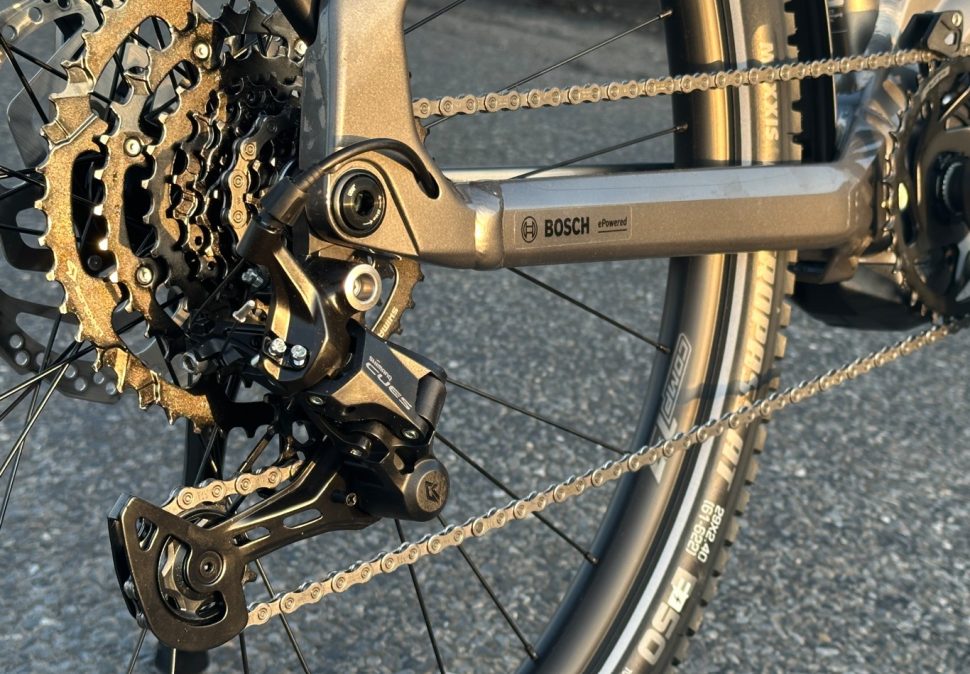
The other major feature of the Merida eFloat CC 400 EQ is the Shimano CUES 4000 drivetrain, with a very low gearing of a 38T chainring paired with a 46T largest sprocket on the back. This gearing, paired with the 100Nm motor, will winch any rider up the steepest incline with ease, even on a fully-loaded bike. The CUES components are designed to handle the extra power of an e-bike, and are also very low-cost to replace once worn out or if damaged. This specification is in no way a compromise – rather a very significant feature. Had the bike come with a higher-end non-CUES drivetrain, my recommendation would be to strip it off and flog it, replacing with CUES 4000 – Merida has saved you the hassle.
Merida eFloat review: How does it ride?
The Bosch Performance Line CX motor is arguably the most highly-regarded in the cycling world at the moment. It has the largest market share in Europe, and I have witnessed customer bikes with many tens of thousands of miles on the clock. The new Smart System models, as fitted here, can be quickly and easily upgraded through Bosch’s Flow mobile app from the stock 85 Nm torque and 600 Watts peak power to an eye-watering 100Nm and 750 Watts. This increase is immediately noticeable and should be the first thing any owner does to their new bike, in my opinion.
I took the eFloat over some pretty challenging terrain, including rocky, rooty and steep singletrack paths, which occasionally defeat me on a full-suspension bike costing twice as much. Suffice to say it’s the rider, not the bike, that will hold you back from exploring with the eFloat. After a 30km off-road ride with 500m of climbing, I was left with just under a third of the 600Wh battery remaining – and this was riding at full power the whole time. Dial things back a bit in terms of either terrain or power and you’d go much further.
The CUES drivetrain performed flawlessly, as I knew it would – I ride CUES on my personal bikes and in three years I’ve never had an issue.
Practical performance vs price
The eFloat CC 400 EQ sits very squarely in the ‘SUV’ category of ebike – characterised by fat tyres, loads of torque / power, an upright riding position and many accessories built in. These all add up to a bike capable of tackling pretty much any job out of the box with ease, not really compromising on any aspect of utility or performance. A key factor is that these performance gains translate into usability for riders living with conditions that might otherwise preclude them – for example, powerful brakes for weaker hands, a powerful motor for those lacking aerobic capacity or muscular strength, etc.
Comparable bikes at this price range include the Cannondale Tesoro Neo X 2 – slightly more expensive, but comes with a semi-enclosed chainguard and a larger 625Whr battery. The 10 speeds instead of 9 may seem like an upgrade – but the Deore line is not CUES ebike-optimised, so that’s actually a backward step. Also the stock tyres are a bit narrower at 2.2”.
The Haibike Trekking 7 uses the same Bosch motor and battery, but for the extra £650 you get the much larger Kiox 500 display in the centre of your bars that can show turn-by-turn navigation on a map, when linked to your phone. Some users will find this a great help, particularly if you ride around cities a lot and don’t want your expensive phone sat on the bars in reach of opportunist thieves. You also get an 11-speed CUES 6000 drivetrain, with a massive 50T low gear at the back. Critically from a usability perspective, the Trekking 7 gives you a dropper post. These three features definitely justify consideration over the Merida offering, if you can afford the extra.
The Cube Kathmandu Hybrid One 800 is cheaper at £2,999 – for that you get the same CX motor, a larger 800Whr battery, and CUES 10-speed gears but the same lowest ratio as the Merida. The seatpost isn’t a dropper but is a suspension model for added comfort. The display is the same wee Purion 200, but is perfectly capable of showing you what you need to know. The 2.2-inch tyres are a bit narrower, but not by much. Given you’re getting a third more battery than the Merida gives you, plus a suspension seatpost for £250 less, that’s a compelling argument to consider the Cube offering.
Conclusions
Overall the Merida eFloat CC 400 EQ is a very well-equipped bike capable of taking on urban tasks or country exploring with ease. There’s tons of power on tap, delivered quietly through an easily-managed motor system. The CUES drivetrain is likely to last for ages and cost buttons to repair when worn out. All of the key accessories you’d want are built in and are of high quality. Befitting a company with Merida’s market power the overall package is well-priced, with component choice not showing any skimping on quality. The Cube alternative gives them a run for their money, but a Merida purchaser will be very happy with their choice.
I’d like to see a dropper post, ideally with suspension, but if this is a deal breaker it can be easily added aftermarket. Similarly a chainguard costs next to nothing. Both would make a great bike even better.
How about the competition?
Read our Merida eFloat CC 400 EQ review and have the appetite for some suggestions to compare? Here’s three similar electric bikes that we have tried, tested and loved.
Giant Explore E+ 0 – £4,999 (Range begins £2,499)
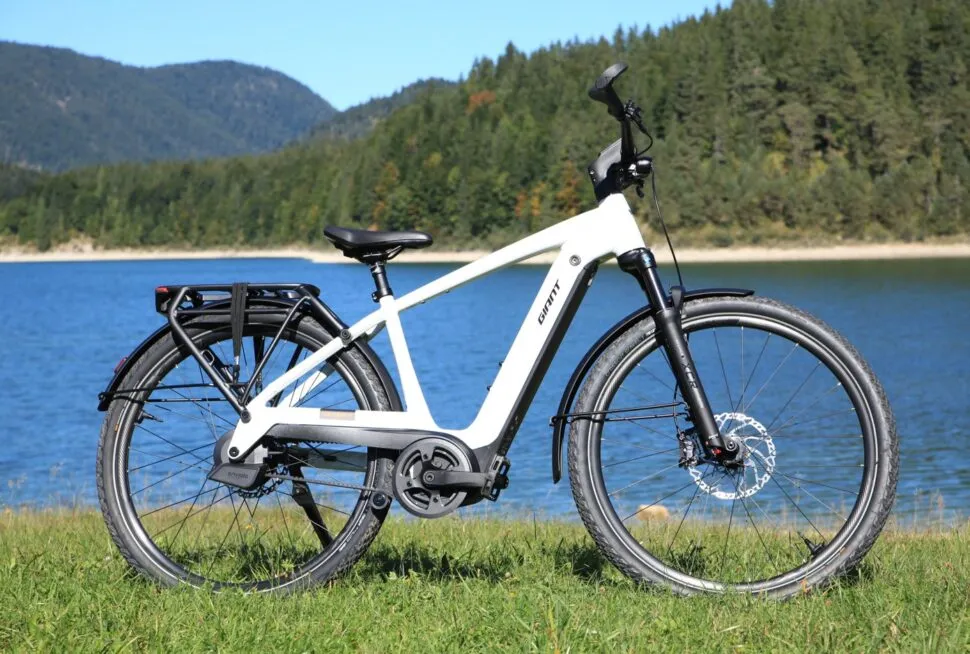
The Giant Explore E range has been incredibly consistent over the years, with each successive model year that we have tried impressing, but none quite like the tech-savvy 2026 model year. This year, there are incredible innovations on the higher-spec models, as with the Explore E+ 0, such as digital tyre pressure readings on the display, as well as a rear radar system that also alerts you to passing traffic throuhg the same screen.
If you’d like to know more, you can read our Giant Explore E+ 0 review.
Riese & Müller Charger 5 Mixte Vario – £5,839
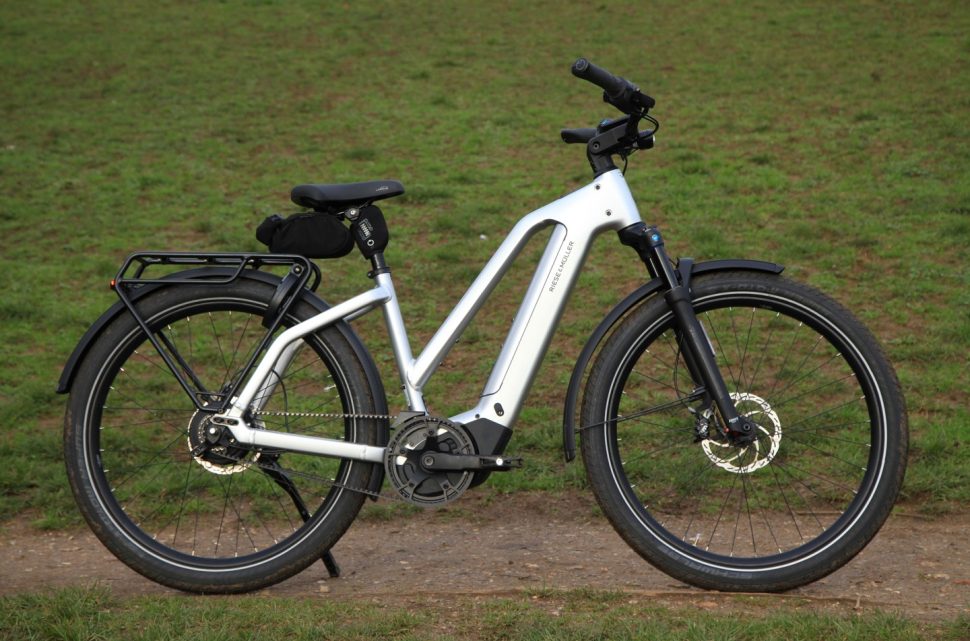
Ever-present at the premium end of the market, Riese & Müller are another consistently impressive premium e-bike manufacturer that build products known for their longevity, equipment quality and even sustainability in manufacturing. The Charger 5 is one of those do-it-all e-bikes that has a variety of build kits to satisfy all budgets, maintenance schedules and adventure styles. We recently took a Bosch motor-driven spec with a belt drive and found it to be incredibly easy to get on with on long countryside rides, with the practical touches to make it a functional bike about town too.
Read our full Riese and Müller Charger 5 Mixte review.
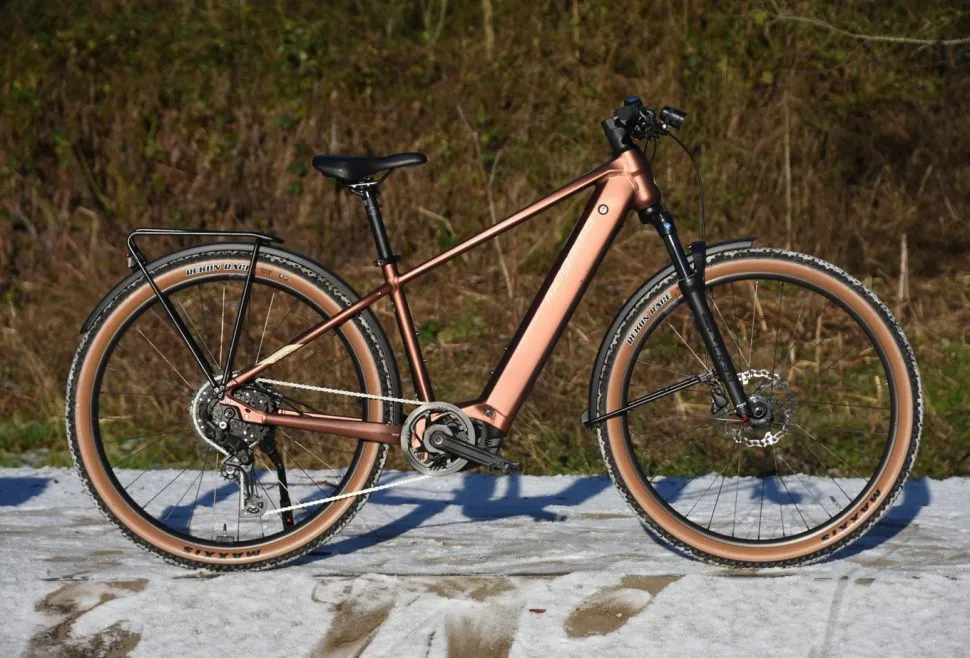
Megamo Reach HT 10 – £3,999
 Richard Peace
In a bit more comparable a price range to the Merida, the Megamo Reach HT 10 is another fully equipped, multi-terrain vehicle that again deploys the up to 100Nm torque of the Bosch Performance Line CX. As you can see above, we headed out into the countryside, in the snow and had a blast, which is all the more achievable thanks to the 100mm travel SR Suntour suspension fork and grippy Maxxis Rekon race tyres.
Read our Megamo Reach HT 10 review.
Merida eFloat review: FAQs
Can I manage the bike using my phone?
Yes, the Bosch Smart System supports full software management through the Flow app, for bike diagnostics, tuning of the ride support, updates, and many other features
Can I carry heavy loads on the rack?
Yes, the rack supports up to 25Kg, so a child seat or heavy panniers are no problem
Can I remove the battery for charging, storage or transport?
Yes, that battery is removable, with the battery cover then covering over the gap to protect from the weather when transporting on a car.