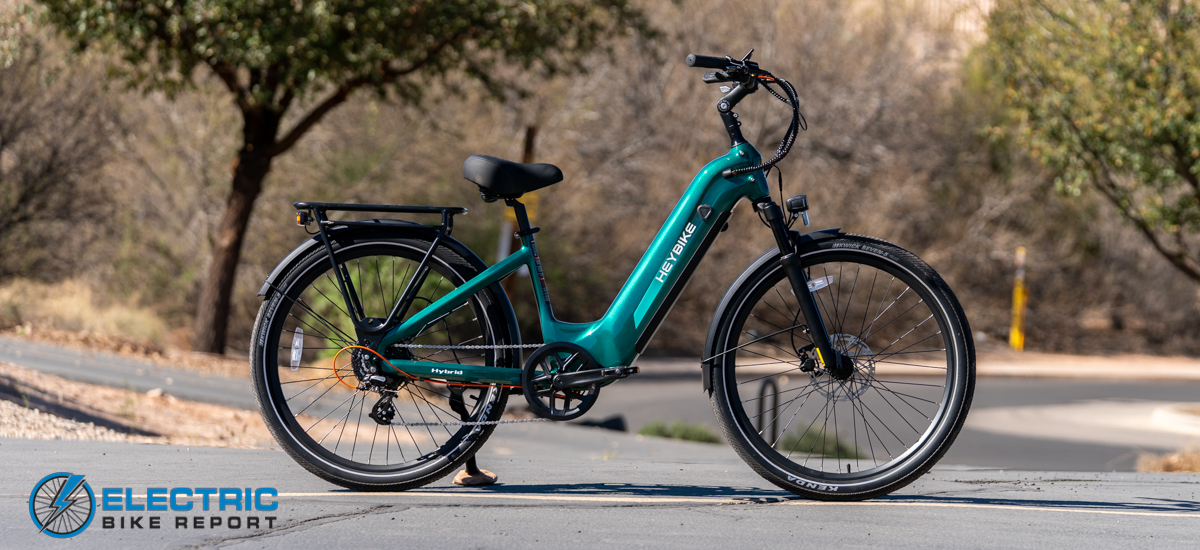
The Hybrid felt solid in terms of its overall ride quality, with a clear focus on comfort, customization, and functionality. It does, however, have some room for improvement, with a few areas of critique that stood out.
First, in terms of sizing, the bike should be generally accommodating for most riders. Heybike offers the Hybrid in a single size advertised to fit those from 5’3” to 6’3”. As a 5’11” rider that is well within this recommended range, I found the bike comfortable, and I believe its pedal assist system is responsive enough that pedaling should still be comfortable for those above 6’3”.
Riders on the shorter end of the spectrum may be somewhat limited, however, since the bike’s saddle can only drop so far. An extra frame size would likely help to accommodate shorter riders, but in the meantime, those who are “vertically challenged” may need to consider the Heybike Venus as an alternative due to its lower recommended height range.
One feature that I greatly appreciated was the Hybrid’s adjustable stem, which allowed me to raise the handlebars and bring them a bit closer to me. This changed the riding position from a sporty, forward-leaning position to one that was more relaxed and upright—embracing the bike’s cruiser influence.
I found the Hybrid’s ride generally smooth and comfortable, thanks to the softness of its wide, cruiser-style spring saddle and 100mm suspension fork. Those who enjoy relaxed pedaling or who often rely on the throttle will likely enjoy the bike’s feel, but its saddle could impede more active pedaling to some degree. I’d personally be likely to swap to something narrower, but other riders may be fine with the stock saddle.
In terms of handling, the Hybrid felt planted and stable. It had a slightly more nimble feel than I expected for its weight, which I attribute to the bike’s curved Dutch-style handlebars. Steering felt predictable and crisp.
The Omega Series Hybrid is the first e-bike from Heybike that we’ve tested with the ability to switch between torque and cadence-sensing modes. The former offers an engaging feel with power that responds to the rider’s effort level. The latter mode’s steady power output makes it better for climbing hills or moving a heavy load of cargo. In both cases, I found the motor engagement to be quick and strong without feeling punchy or overpowered.
I felt the bike was well-equipped for daily use. It comes outfitted with commuter-friendly essentials, such as integrated lights (including brake lights and turn signals), fenders, a cargo rack with a 66lb capacity, an electronic horn, and a throttle. Riders can also choose to add an optional suspension seatpost for even more comfort.
I’d say that the Hybrid’s cockpit felt a bit busy with its relatively large control modules, but after some tweaking, I was able to get everything within easy reach of the supportive rubber grips. The user interface had a small learning curve, but overall, the bike’s operation was intuitive and relatively straightforward.
The Heybike app is worth diving into in more detail. In addition to changing Classes, riding modes, and the speeds of individual assist levels, the app also offers ride tracking features, access to a social-media-like platform shared with other Heybike riders, and navigation in concert with either Apple or Google maps. As e-bike apps go, it’s one of the more robust that we’ve tested, offering a range of useful customization options and ride tools.
Ultimately, the Hybrid checked the boxes we look for in ride quality. The bike felt comfortable, sturdy, and well-put together. It’s flexible and customizable for riders of different styles, it’s thoughtfully equipped with practical features, and it generally offers solid value for its price.