
Listen to the article
0 min
This audio is auto-generated. Please let us know if you have feedback.
Dive Brief:
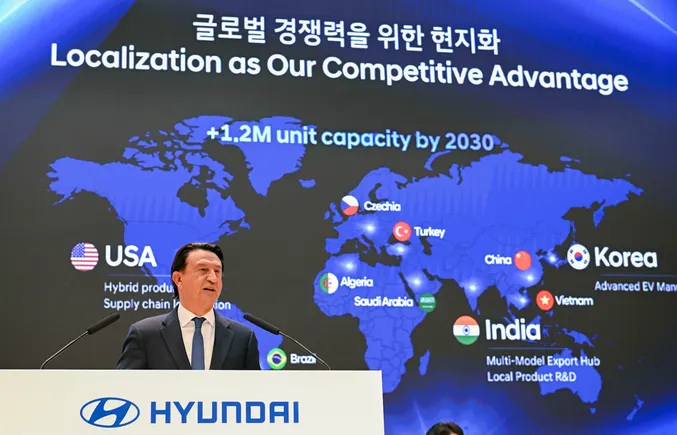
Hyundai Motor Co. plans to launch 36 “new or enhanced models” in the North America market between 2026 and 2030, CEO and president José Muñoz announced at the company’s annual general shareholder meeting in Korea, according to a press release.
The new models will be a mix of ICE, hybrids, electric vehicles and extended‑range electric powertrains to meet what Hyundai said was “evolving customer demands across the region.”
“By expanding our product portfolio and offering a wider range of powertrains in North America, we’re giving customers more choice while continuing to strengthen our long‑term investment in U.S. manufacturing, jobs, and the broader automotive ecosystem,” Muñoz said in a statement.
Dive Insight:
The aggressive vehicle launch plans are part of Hyundai’s $26 billion investment commitment in the U.S. from 2025 to 2028 announced last August, which was $5 billion more than its previous investment of $21 billion announced earlier last year. The investment is expected to create 25,000 direct job opportunities.
The automaker said the investments will go towards boosting vehicle production capacity, expanding its U.S. supply chain, funding construction of a steel plant in Louisiana and building a new robotics innovation hub in partnership with Boston Dynamics, a company it owns a 80% controlling stake in.
“Hyundai’s expanded North American product lineup, growing U.S. production footprint, and increased parts localization position the brand for sustained growth, greater flexibility, and stronger alignment with customer priorities across the U.S., Canada, and Mexico,” the company said in the release.
The 36 new or enhanced models for North America include a mix of passenger cars, SUVs, trucks, and commercial vehicles, per the release. Other core models will get expanded trim options that include Hyundai’s “XRT” off-road models and “N” high-performance models, the automaker said.
The U.S. market is one of Hyundai’s largest globally, and the company aims to gain a competitive advantage through localization in key global regions. The automaker achieved its best-ever retail sales in the U.S. for the fifth consecutive year in 2025, reaching 901,686 units.
Electrified vehicles accounted for 30% of Hyundai’s U.S. retail sales mix last year, with sales of hybrid models jumping 36% in 2025. Last September, Hyundai announced plans to launch a midsize pickup and double its hybrid vehicle lineup in the U.S. to more than 18 models by 2030, with a goal to increase its electrified vehicle sales to 3.3 million units by then.
Hyundai operates two assembly plants in the U.S., Hyundai Motor Manufacturing Alabama and its Metaplant America EV factory in Georgia. The Alabama factory can produce 400,000 vehicles a year at full capacity, while its Metaplant can produce up to 500,000 vehicles a year once it’s fully operational.
But like other OEMs, the automaker is facing tariff pressures and is looking to expand its U.S. supply chain, which is a key part of its planned $26 billion investment.
In January, Hyundai Motor America reported a $7.1 billion decline (21.7%) in net profit in 2025. The declines were even higher in Q4, with its net profit plunging 52.1% YoY, despite the company achieving its highest-ever quarterly revenue of $32.3 billion. The automaker cited U.S. tariffs as a significant factor for the profit declines.
The steel plant in Louisiana is expected to produce 2.7 million metric tons of steel annually for its U.S. vehicle assembly plants when it begins operations in 2029. It will allow the automaker to avoid tariffs on imported steel, which currently is 50%.
To further mitigate the impact of tariffs on its profitability, the company said around 80% of its new vehicles sold in the U.S. are targeted to be assembled domestically by 2030, with its domestic supply chain content increasing from 60% to roughly 80% by then.
Last week, Hyundai said it was developing a scalable AI-powered autonomous driving architecture and will integrate Nvidia’s Drive Hyperion platform in select Hyundai and Kia vehicles, including robotaxis, through Hyundai’s autonomous driving joint venture Motional.