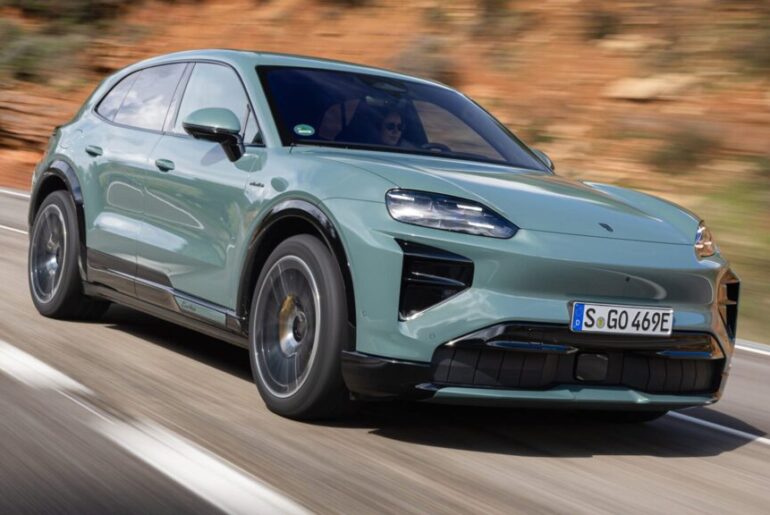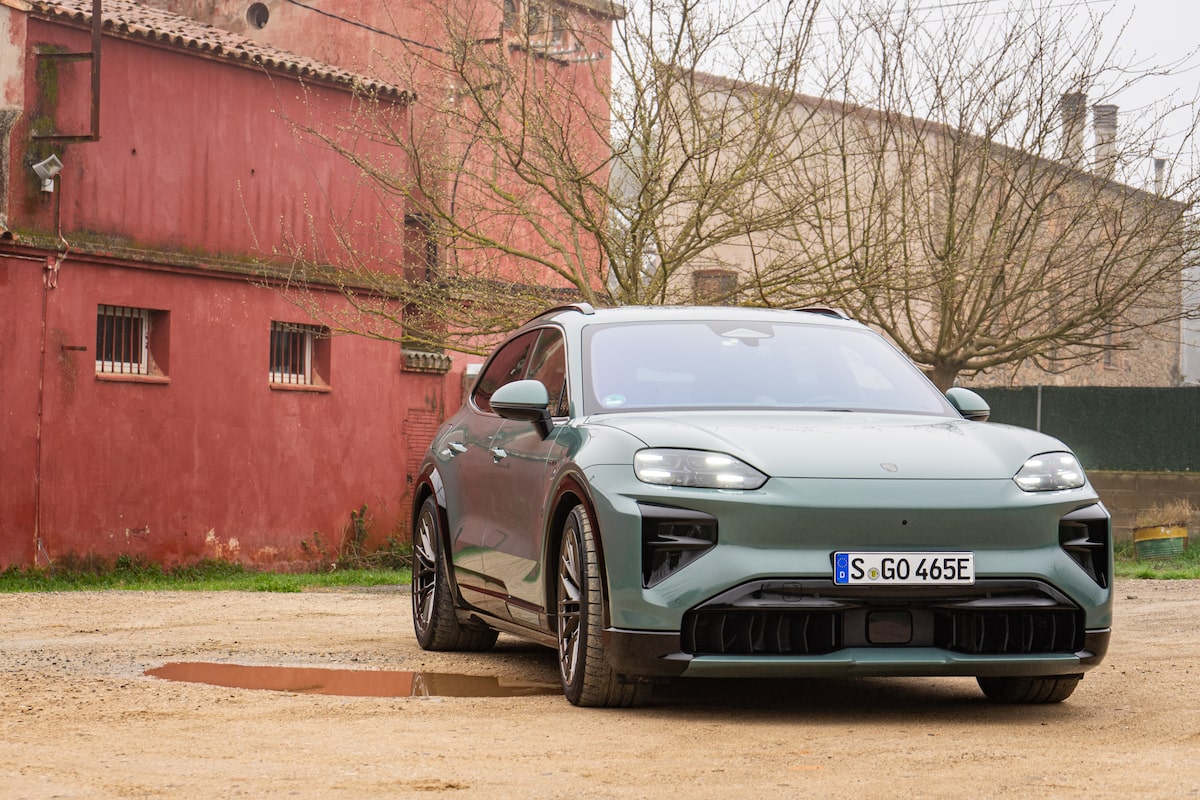
The Cayenne Electric starts at $131,300 for the base model and $178,300 for the Turbo.Kunal D’souza/The Globe and Mail
To avoid financial collapse in the late 1990s, Porsche looked to diversify its portfolio and introduced the Cayenne SUV in 2002.
Purists, who never thought they’d see the maker of the legendary 911 dabble with something as mainstream as an SUV, scoffed at it. Luckily for Porsche, high-profit margins in luxury SUVs reversed its fortunes and drew in customers that would have not considered a Porsche before.
Today, the Cayenne is Porsche’s bestseller and about 60 per cent of the German maker’s sales are SUVs.
But the company faces new challenges. It recently reported sales revenue was down about 10 per cent in 2025 compared to 2024, it delivered about 10-per-cent fewer vehicles and operating revenue was down 92 per cent.
The company said the decline is because of “extraordinary expenses” resulting from tariffs, pressure from the Chinese EV market stifling sales and a realigning of its product strategy to back away from pure battery-electric offerings and switch to a mix of gas-powered and hybrid options.
One increase the maker is seeing is with fully electric vehicles, which nearly doubled their share of sales to 22 per cent.
At the annual press conference this March, newly appointed chief executive officer Michael Leiters said “we will comprehensively reposition Porsche, make the company leaner, faster and the products even more desirable.”
It will do this, he says, by focusing on Porsche’s strengths of offering value over volume and building uncompromisingly good sports cars as well as explore “derivatives both above our current two-door sports cars and above the Cayenne.”
In short, to compete in China and with China-made EVs globally, Porsche plans to move upmarket in terms of luxury, technology and performance. Which brings us to the new Cayenne Electric. Porsche hinted at vehicles above the Cayenne, but even the new Cayenne Electric with neck-snapping power, more technology, finer touches and a starting price of $131,300 for the base model and $178,300 for the Turbo, it is certainly moving upmarket.
The Turbo version has 1,139 horsepower and 1,106 lb-ft of torque when using the launch control function.Kunal D’souza/The Globe and Mail
The massive sunroof on the new Cayenne Electric.Kunal D’souza/The Globe and Mail
It’s a large chunk of change, but the Turbo version which we drove in Barcelona is the most powerful production Porsche ever. Equipped with a new dual-motor electric powertrain, it produces up to 1,139 horsepower and 1,106 lb-ft of torque when using the launch control function. If you’re just plodding along, you get 844 horsepower.
Powering the motors is a new 107.5-kilowatt-hour battery pack, that director of drive systems Marco Schmerbeck says is the most efficient battery design the company has done to date.
“It’s the first time we’ve used cooling channels on the top and bottom of the battery,” he says. “You get better efficiency, more power, better acceleration and higher charging power.”
The Cayenne Electric can recharge at a rate of up to 400 kilowatts or add up to 325 kilometres of range in 10 minutes, but that’s if you find a charger capable of supplying that output (There aren’t any in Canada).
It’s also possible to recover up to 600 kilowatts of energy from braking regeneration, a number Schmerbeck says is equivalent to their Formula-E car, which has had a direct influence on the battery and motor technology used in the Cayenne. The company says 97 per cent of regular braking can be accomplished without ever needing to use the actual brakes.
The rear axle motor in the Turbo is the most powerful Porsche has created yet, using a silicon carbide inverter for maximum efficiency and direct oil cooling, another innovation from Formula E.
“[During development] we always had the same problem, which was heat, which lowers efficiency,” says Denis Rancak powertrain manager for Cayenne.
The rear seats on the new Cayenne Electric have more leg and head room than the gas version. They are also power operated.Kunal D’souza/The Globe and Mail
Rancak explains that in an electric motor most of the heat is generated by the copper windings and conventional cooling efforts involve using an external water jacket that wraps around the motor, making them physically bigger. Porsche’s system eliminates this jacket by pumping oil along channels in between the copper windings, cooling them directly.
The technology was also taken from Formula E, according to Rancak, and is being used for the first time in a production car. The cooling is so effective that the motor has a 98-per-cent efficiency rating, meaning that 98 per cent of the energy from the battery is converted to mechanical power at the wheels, and only 2 per cent gets lost as waste heat.
With these cutting-edge motors and batteries, the Cayenne Turbo Electric can put down astonishing acceleration numbers, launching to 100 kilometres an hour in 2.5 seconds and to 200 km/h in 7.4. Using the launch control function feels like you’ve been shot out of a cannon and the acceleration doesn’t let up even as you pass highway speeds.
Standing on the brake pedal during a panic stop attempt produced even more g-forces than the launch, with super short stopping distances even without specifying the optional carbon ceramic brakes with 10-piston front rotors.
Our test cars were equipped with Active ride, a hydraulic suspension system that enables individual wheel control and effectively eliminates body movement during spirited driving. When driving the wheel can be actively pushed toward the road or pulled up to maintain a perfect contact patch.
It gives the Cayenne unnatural agility and the driver confidence to push harder in the corners than they otherwise might be inclined to do. The steering is quick and provides real feedback and, even with more than 1,000 horsepower, the Turbo never feels unwieldy or scary.
The propulsion sound pumped in through the speakers is actually helpful and not annoying, offering the proper amount of auditory feedback to determine throttle position. The Cayenne is also an extremely competent off-roader able to tackle thick muddy trails and clamber up and down steep rocky embankments without breaking a sweat.
It’s beautifully finished inside too, with perfect stitching, the highest quality leather and excellent seats. An all-new curved centre display flows down the centre console ending at a wrist rest that makes it easier to operate when driving. Our test car also had a passenger screen, which is quite frankly one screen too many. Thankfully there are still physical buttons for the climate control and a volume knob but frustratingly the air vents can only be adjusted through the screen.
There is a lot of storage in the centre and under the screens, but the passenger screen seems to be one too many. There are still physical buttons to control the climate and volumne.Kunal D’souza/The Globe and Mail
Below the screen is a soft spot to rest your wrist.Kunal D’souza/The Globe and Mail
The rear seats are power operated and you get luxurious touches such as acoustic glass and soft close doors as well as more leg and head room than the gas version.
The new Cayenne is exorbitantly expensive but, if judging it based purely on its performance, capability and luxury features, it’s probably the best new SUV in the world. And if Porsche hopes to compete with China, the new juggernaut of the automotive industry, it has to be.
Deliveries for the new Cayenne Electric are expected this summer.
The trunk on the new Cayenne Electric.Kunal D’souza/The Globe and Mail
Tech specs
2026 Porsche Cayenne Turbo Electric
Price: $178,300 (base) plus $2,950 for destination plus fees and taxPowertrain: Dual electric motors / 107.5 kWh battery (usable)Transmission / drive: Single-speed / all-wheel driveHorsepower / torque (lb-ft): 844 up to 1,139 / 1,106 during launch controlRange: 623 kilometres (WLTP)Curb weight: 2,658 kilogramsEnergy consumption: To be announcedAlternatives: BMW iX, Tesla Model X, Rivian R1S, Lucid GravityOpen this photo in gallery:
The frunk has enough space for a small piece of luggage.Kunal D’souza/The Globe and Mail
The writer was a guest of the automaker. Content was not subject to approval.
Shopping for a new car? Check out the new Globe Drive Build and Price Tool to see the latest discounts, rebates and rates on new cars, trucks and SUVs. Click here to get your price.